
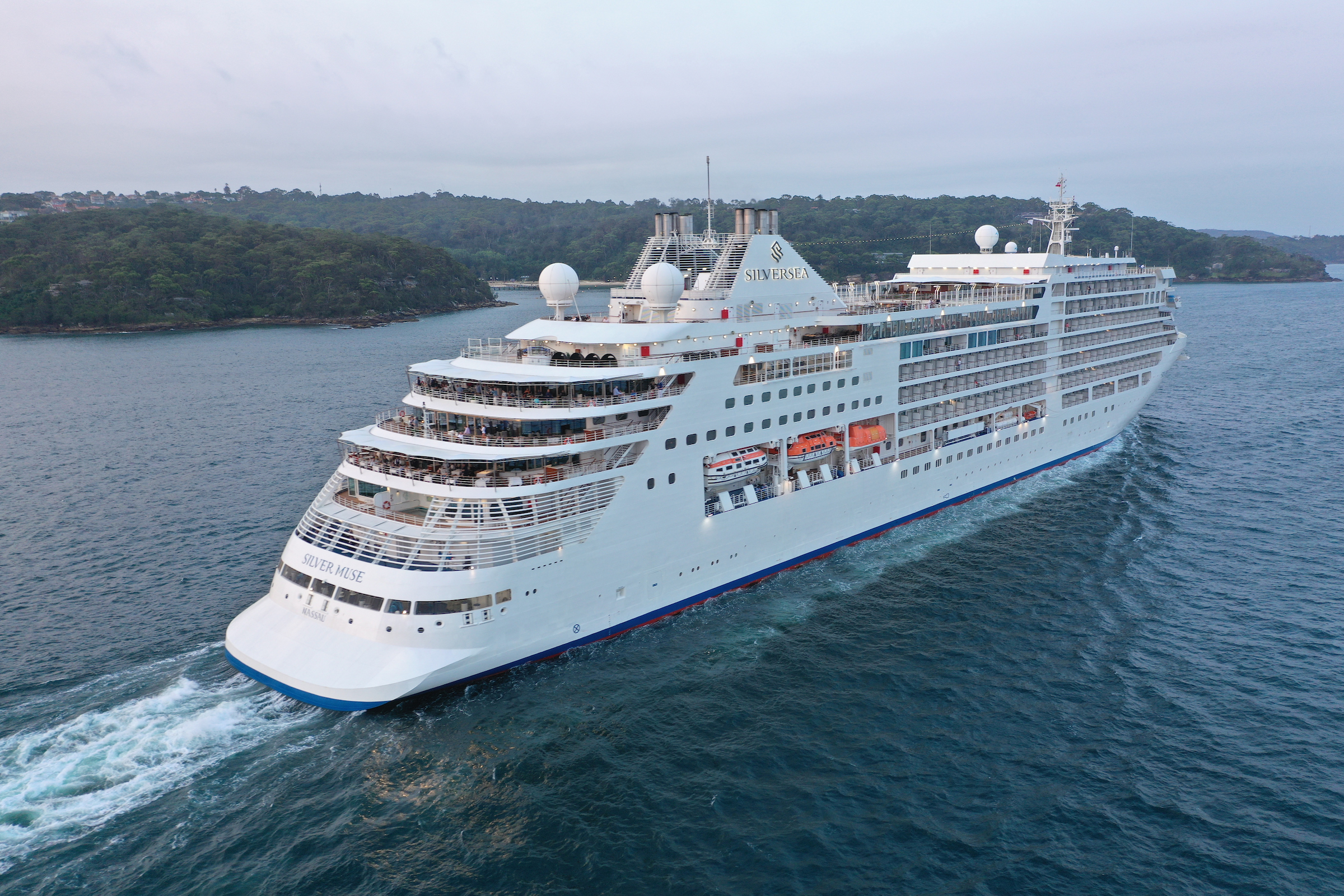
30 nightsFrom Incheon15 ports of call
Transpacific Crossing Featuring Japan & Alaska
Silversea · Silver Muse
Overview
A 30-night voyage aboard Silver Muse, departing Incheon on 2 May 2029 and arriving in Vancouver, Canada, calling at 15 destinations along the way.
IncheonBaoshan (Shanghai)Busan, South KoreaSakaiminatoMaizuruKanazawaAomoriMiyako,Iwate, JapanHitachinaka, JapanTokyo (Yokohama), JapanHakodateKodiak, AlaskaSitkaKetchikanVancouver, Canada
Cabin prices
Live prices per person based on two sharing. Select a grade to see its fare options.
Loading live cabin prices…
Itinerary
30 nights · 32 ports of call- 1
Day 1 ·Incheon (Seoul)Embark
2 May 2029The bright lights of neighbouring big city Seoul might burn brightly but Incheon, just 27 kilometres away, has nothing to be ashamed of. The coastal city was the first to open its borders to the world in 1883, and as such has always enjoyed a special relationship with the west. So much so that it was granted “English Status” in 2007, with many residents priding themselves on their command of the language. View less
The city’s love of English has made it a business powerhouse so expect soaring skyscrapers and smart technology as part of the landscape. Incheon was also the first to welcome the Chinese and today the city’s Chinatown is one of the most vibrant and welcoming there is. A frenetic and exciting hybrid of Chinese and Korean heritage, it is said that Jjajangmyeon (black soy bean noodles), South Korea’s de facto national dish originates from here. Try a steaming bowl from one of the many vendors, then walk it off with the short 15-minute stroll from Chinatown to the traditional Sinpo Market for different kind of sensational feast. The city is steeped in history, notably in recent times during the Korean War. In 1950, the US general General MacArthur led UN forces behind enemy lines in freeing the city from North Korean pressure. MacArthur’s victory is commemorated by a statue in the Jaya (Freedom) Park. The city’s history of course goes back much further, with the first historical record dating as far back as 475 CE. At the time the city was called Michuhol, only changing its name to Incheon in 1413. - 2
Day 2 ·At Sea
3 May 2029 - 3
Day 3 ·Shanghai, China
4 May 2029Strategically located where the Yangtze River, Grand Canal and Pacific Ocean meet, Shanghai has served as a major commercial port since the Song Dynasty (10th century). From here, the region's substantial cotton crop was shipped to Beijing and more remote regions in China and Japan. By the Qing Dynasty, vast mercantile guilds, organized by trade, had established economic and a considerable
amount of political control of the city. In the 1840s Shanghai was described by a representative of the British East India Company as “the principal emporium of Eastern Asia.” Not surprisingly, after the Opium Wars the British moved in under the Treaty of Nanking, followed by the French, and set up the first foreign concessions in the city. - 4
Day 4 ·Shanghai, China
5 May 2029Strategically located where the Yangtze River, Grand Canal and Pacific Ocean meet, Shanghai has served as a major commercial port since the Song Dynasty (10th century). From here, the region's substantial cotton crop was shipped to Beijing and more remote regions in China and Japan. By the Qing Dynasty, vast mercantile guilds, organized by trade, had established economic and a considerable
amount of political control of the city. In the 1840s Shanghai was described by a representative of the British East India Company as “the principal emporium of Eastern Asia.” Not surprisingly, after the Opium Wars the British moved in under the Treaty of Nanking, followed by the French, and set up the first foreign concessions in the city. - 5
Day 5 ·Shanghai, China
6 May 2029Strategically located where the Yangtze River, Grand Canal and Pacific Ocean meet, Shanghai has served as a major commercial port since the Song Dynasty (10th century). From here, the region's substantial cotton crop was shipped to Beijing and more remote regions in China and Japan. By the Qing Dynasty, vast mercantile guilds, organized by trade, had established economic and a considerable
amount of political control of the city. In the 1840s Shanghai was described by a representative of the British East India Company as “the principal emporium of Eastern Asia.” Not surprisingly, after the Opium Wars the British moved in under the Treaty of Nanking, followed by the French, and set up the first foreign concessions in the city. - 6
Day 6 ·At Sea
7 May 2029 - 7
Day 7 ·Busan, South Korea
8 May 2029"A tapestry of kaleidoscopic colours, intense seafood flavours, and urban beach bliss, Busan rolls across a glorious natural setting on the Korean Peninsula's south-east. One of the largest and busiest ports in the world, 3.5 million people call South Korea's second city home, and the amiable locals help to lend the city its quirky, offbeat outlook. A spacious, playful and cosmopolitan place, Busan is a lively, liveable city, cradled by lush mountains and endless ocean scenery.
Haedong Yonggung Temple nestles on a dramatic cliffside, just above the crumbling rocks and crashing waves of the East Sea. Dating back to 1376, the temple's multi-storey pagoda is adorned with lions - each representing a different emotion. Elsewhere, lanterns glitter in the night sky around Mount Geumjeongsan, freshly released from the beautiful Beomeosa Temple, which was established in AD 678. The hillside shantytown of Gamcheon Culture Village has completed an improbable transformation, blossoming from a sea of makeshift homes for Korean war refugees, into a colourful explosion of creativity and curiosity. Local artists have been let loose to create interactive installations, and the entire area is now an expansive canvas for expression. Lose yourself among vibrant alleyways of flamingo-pink, lemon-yellow and baby-blue painted facades in this unique area. Sample bibimbap, fiery-hot beef and rice, from street food vendors, before relaxing on one of South Korea's best beaches - Haeundae's banana bend of sand. Metallic skyscrapers offer an unusual backdrop to this pristine expanse of golden powder and are mirrored by elaborate sandcastles and sculptures during the annual sand festival - when spontaneous water fights and firework displays also take place. Gwangalli beach is another urban option, laying out spectacular views of the reaching Gwangan Bridge - the country's second largest bridge. At night, 16,000 bulbs bathe this engineering marvel in colour." - 8
Day 8 ·Sakaiminato
9 May 2029Sakaiminato is a city in Tottori Prefecture, Japan - 9
Day 9 ·Maizuru
10 May 2029Maizuru is a city in south-central Japan. The Goro Sky Tower has panoramic views over the islands of Maizuru Bay. Maizuru Park contains the ruins of Tanabe Castle, and is known for spring cherry blossoms. East, Brick Park is a group of Meiji-era warehouses, now home to the World Brick Museum. Kongō-in Temple is known for its ornate pagoda and fall colors. On the north coast, Ryuguhama Beach faces the sea. ― Google - 10
Day 10 ·Kanazawa
11 May 2029The capital of the Ishikawa Prefecture, Kanazawa once rivalled Kyoto and Edo (Tokyo) as a town rich in cultural achievements. Kanazawa escaped destruction during World War II and accordingly has been able to preserve many of the old districts in good shape. The city is famous because of Kenrokuen. Located next to Kanazawa Castle, Kenrokuen is classified as “One of the Three Gardens of Japan”. The garden has an artificial pond, and hills and houses are dotted within the 11.4 hectares. View less
It has Japan’s oldest fountain using natural water pressure and a tea-house dating back to 1774. Close by is the Higashi Chaya Gai Geisha District, designated a National Cultural Asset and the biggest of the Geisha districts of Kanazawa. Some of the houses not only retain the original structure, but still are used as Geisha houses. Some of the streets have traditional shops creating a nostalgic atmosphere. Kanazawa is also known for its lacquer ware, Kutani-style pottery, gold-leaf workmanship and delicately painted silk kimonos. - 11
Day 11 ·At Sea
12 May 2029 - 12
Day 12 ·Aomori
13 May 2029From fiery festivals to spectacular mountain scenery, soaring temples to castles surrounded by cherry blossom blooms, Aomori is one of Japan’s most enchanting destinations. Framed by dark peaks clad with dense forestry, the city enjoys a picturesque location on Japan’s main island Honshu. While there are gorgeous pink tinted parks, tiered castles and towering Buddha statues to explore, the Aomori Prefecture’s capital is perhaps best known for the summer festival of fire that lights it up each year.
Lavish illuminated floats fill the streets during Nebuta Matsuri festival, as dancing locals wave flickering lanterns through the night sky - and drummers pound out pulsating rhythms. Nebuta Matsuri has a euphoric and energetic atmosphere which makes it stand out as an unmissable experience compared with some of Japan’s more restrained festivals. At other times of the year, places like the stunning Hirosaki Castle bloom with rose-pink cherry blossom, as spring’s sunshine clears away winter’s plentiful snowfall. The castle’s moat, glowing with the pale hue of fallen blossom, is a truly mesmerising sight to behold. Don’t worry if you’re too late though, you might be able to catch the pink-flush of the apple blossom - which comes slightly later. Extraordinary prehistoric Jomon period history is waiting to be unearthed at the living archaeological site, Sannai-Maruyama Ruins. Or, the untouched wilderness of UNESCO World Heritage Site Shirakami Sanchi is within reach. This sprawling mass of beech trees covers a third of the Shirakami mountain range, and the dense forestry once blanketed the majority of northern Japan’s land. Visit to scratch the surface of this untamed landscape’s beauty and see sprawling waterfalls cascading down mountainsides, in a beautiful off-bounds landscape, where black bears roam freely. - 13
Day 13 ·Miyako, Iwate, Japan
14 May 2029Miyako is a city located in Iwate Prefecture, Japan. As of 1 April 2020, the city had an estimated population of 51,150, and a population density of 41 persons per km². The total area of the city is 1,259.15 square kilometers. - 14
Day 14 ·Hitachinaka
15 May 2029 - 15
Day 15 ·Tokyo, Japan
16 May 2029Dense and delightful, there’s nowhere else like Japan’s kinetic capital - a city where ancient traditions blend seamlessly with a relentless pursuit for the future’s sharpest edge. See the city from above, as elevators rocket you up to towering viewing platforms, from which you can survey a vast urban ocean, interspersed with sky-scraping needles. Look out as far as the distant loom of Mount Fuji’s cone on clear days. View less
Futuristic – second-accurate - transport seamlessly links Tokyo’s 14 districts, while the glow of flashing advertisement boards, clanks of arcade machines, and waves of humanity flowing along its streets, adds to the sense of mesmerising, dizzying and glorious sensory overload. One of Tokyo’s most iconic sights, don’t miss the flood of people scrambling to cross Shibuya’s famous intersection. Join the choreographed dance, as crowds of briefcase-carrying commuters are given the green light to cross at the same time – bathed in the light of massive neon advertisements. The culture is immensely rich and deep, with 7th-century, lantern-decorated temples, stunning palaces and tranquil scarlet shrines waiting below cloaks of incense and nestling between soaring skyscrapers. Restaurants serve up precisely prepared sushi, and wafer-thin seafood slivers, offering a unique taste of the country’s refined cuisine. Settle into traditional teahouses, to witness intricate ceremonies, or join the locals as they fill out karaoke bars to sing the night away. In the spring, cherry blossom paints a delicate pink sheen over the city’s innumerable parks and gardens. - 16
Day 16 ·At Sea
17 May 2029 - 17
Day 17 ·Hakodate (Hokkaido)
18 May 2029Arrive 07:00Depart 17:00Gaze down over Hakodate, from the heights of its namesake peak - Mount Hakodate - to see the city stretching out spectacularly, with back-to-back twin bays splitting the ocean. Hakodate port was one of the first to open Japan up to the world, and to international trade in 1859 - a fact reflected in the architecture, with its influences from the West and beyond. The port area is a redbrick wash of warehouses turned shopping malls, all observed by the onion domes of the city's Russian Orthodox church. View less
Elsewhere, the star-shaped Goryokaku fortress glows with natural colours and a beautiful haze of cherry blossom during the season. Goryokaku Tower, which rises up beside it, offers a sweeping bird's eye view of the green fortress and mountain backdrop. Buses trundle up the 335-metre incline to the top of Mount Hakodate, but the best way to reach the views is to jump on the ropeway, which swings high above downtown's buildings, over a carpet of pine trees. Head up to the mountain's heights as sunset approaches. With darkness sweeping in, and the lights flickering to life, the panorama is one of Japan's most spectacular. Soak it all in, and look out to the horizon, dotted with the shimmering lights of ships hauling in harvests of the city's renowned squid. The plankton-rich waters attract a delicious variety of feasting sea life to Hakodate's coast, which is then plated up in the city's numerous, skilled restaurants. For an eye-opening, whirring morning, see the freshest produce being doled out at Hakodate Morning Market – amid a cacophony of noise and activity. - 18
Day 18 ·At Sea
19 May 2029 - 19
Day 19 ·At Sea
20 May 2029 - 20
Day 20 ·At Sea
21 May 2029 - 21
Day 21 ·At Sea
22 May 2029 - 22
Day 22 ·At Sea
23 May 2029 - 23
Day 23 ·At Sea
24 May 2029 - 23
Day 23 ·International Date line
24 May 2029 - 23
Day 23 ·At Sea
24 May 2029 - 24
Day 24 ·At Sea
25 May 2029 - 25
Day 25 ·Kodiak Island, Alaska , United States
26 May 2029Arrive 08:00Depart 17:00The domain of grizzlies, brown and black bears, Kodiak Island is a raw, wild, and utterly authentic Alaskan wilderness. The Emerald Isle is the USA's second-largest island, and with a wilderness stretching out over 3,670 square miles, it's a thrilling voyage into the Alaskan unknown. The weather may get a little cloudy at times, but the locals actively welcome a covering of cloud – perhaps partly because the clouds and fog are said to have deterred Japanese attacks during World War II's hostilities. View less
Be sure to bring your camera with you; it's nigh on impossible to take a bad photo of these irresistible vistas - and you'll quickly see why Kodiak Island is the destination of choice for wildlife documentary producers. Cinematic setpieces regularly play out, as eagles soar over expansive sweeps of fir-tree forested mountains and still lakes, releasing occasional piercing calls. Some of the animal kingdom's most feared and revered creatures call Kodiak Island home, and your first sight of a bear reaching a massive paw into the water, or treading through a gently burbling stream, will live with you forever. Soar in a seaplane to track the bears with an expert guide. Masters of disguise, it often takes a trained eye to spot the bears in their natural habitats. Brush up on the skills you'll need in advance, with a read of our bear watching blog. [Insert blog: 7 tips for bear watching in Alaska]. The waters of Kodiak Island are also home to some of the world's most productive fishing. Try out your own skills, or accompany a seafaring fishing vessel, to witness life on the waves first-hand, as they plunder the depths of the ocean. - 26
Day 26 ·At Sea
27 May 2029 - 27
Day 27 ·Sitka (Alaska)
28 May 2029Arrive 07:00Depart 18:00Sitka began as a major Tlingit Indian village and was called “Shee Atika,” which translates roughly as “settlement on the outside of Shee.” “Shee” is the Tlingit name of Baranof Island.
In 1799, Alexander Baranof, the general manager of the Russian American Company, decided to move his base of operations from Kodiak and set up camp at what is now called Old Sitka, 7.5 miles north of the present-day town. He called the settlement St. Archangel Michael. The Tlingit Indians of the area resisted the occupation and, in 1802, with Baranof away, burned the fort and massacred the Russian settlers. Two years later, Baranof returned and besieged the Indian fort. The Tlingits withdrew and the area was once again in Russian hands. This time, the Russians built the new city on a different site and called it New Archangel.
For over six decades, New Archangel was the capital of the Russian empire in Alaska. By 1867, the Alaska colony had become too much of a financial burden to Russia. William Seward, U.S. Secretary of State, negotiated with the Russian Czar to purchase the Territory of Alaska for $7.2 million. The American press scoffed at Seward and the U.S. government for purchasing what they called “Seward's Folly,” “Seward's Icebox,” and “Walrussia.”
On October 18, 1867, the Russian flag was lowered at New Archangel and the Stars and Stripes were raised over newly renamed Sitka. The name comes from the Tlingit word “Sheetkah,” which means “in this place.” All Russian citizens living in the former colony were given the opportunity to become American citizens. Many went home, although a few stayed or migrated to California.
Sitka remained the capital of the Territory of Alaska from 1867 to 1906, when it was moved to Juneau. The move was a direct result of the gold rush. In plain terms, Sitka did not have any and Juneau did.
After the Japanese attack on Pearl Harbor, Sitka became a full-scale naval base. At one time during the war, Sitka had a total population of 37,000. With the end of World War II, however, the city settled into a quieter existence. The biggest boom in modern days for Sitka came in 1959 when the Alaska Lumber and Pulp Company built a pulp mill at Silver Bay, near the city.
Today, picturesque Sitka is known for its fishing and of course its many historic attractions. - 28
Day 28 ·Ketchikan, Alaska
29 May 2029Arrive 08:00Depart 18:00The Salmon Capital of the World is a thrilling introduction to wild and wonderful Alaska, sitting at the southern gateway to the Inside Passage's famed route of larger than life scenery. Cruise through the waters, or soar just above in a sightseeing plane, to take in the full majesty of the magnificent Misty Fjords National Monument. Home to grizzly and black bears - as well as cruising whales and swimming seals - the wildlife spotting opportunities in this majestic corner of the world are nothing short of spectacular. View less
Towered over by steep banks and valley walls, Ketchikan's ocean inlet is peppered with granite stacks, looming from the waters. Surrounded by glorious landscapes, head to the Alaska Rainforest Sanctuary, which is alive with bald eagles, black bears and remarkable, thick, yellow banana slugs - the squeamish are advised to keep well clear. Visit Ketchikan's Heritage Centre, where a collection of intricately carved totem poles rise up, preserving the heritage of the indigenous Tlingit and Haida people of these lands. Ketchikan has the world's largest collection, and some of the oldest and most precious totems in existence. This frontier city hasn’t always been so wholesome, however. See the colourful historic street that is built on crooked stilts over Ketchikan Creek, which has a crude history as the main red-light district in the city. The brothels closed in the 1950s, but you can explore this legendarily seedy past at Dolly’s House - a brothel turned museum. See the Married Man trail, a historical route used to enter Creek Street away from prying eyes. - 29
Day 29 ·Inside Passage Cruising
30 May 2029 - 30
Day 30 ·Vancouver, CanadaDisembark
31 May 2029Arrive 07:00Boasting mountains, sea, culture, art and so much more, many cities claim to have it all, but few can back it up like Vancouver. Famously livable, just visiting this highrise city - surrounded by staggering natural beauty - is a thrill. Offering all of the creature comforts of an ultra-modern, worldly metropolis - even downtown has a hint of mountain-freshness to its air - and part of Vancouver's appeal is how easily you can swap the skyscrapers for whale-filled oceans and mountain-punctured skies. View less
Head up to the Vancouver Lookout Tower for the ultimate 360-degree views of the city glistening, amid the beautiful embrace of the beckoning wilderness beyond. But what to see first? Art lovers might choose the Vancouver Art Gallery or the Contemporary Art Gallery. Nature lovers might rush for the ferry to visit Vancouver Island - where they can encounter grizzly bears, whales and orcas. Culture vultures, on the other hand, will probably head for the sights and sounds of Canada's biggest Chinatown. From steaming dim sum for lunch to Chinese apothecaries offering herbs to soothe any illness, it’s all here thanks to the migrant workers of the 19th century. The one-of-a-kind treasure of Stanley Park brings wild wonder and natural beauty to this cosmopolitan city's doorstep, and the pine-tree clad park offers isolated trails and amazing views. Wander the Seawall that encircles it - a 20-mile coastal path, full of joggers, whizzing skaters and wandering couples. Grab a bike and cycle between Coal Harbour and Kitsilano Beach. You can top up your tan on the shore, as you soak in the glorious views of the mountains and cityscape from the sands.
Your ship: Silver Muse
Explore Silver Muse's cabins, dining and onboard facilities.