
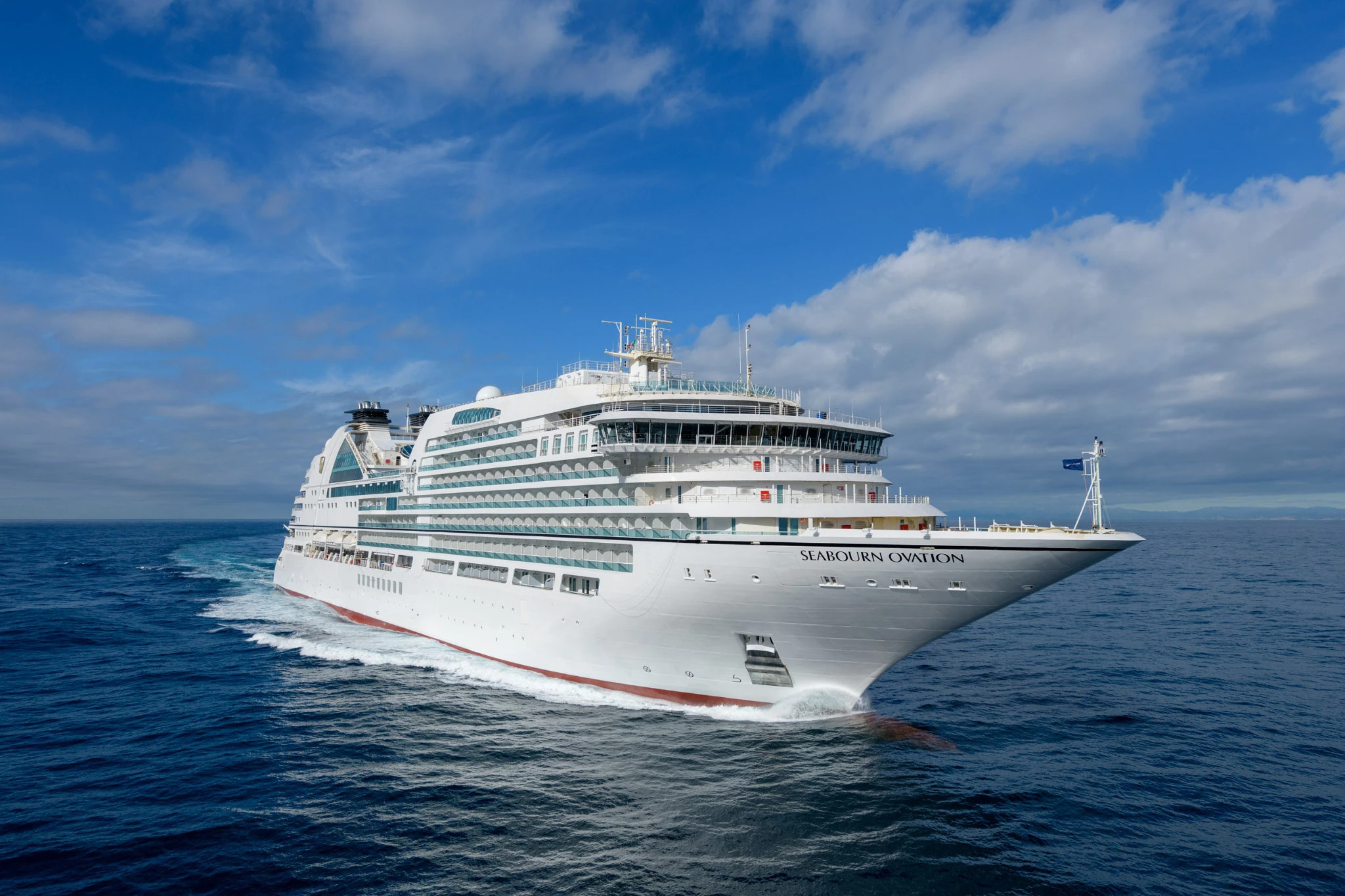
18 nightsFrom Dubrovnik12 ports of call
18-Day Ancient Exploration: Greece, Egypt & Ephesus
Seabourn · Seabourn Ovation
Overview
A 18-night voyage aboard Seabourn Ovation, departing Dubrovnik on 20 Oct 2029 and arriving in Civitavecchia, Rome, calling at 12 destinations along the way.
DubrovnikKotorCorfuGythionAthens (Piraeus), GreeceKusadasiBodrumRhodesAlexandria, EgyptSyracuse,ItalySalernoCivitavecchia, Rome
Cabin prices
Live prices per person based on two sharing. Select a grade to see its fare options.
Loading live cabin prices…
Itinerary
18 nights · 19 ports of call- 1
Day 1 ·Dubrovnik, CroatiaEmbark
20 Oct 2029Depart 23:00Founded in the 7th century, Dubrovnik rose to greatness as a merchant state, independent republic and cultural crossroads. The traffic-free Old Town has been called a Croatian Athens. This UNESCO designated World Heritage Site is a living museum of the ages with fortifications, chapels, monastic cloisters and Europe's second-oldest synagogue crowded into its ancient walls. Relax at a sidewalk café, listen to the chimes of the 14th-century bell tower or join the promenade down the palace-lined avenue known as the Stradun. - 2
Day 2 ·Kotor, Montenegro
21 Oct 2029Arrive 07:00Depart 18:00One of the best preserved medieval towns of the Adriatic, Kotor is protected by UNESCO. Between 1420 and 1797, the area was under the rule of the Republic of Venice and the Venetian influence can be seen in its architecture. The Gulf of Kotor is sometimes called the southernmost fjord in Europe, although it is actually a submerged river canyon. The overhanging limestone cliffs of Orjen and Lovcen complete one of the Mediterranean's most beautiful landscapes. - 3
Day 3 ·Brindisi (Lecce), Italy
22 Oct 2029Arrive 08:00Depart 18:00Set on a peninsula between two arms of the Adriatic Sea, Brindisi was an important port of the Roman Empire, and later for the East India Company. In the 2nd century BC the Appian Way was built, linking the port to Rome, and a column near the harbor marks the end of that famous route. It is here that in 71 BC, the gladiator Spartacus led thousands of rebel slaves in an unsuccessful escape. Today visitors find Romanesque churches, a 13th-century castle and, in the surrounding Apulia region, remains of ancient Messapian culture. - 4
Day 4 ·Corfu, Greece
23 Oct 2029Arrive 07:00Depart 17:00A scant few miles off the Albanian coast lies the island of Corfu, one of the most richly endowed of all the Greek Isles. Praised by Homer in the Odyssey and selected by Shakespeare as the setting for "The Tempest," the island retains evidence of cultural heritage from each of its past rulers - Byzantium, Venice, France, Russia and Great Britain. Rolling acres of olive groves, small orchards of lemon and orange trees, tall cypress, oleander, and myrtle bushes lend a lush, verdant look to the island. While the oldest part of Corfu Town has cobblestone lanes so narrow only pedestrian travel is possible, the modern sector has wide avenues. Residents boast that its "Spianada" is the largest and most beautiful square in all Greece. - 5
Day 5 ·Itea (Delphi), Greece
24 Oct 2029Arrive 08:00Depart 18:00Itea is a small bathing resort and port at the end of a bay not too far from the ancient port of Delphi. The hills are covered with olive trees belonging to the sanctuary of Apollo in ancient times. Referred to as a "sea of olives," their production is now an important part of the local economy. - 6
Day 6 ·At Sea
25 Oct 2029 - 7
Day 7 ·Gythion (Sparta), Greece
26 Oct 2029Arrive 08:00Depart 18:00Gythion, the small port town for Sparta, edges its way up the hillside, which surrounds the harbor. According to Homer, Paris and Helen spent their first night together here, on a tiny islet in the bay. To commemorate the occasion, Paris erected a shrine to Aphrodite, goddess of love, only to have it torn down by the vengeful Menelaus after he recaptured Helen. In its place Menelaus erected statues honoring Praxidica (Punishment) and Themis (Justice). Not far away, at the tip of the Peloponnese, lies the Mani, a distinctive area unlike anything else in Greece. This desolate region of underground lakes and rivers and windswept landscapes is strangely beautiful. To the north of Gythion lie Sparta and Mystra, well worth a visit. - 8
Day 8 ·Piraeus (Athens), Greece
27 Oct 2029Arrive 07:00Depart 17:00Piraeus has been the port for Athens since 482 BC. The busy harbor is filled with ferries and cruise ships making their way to the Greek Islands and other Mediterranean cities. The busy metropolis of Athens and its treasure trove of antiquities lie just a few miles from the port. Even as the reality of the modern city took hold, with its high-rise apartments, crowded sidewalks and bustling traffic, the beauty of the Acropolis, the outstanding museums, charming cafés, sidewalk markets and startling views come together in a cultural mosaic for all to enjoy. - 9
Day 9 ·Kusadasi (Ephesus), Turkey
28 Oct 2029Arrive 09:00Depart 23:00Kusadasi, which means "bird island," is set in a superb gulf known for its sparkling water, broad sandy beaches and large marina. The city has managed to retain a certain earthiness while doing a brisk trade in Turkish carpets and leather goods to visitors. The town's old quarter is a picturesque maze of winding streets and houses adorned with flowers and birdcages. In the center stands a 17th-century caravanserai, now converted into a hotel. The resort is also gateway to important sites of archaeological and religious interest. - 10
Day 10 ·Bodrum, Turkey
29 Oct 2029Arrive 08:00Depart 18:00Today Bodrum is a picturesque yacht harbor filled with traditional wood-varnished sailboats, charming outdoor cafes and streets bursting with small shops selling carpets, leatherwear, jewelry and local artwork. In antiquity, it was the site of ancient Halicarnassus. Under King Mausolus, the city prospered, and in death, the king left the city its most enduring legacy, his majestic tomb, from which we derive the term "mausoleum." Only its massive foundations remain today but it was the largest tomb ever built by the Greeks and one of the Seven Wonders of the Ancient World. Models on the site recreate its form for visitors. Alexander the Great attacked the city in 334 BC, leveling all but the Mausoleum, which was later destroyed by an earthquake.
When the Knights of St. John lost their castle in Smyrna in 1402, they came here. Finding the mausoleum in ruins, they used the stone to construct the Castle of St. Peter, which proudly stood sentinel to the city. Together with their fortifications on Kos and Rhodes, the Knights dominated the southeastern Aegean, running a hospital for passing pilgrims and ruling the seas as privateers in swift vessels. They remained until 1523, when Ottoman ruler, Suleyman the Magnificent, conquered Rhodes and the Knights' position became untenable. The castle still dominates the harbor and houses an archeological museum. - 11
Day 11 ·Rhodes, Greece
30 Oct 2029Arrive 08:00Depart 18:00Best known of the Dodecanese Islands, Rhodes is a fascinating architectural patchwork of her past. Here the legacy of the ancient Greeks mingles with that of besieging Turks, crusading knights, and occupying Italians. Twin bronze deer, the symbol of Rhodes, guard the Mandraki Harbor where the 100-foot Colossus is said to have stood, a wonder of the ancient world. The medieval Crusader City is dominated by the Palace of the Grand Masters, while cobbled streets lead to the bustling bazaar and a lively harbor that is a center of the international yachting scene. - 12
Day 12 ·At Sea
31 Oct 2029 - 13
Day 13 ·Alexandria, Cairo, Egypt
1 Nov 2029Arrive 07:00Alexander the Great founded this city, but never lived to see it. When he took Egypt from the Persians in 332 BC, he decided to move the capital from Memphis to the Mediterranean. Leaving instructions with his architect, he traveled on to Asia where he died. Egypt passed under the control of his general, Ptolemy I, who made Alexandria a great intellectual center. The city was designed with grand proportions. Its lighthouse, the Pharos, was a beacon to all. The Mouseion, from which our word "museum" derives, incorporated laboratories, observatories and a vast library. With the fall of the Ptolemies, Alexandria slumbered in obscurity until revived as an international seaport. A cosmopolitan, decadent colonial era, captured such works as Lawrence Durrell's Alexandrian Quartet, ended in the 1950's, but the beaches, restaurants and architecture still draw visitors, along with such excavations as Cleopatra's Palace, where this Queen of Egypt shared her love with Mark Anthony. - 14
Day 14 ·Alexandria, Cairo, Egypt
2 Nov 2029Depart 21:00Alexander the Great founded this city, but never lived to see it. When he took Egypt from the Persians in 332 BC, he decided to move the capital from Memphis to the Mediterranean. Leaving instructions with his architect, he traveled on to Asia where he died. Egypt passed under the control of his general, Ptolemy I, who made Alexandria a great intellectual center. The city was designed with grand proportions. Its lighthouse, the Pharos, was a beacon to all. The Mouseion, from which our word "museum" derives, incorporated laboratories, observatories and a vast library. With the fall of the Ptolemies, Alexandria slumbered in obscurity until revived as an international seaport. A cosmopolitan, decadent colonial era, captured such works as Lawrence Durrell's Alexandrian Quartet, ended in the 1950's, but the beaches, restaurants and architecture still draw visitors, along with such excavations as Cleopatra's Palace, where this Queen of Egypt shared her love with Mark Anthony. - 15
Day 15 ·At Sea
3 Nov 2029 - 16
Day 16 ·At Sea
4 Nov 2029 - 17
Day 17 ·Syracuse, Sicily, Italy
5 Nov 2029Arrive 07:00Depart 14:00Now a sun-bleached provincial capital, Siracusa was once one of the most prestigious cities in the known world. Founded in the 8th century BC by settlers from Corinth, Siracusa gradually grew in prestige to rival Athens and was considered the western capital of Magna Graecia. In the Greek world dictators, often called tyrants, exercised unlimited power over colonies like Siracusa. Although often unpleasant people, they also often patronized poets and artists and competed to bring intellectuals to their courts. Siracusa was home to Archimedes, Plato and Aeschylus during its height of power and prestige. Today's visitors come to marvel at the remains of the ancient structures, reminders of the past glory and rich history of the area. The city is superbly situated at the head of a beautiful bay and enjoys a mild climate. The coastline to the south is renowned for its beauty, clear waters and evocative, mythical scenery. There are romantic abandoned coves and wide, sandy beaches not easily matched anywhere else in Italy. - 18
Day 18 ·Salerno
6 Nov 2029Arrive 09:00Depart 17:00 - 19
Day 19 ·Civitavecchia (Rome), ItalyDisembark
7 Nov 2029Arrive 07:00Originally built by Emperor Trajan who had a villa here, Civitavecchia has flourished as a major port for Rome since the 13th century. Today it is an important ferry terminal and for many travelers the gateway to the Eternal City, Rome. The Renaissance fortifications that surround the harbor area were begun by Bramante and completed by Michelangelo in 1535.
Your ship: Seabourn Ovation
Explore Seabourn Ovation's cabins, dining and onboard facilities.