
21 nightsFrom Athens (Piraeus), Greece18 ports of call
21-Day Treasures From Greece, Italy & The Adriatic
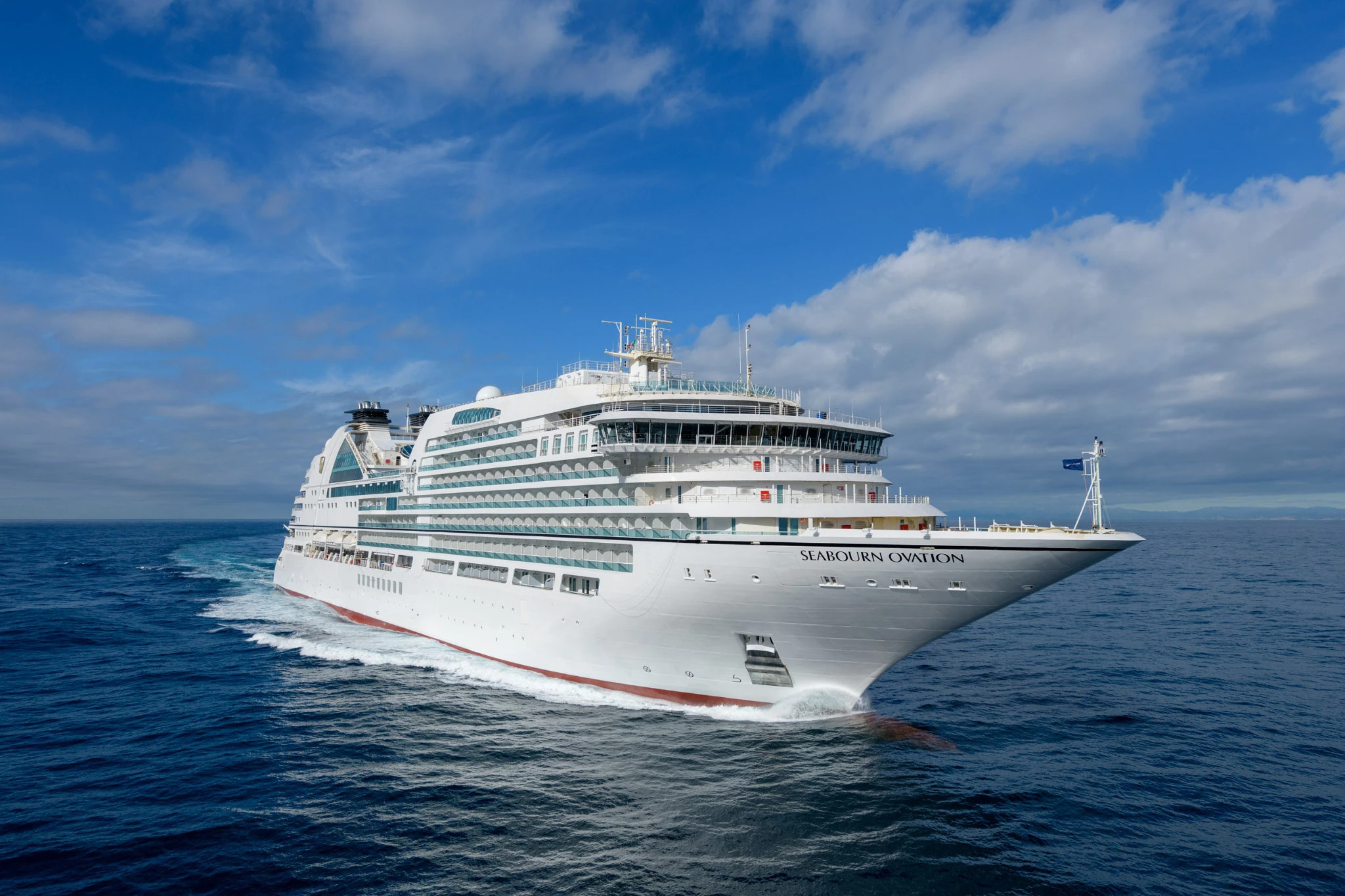
Seabourn · Seabourn Ovation
Overview
A 21-night voyage aboard Seabourn Ovation, departing Athens (Piraeus), Greece on 29 Sept 2029 and arriving in Dubrovnik, calling at 18 destinations along the way.
Athens (Piraeus), GreeceNafplionKotorVodiceOpatijaKoperVenice (Fusina), ItalyRovinj, CroatiaZadar, CroatiaTrogirLipari IslandsSorrentoCivitavecchia, RomeAmalfi, ItalyTaorminaSenglea, MaltaSarandeDubrovnik
Cabin prices
Live prices per person based on two sharing. Select a grade to see its fare options.
Loading live cabin prices…
Itinerary
21 nights · 22 ports of call- 1
Day 1 ·Piraeus (Athens), GreeceEmbark
29 Sept 2029Depart 22:00Piraeus has been the port for Athens since 482 BC. The busy harbor is filled with ferries and cruise ships making their way to the Greek Islands and other Mediterranean cities. The busy metropolis of Athens and its treasure trove of antiquities lie just a few miles from the port. Even as the reality of the modern city took hold, with its high-rise apartments, crowded sidewalks and bustling traffic, the beauty of the Acropolis, the outstanding museums, charming cafés, sidewalk markets and startling views come together in a cultural mosaic for all to enjoy. - 2
Day 2 ·Nafplion, Greece
30 Sept 2029Arrive 08:00Depart 17:00Held to be one of the loveliest small towns in all the islands, Navplion has a tradition and culture all its own. The sheltered location, below a rocky headland crowned by a Venetian fortress is perhaps unrivaled in Greece. After the Greek revolution of the early 19th century, Navplion served as the first modern capital. The neoclassical houses, large official buildings and carefully planned seafront streets all date from this period. - 3
Day 3 ·At Sea
1 Oct 2029 - 4
Day 4 ·Kotor, Montenegro
2 Oct 2029Arrive 08:00Depart 18:00One of the best preserved medieval towns of the Adriatic, Kotor is protected by UNESCO. Between 1420 and 1797, the area was under the rule of the Republic of Venice and the Venetian influence can be seen in its architecture. The Gulf of Kotor is sometimes called the southernmost fjord in Europe, although it is actually a submerged river canyon. The overhanging limestone cliffs of Orjen and Lovcen complete one of the Mediterranean's most beautiful landscapes. - 5
Day 5 ·Vodice (Sibenik)
3 Oct 2029Arrive 08:00Depart 18:00Vodice is a popular seaside town on the Dalmatian coast of the Adriatic Sea. It has the familiar red-tiled roofs and wide stone seaside promenades of other Dalmatian ports. In the town, there are several interesting features. One is the old Church of St. Cross dating from 1402, and the newer, baroque Parish Church of St. Cross from 1746, with a tall bell tower. The Church of St. Elijah is even older, dating from 1298. There are several popular pebble and sand beaches around Vodice. Outside town are a pair of fields with archaeological remains of Roman era occupation, including walls, cisterns, wells and fortifications. Each field also holds a small church. The Coric Tower is a fortified manor built by a powerful family during the mid-17th century to protect against Turkish attacks. From Vodice it is also easy to access the seaside town of Sibenik, the waterfalls and pools of Krka National Park and the offshore islands of the Kornati National Park. - 6
Day 6 ·Opatija, Croatia
4 Oct 2029Arrive 08:00Depart 18:00On the western peninsula of Croatia, just south west of the city of Rijeka Croatia, lies the beautiful town of Opatija. Anyone visiting the area will instantly understand why this small Croatian village of just 8,000 inhabitants is so popular. With its breathtaking views over the Adriatic towards the Kvarner Islands and up towards the Istrian mountains in the distance, Opatija really is a place of natural beauty. It is an ideal holiday resort, with its lovely mild climate, extensive beaches and 43-kilometre coastline. The European elite frequented the town for many centuries, earning it the well-deserved title, "The Adriatic Nice". - 7
Day 7 ·Koper, Slovenia
5 Oct 2029Arrive 08:00Depart 18:00Located on the tip of Istria, Slovenia's main port was an island until the 19th century, but local history goes back much further. Called Aegida by the Greeks, Capris by the Romans and Justinopolis in Byzantine times, Koper was the influential city in the Venetian Empire and five mayors sat on the throne of the Venetian doges. Today monuments of this Golden Age line the cobblestone streets of an Old Town that boasts a wealth of architecture, cultural monuments and intriguing shops. - 8
Day 8 ·Fusina (Venice), Italy
6 Oct 2029Arrive 07:00Depart 22:00 - 9
Day 9 ·Rovinj, Croatia
7 Oct 2029Arrive 08:00Depart 18:00Nestled among the myriad islets of the Istrian coast in the Gulf of Venice, the charming harbor of Rovinj is comprised of candy-colored buildings, fringed with marinas and dominated by the fairytale spire of the Cathedral of Saint Euphemia, modeled on St. Marks' in Venice. The old town is a treasury of historic monuments - a 13th-century Romanesque baptistry, a baroque City Hall, and an 18th-century monastery - all tucked among cobbled streets that invite exploration. Known as the "Montmartre of Istria," this is an artists' colony with many galleries. - 10
Day 10 ·Zadar, Croatia
8 Oct 2029Arrive 08:00Depart 18:00Located in central Dalmatia Zadar is one of the Adriatic's most historically interesting towns with a wealth of sightseeing and exciting nightlife. Zadar was founded by the Romans, attacked by the Turks, ruled by the Austrians and made part of Italy until 1943 when the Germans moved in. Allied bombing destroyed much of the historic centre which was rebuilt after the war only to suffer more attacks by Yugoslav forces in 1991. In recent years Zadar has undergone a startling revival. Cafes and bars are filled, museums and churches have been restored and tourists pour in to take boats to nearby islands. - 11
Day 11 ·Trogir (Split), Croatia
9 Oct 2029Arrive 08:00Depart 18:00Trogir is a town on the central Adriatic coast of Croatia. Its preserved old town, known for its mix of Renaissance, baroque and Romanesque buildings, lies on a small island connected to the mainland and the island of Čiovo by bridges. The 13th-century Cathedral of St. Lawrence houses the Renaissance Chapel of St. John and offers sweeping views from its bell tower. Parts of the medieval city walls remain intact. - 12
Day 12 ·At Sea
10 Oct 2029 - 13
Day 13 ·Lipari, Italy
11 Oct 2029Arrive 08:00Depart 18:00Lipari is the largest of the seven major islands making up the Aeolian Islands. They were originally named after Aeolus, the mythical god of wind who the ancients believed made his home in a cave here. Recently renamed the Lipari Islands, they were created by volcanic eruptions thousands of years ago and have a primitive rocky beauty accented by Mediterranean greenery. Their natural beauty and easy lifestyle have made the islands increasingly popular for those who wish to escape the modern world and its stresses. The crystal clear aqua-blue waters and the volcanic beaches are some of the most inviting in Italy. Many are inaccessible except by fishermens' boats. An abundance of fish and shell fish makes for some very good restaurants specializing in seafood. - 14
Day 14 ·Sorrento, Italy
12 Oct 2029Arrive 08:00Depart 18:00With an idyllic cliff-top location on the Bay of Naples, Sorrento has inspired legends for centuries. In Greek mythology, the Sirens were said to live here, luring sailors onto the rocks. Today, citrus trees scent the air and add zest to the city's limoncello liqueur. Sorrento is an ideal place to savor the local color, and to shop for embroidered linens, cameos and Capodimonte ceramics, all of which can be found in Old Town and along the pedestrian-only Via San Cesareo. - 15
Day 15 ·Civitavecchia (Rome), Italy
13 Oct 2029Arrive 07:00Depart 18:00Originally built by Emperor Trajan who had a villa here, Civitavecchia has flourished as a major port for Rome since the 13th century. Today it is an important ferry terminal and for many travelers the gateway to the Eternal City, Rome. The Renaissance fortifications that surround the harbor area were begun by Bramante and completed by Michelangelo in 1535. - 16
Day 16 ·Amalfi, Italy
14 Oct 2029Arrive 08:00Depart 18:00The Amalfi Coast has been called the greatest meeting of land and sea on earth. Situated in the Campania region between Sorrento and Salerno, Amalfi and Positano are the two main towns on the world-famous Amalfi Drive - renowned as the most scenic and romantic road in Italy. The road is carved into the side of rocky cliffs plunging into the sparkling sea. Erosion has sculpted the rocky slopes into gargoyle shapes and hollowed out fairy grottoes where the air is tinted turquoise by the glowing blue water below. During the Middle Ages, Amalfi was an independent maritime state with a population of 50,000. The ship compass was invented here in 1302. Approximately 10 miles away from Amalfi is the village of Ravello. An enchanting village with wonderful views and quiet lanes, Ravello boasts romantic gardens surrounding medieval ruins, affording magnificent views of the entire Bay of Salerno. - 17
Day 17 ·Giardini Naxos (Taormina), Italy
15 Oct 2029Arrive 08:00Depart 18:00This harbor on the eastern shore of Sicily near Messina gives us close access to the fabulous Greco-Roman ruins of Taormina, as well as the active volcano Mt. Etna. The temples, streets and large amphitheater of Taormina make it one of Italy’s premier ancient sites. Its location overlooking the sea and with the backdrop of snow-capped Etna complete the package and make it among the most famous attractions in the Mediterranean region. Giardini Naxos itself boasts a lovely beach at Lido Europa, and intrepid visitors can climb Mt. Etna to see a volcano close up - 18
Day 18 ·Valletta, Malta
16 Oct 2029Arrive 08:00Depart 18:00Occupied successively by the Phoenicians, Greeks, Carthaginians, Romans, Arabs, French and British, Malta has been of strategic importance throughout history. A British Crown Colony until 1964, Malta received the George Cross for its valiant resistance to German occupation in WWII. The island's rich heritage is reflected in the architecture of Valletta, the current capital, and Medina, the capital until 1565. In Valletta the Knights of St. John built such masterpieces as St. John's Co-Cathedral and the Palace of the Grand Masters, along with the fortifications that guard the town's magnificent harbors. - 19
Day 19 ·At Sea
17 Oct 2029 - 20
Day 20 ·Taranto, Italy
18 Oct 2029Arrive 08:00Depart 18:00 - 21
Day 21 ·Sarande, Albania
19 Oct 2029Arrive 07:00Depart 16:00This important port on Southern Albania curls around a superb natural harbor, dominated by the hilltop 16th century Lekuresi Castle with distinctive round towers. In the town center are the ruins of a 5th century synagogue, later a Christian basilica, with remnant mosaic floors. Another picturesque ruin is the Forty Saints Monastery from the 6th century, which is thought to have been an important pilgrimage site. But the main attraction in southern Albania is the archaeological site of Butrint, a UNESCO World Heritage Site with extensive ruins of communities dating from prehistory, though the Greek and Roman eras, as well as the Byzantine period, until the medieval period. - 22
Day 22 ·Dubrovnik, CroatiaDisembark
20 Oct 2029Arrive 07:00Founded in the 7th century, Dubrovnik rose to greatness as a merchant state, independent republic and cultural crossroads. The traffic-free Old Town has been called a Croatian Athens. This UNESCO designated World Heritage Site is a living museum of the ages with fortifications, chapels, monastic cloisters and Europe's second-oldest synagogue crowded into its ancient walls. Relax at a sidewalk café, listen to the chimes of the 14th-century bell tower or join the promenade down the palace-lined avenue known as the Stradun.
Your ship: Seabourn Ovation
Explore Seabourn Ovation's cabins, dining and onboard facilities.