
21 nightsFrom Barcelona18 ports of call
21-Day Treasures Of The Riviera, Malta & Croatian Coasts
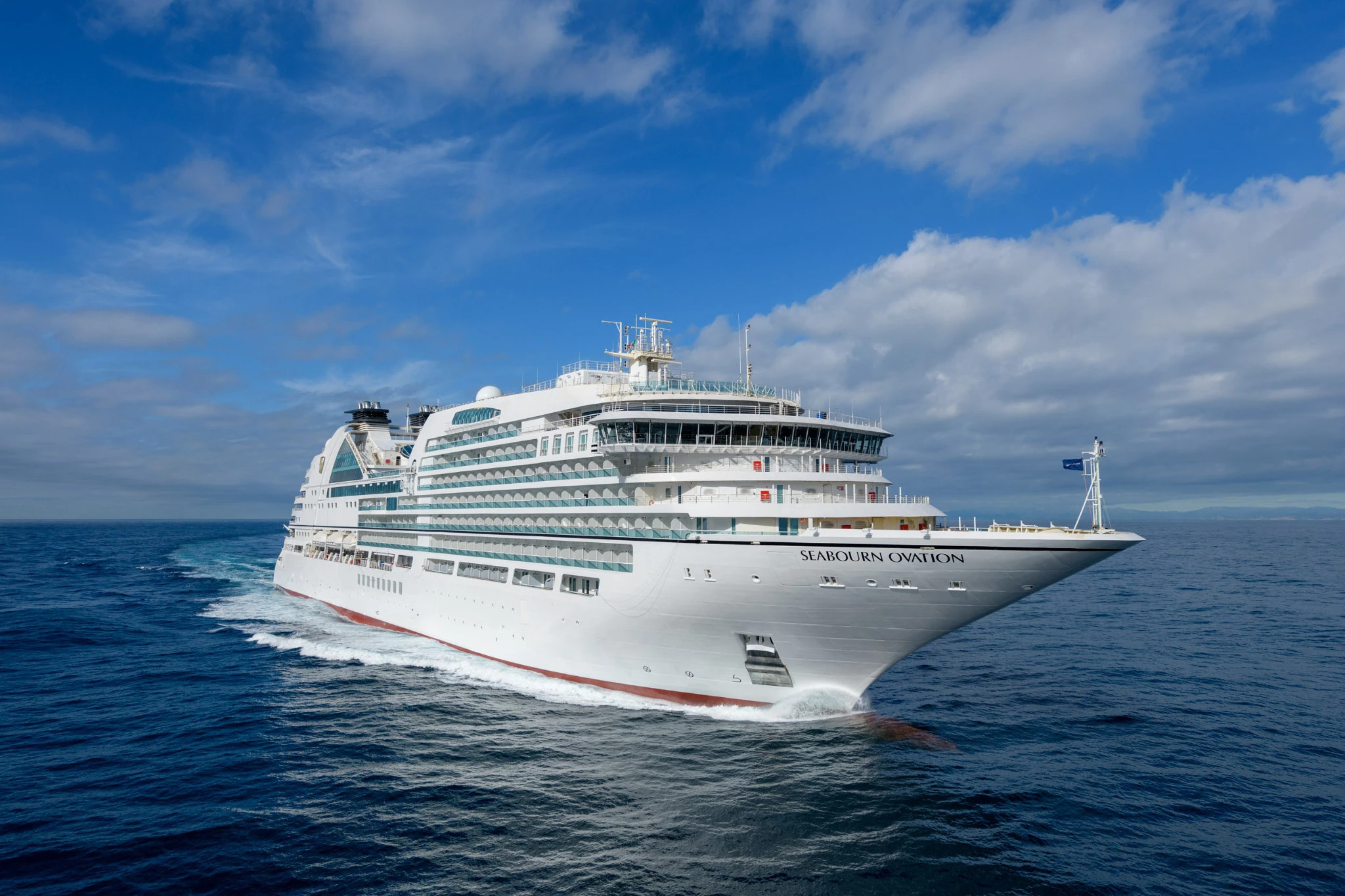
Seabourn · Seabourn Ovation
Overview
A 21-night voyage aboard Seabourn Ovation, departing Barcelona on 18 Aug 2029 and arriving in Dubrovnik, calling at 18 destinations along the way.
BarcelonaPalamosSete, FranceMarseille, FranceFrejus, FrancePortofinoCivitavecchia, RomeAmalfi, ItalyTaorminaSenglea, MaltaSarandeDubrovnikKotorKoperRijekaHvarKorculaDubrovnik
Cabin prices
Live prices per person based on two sharing. Select a grade to see its fare options.
Loading live cabin prices…
Itinerary
21 nights · 22 ports of call- 1
Day 1 ·Barcelona, SpainEmbark
18 Aug 2029Depart 23:00Barcelona, the capital of Catalonia, is said to have been founded by the Phoenicians, and was once the rival of the powerful states of Venice and Genoa for control of the Mediterranean trade. Today, it is Spain's second largest city and has long rivaled, even surpassed Madrid in industry and commerce. The medieval atmosphere of the Gothic Quarter and the elegant boulevards combine to make the city one of Europe's most beautiful. Barcelona's active cultural life and heritage brought forth such greats as the architect Antonio Gaudi, the painter Joan Miro, and Pablo Picasso, who spent his formative years here. Other famous native Catalan artists include cellist Pau Casals, surrealist Salvador Dali, and opera singers Montserrat Caballe and Josep Carreras. Barcelona accomplished a long-cherished goal with the opportunity to host the Olympics in 1992. This big event prompted a massive building program and created a focal point of the world's attention. - 2
Day 2 ·Palamos, Spain
19 Aug 2029Arrive 08:00Depart 18:00Located at the foot of the mountains on Spain's rugged Costa Brava, Palamos boasts seven superb beaches, Iberian archeological remains from the year 6 BC, and the Church of Sant Esteve on the beach. Highlighting the town center is its 16th-century cathedral. - 3
Day 3 ·Sete, France
20 Aug 2029Arrive 08:00Depart 23:00The port town of Sete hugs the tiny Mont St. Clair, and is caught between the Mediterranean and the Bassin de Thau, a salt lake directly behind it. It is crisscrossed by numerous canals which link the lake to the sea, and connected by 12 bridges. Along the quay, renovated buildings provide a multitude of architectural details from the 18th and 19th centuries. The life of the town is found in its squares: Place Leon Blum, with its fountain and Wednesday morning flower market; Place Aristide, with its old fashioned bandstand; and Place de la Republique, with its huge retaining walls and vaulted loggias. Sete retains its historic purpose as a fishing boat haven for North African trade; the old harbor dates from the time of Louis XIV. - 4
Day 4 ·La Joliette (Marseille),France
21 Aug 2029Arrive 08:00Depart 18:00Marseille is the second largest city in France after Paris. It is also one of the oldest continuously inhabited cities in the Mediterranean. Cave paintings in the nearby Calanques are estimated to be 30,000 years old, and remains of brick habitations date from 6,000 BCE. The more recent history begins with a Hellenic port in about 600 BCE, some remains of which are on view at the city’s History Museum. It has been one of the world’s major seaports almost from its founding, and served as the main European terminus of the French colonial empire in Africa and the Far East. It is located in the Provence-Alpes-Cote d’Azur region and is the capital of the Bouches-du-Rhone department. On an island in the expansive bay of Marseille stands the prison of Chateau d’If made famous by the Alexandre Dumas novel “The Count of Monte Cristo.” The Vieux-Port with its atmospheric buildings and wharves is the area where visitors can search for the perfect example of the local specialty bouillabaisse, a rich fish stew containing at least three, and often more varieties of local fishes. Marseille’s newly renovated port at the venerable Joliette Docks is situated very close to the striking Cathédrale de la Major and the fascinating collections at the Museum of African, Oceanic and American Indian Arts. - 5
Day 5 ·Frejus, France
22 Aug 2029Arrive 08:00Depart 18:00Although today it is cut off from the sea, Fréjus was the second-largest naval port in the Roman empire in the 1st Century B.C. The town’s name descends from Forum Julii, the retirement center for the 8th Legion. The Roman ruins in the area are what draws most visitors today, and the massive pillars of the aqueducts, sections of walls and the crumbling remains of the tree-shaded theater and amphitheater are picturesquely situated and satisfying. In the town center, a central square faces the medieval stone cathedral and its adjacent cloisters, with impressive doors, handsomely carved woodwork and elaborate ceilings. Outside town, the 1889 Palladian Villa Aurelienne sits amid 60 acres of Mediterranean gardens. Fréjus suffered a terrible flood in 1959 when runoff from unprecedented rains swept down the mountains and broached the dam at Malpasset. The ruined site is a reminder of man’s fragility in the face of Nature’s power. On another hilltop, the small, octagonal Chapel of Notre Dame de Jerusalem is richly decorated with stained glass windows and colorful frescoes designed by the artist Jean Cocteau and completed after his death. - 6
Day 6 ·Portofino, Italy
23 Aug 2029Arrive 07:00Depart 18:00Portofino is a charming, popular resort village on the Italian Riviera, a favorite with artists and seasoned travelers. Situated on a beautiful bay, the surrounding mountains covered with dense vegetation of olive and cypress trees, form a unique setting of incomparable beauty. The ship will anchor in the bay and tenders will transport you to this tiny resort village, which is closed to vehicle traffic. Everything is concentrated around a small square offering an opportunity to stroll around on foot, shop, or just relax at one of the many open-air cafes. - 7
Day 7 ·At Sea
24 Aug 2029 - 8
Day 8 ·Civitavecchia (Rome), Italy
25 Aug 2029Arrive 07:00Depart 18:00Originally built by Emperor Trajan who had a villa here, Civitavecchia has flourished as a major port for Rome since the 13th century. Today it is an important ferry terminal and for many travelers the gateway to the Eternal City, Rome. The Renaissance fortifications that surround the harbor area were begun by Bramante and completed by Michelangelo in 1535. - 9
Day 9 ·Amalfi, Italy
26 Aug 2029Arrive 08:00Depart 18:00The Amalfi Coast has been called the greatest meeting of land and sea on earth. Situated in the Campania region between Sorrento and Salerno, Amalfi and Positano are the two main towns on the world-famous Amalfi Drive - renowned as the most scenic and romantic road in Italy. The road is carved into the side of rocky cliffs plunging into the sparkling sea. Erosion has sculpted the rocky slopes into gargoyle shapes and hollowed out fairy grottoes where the air is tinted turquoise by the glowing blue water below. During the Middle Ages, Amalfi was an independent maritime state with a population of 50,000. The ship compass was invented here in 1302. Approximately 10 miles away from Amalfi is the village of Ravello. An enchanting village with wonderful views and quiet lanes, Ravello boasts romantic gardens surrounding medieval ruins, affording magnificent views of the entire Bay of Salerno. - 10
Day 10 ·Giardini Naxos (Taormina), Italy
27 Aug 2029Arrive 08:00Depart 18:00This harbor on the eastern shore of Sicily near Messina gives us close access to the fabulous Greco-Roman ruins of Taormina, as well as the active volcano Mt. Etna. The temples, streets and large amphitheater of Taormina make it one of Italy’s premier ancient sites. Its location overlooking the sea and with the backdrop of snow-capped Etna complete the package and make it among the most famous attractions in the Mediterranean region. Giardini Naxos itself boasts a lovely beach at Lido Europa, and intrepid visitors can climb Mt. Etna to see a volcano close up - 11
Day 11 ·Valletta, Malta
28 Aug 2029Arrive 08:00Depart 18:00Occupied successively by the Phoenicians, Greeks, Carthaginians, Romans, Arabs, French and British, Malta has been of strategic importance throughout history. A British Crown Colony until 1964, Malta received the George Cross for its valiant resistance to German occupation in WWII. The island's rich heritage is reflected in the architecture of Valletta, the current capital, and Medina, the capital until 1565. In Valletta the Knights of St. John built such masterpieces as St. John's Co-Cathedral and the Palace of the Grand Masters, along with the fortifications that guard the town's magnificent harbors. - 12
Day 12 ·At Sea
29 Aug 2029 - 13
Day 13 ·Taranto, Italy
30 Aug 2029Arrive 08:00Depart 18:00 - 14
Day 14 ·Sarande, Albania
31 Aug 2029Arrive 07:00Depart 16:00This important port on Southern Albania curls around a superb natural harbor, dominated by the hilltop 16th century Lekuresi Castle with distinctive round towers. In the town center are the ruins of a 5th century synagogue, later a Christian basilica, with remnant mosaic floors. Another picturesque ruin is the Forty Saints Monastery from the 6th century, which is thought to have been an important pilgrimage site. But the main attraction in southern Albania is the archaeological site of Butrint, a UNESCO World Heritage Site with extensive ruins of communities dating from prehistory, though the Greek and Roman eras, as well as the Byzantine period, until the medieval period. - 15
Day 15 ·Dubrovnik, Croatia
1 Sept 2029Arrive 07:00Depart 23:00Founded in the 7th century, Dubrovnik rose to greatness as a merchant state, independent republic and cultural crossroads. The traffic-free Old Town has been called a Croatian Athens. This UNESCO designated World Heritage Site is a living museum of the ages with fortifications, chapels, monastic cloisters and Europe's second-oldest synagogue crowded into its ancient walls. Relax at a sidewalk café, listen to the chimes of the 14th-century bell tower or join the promenade down the palace-lined avenue known as the Stradun. - 16
Day 16 ·Kotor, Montenegro
2 Sept 2029Arrive 08:00Depart 18:00One of the best preserved medieval towns of the Adriatic, Kotor is protected by UNESCO. Between 1420 and 1797, the area was under the rule of the Republic of Venice and the Venetian influence can be seen in its architecture. The Gulf of Kotor is sometimes called the southernmost fjord in Europe, although it is actually a submerged river canyon. The overhanging limestone cliffs of Orjen and Lovcen complete one of the Mediterranean's most beautiful landscapes. - 17
Day 17 ·At Sea
3 Sept 2029 - 18
Day 18 ·Koper, Slovenia
4 Sept 2029Arrive 08:00Depart 18:00Located on the tip of Istria, Slovenia's main port was an island until the 19th century, but local history goes back much further. Called Aegida by the Greeks, Capris by the Romans and Justinopolis in Byzantine times, Koper was the influential city in the Venetian Empire and five mayors sat on the throne of the Venetian doges. Today monuments of this Golden Age line the cobblestone streets of an Old Town that boasts a wealth of architecture, cultural monuments and intriguing shops. - 19
Day 19 ·Rijeka, Croatia
5 Sept 2029Arrive 08:00Depart 18:00Tucked into Kvarner Bay off the Dalmatian Coast of the Adriatic, Rijeka is Croatia’s premier seaport and third largest city. It is a mix of modern structures and grand old buildings from the heyday of the Austro-Hungarian Empire. The city skyline is dominated by the 13th century Trsat Castle, believed to be the oldest fortification on Croatia’s coast, and now a tourist visitor center. The traditional entry to the medieval city is the round, yellow City Tower with its 18th century clock. The Our Lady of Trsat Sanctuary has been a pilgrimage site since the 14th century, when a pope gifted the church with an icon of the Virgin, which still graces the altar. It can be reached by the 16th century Petar Kruzic Stairway, and also contains an extensive collection of sacral art and artifacts. The Habsburg-era Governor’s Palace hosts a Maritime and Historic Museum, and the unique, round St. Vitus Cathedral is from the same period. Stroll the main city market, the Placa, to get a feel of the city and its people. Although the city itself does not have much to offer in the way of beaches, it is the gateway to the fabulous Dalmatian islands playgrounds just offshore. - 20
Day 20 ·Hvar, Croatia
6 Sept 2029Arrive 08:00Depart 18:00Beautifully situated on a large natural bay, the ancient town of Hvar, on the island of the same name, served as an important harbor for Venice's Adriatic fleet from the 12th through the 18th centuries. Vestiges of this momentous time are reflected in the fortifications that still stand guard over the harbor, and in the very heart of the port, a large arsenal. Hvar today is a quiet spot reminiscent of the French Riviera at the turn-of-the-last-century. Sail and fishing boats bob and sway in the harbor and a 17th-century bell tower marks off the hours. Winding limestone lanes converge onto an expansive piazza, the largest in Dalmatia, which connects the older part of town to the ""modern"" side - that built after the 15th century. Inland, Hvar's green hills are woven with vineyards and lavender fields, and offshore tiny islets are scattered like pearls in a clear cobalt sea. - 21
Day 21 ·Korcula, Croatian Isle
7 Sept 2029Arrive 08:00Depart 18:00"The gods wanted to crown their creation so on the last day they turned tears, stars and the sea breeze into the isles of Kornati." Thus wrote George Bernard Shaw referring to the largest archipelago in the Mediterranean, the islands, islets, and reefs of the Dalmatian coast.
Korcula, the town and port on an island of the same name, could be called a Dubrovnik in miniature. Situated at the most strategic point of the island, along ancient sea trade routes, it has always attracted travellers and settlers. It is a window onto thousands of years of European culture; down through the centuries Hellenic, Roman, Illyrian, Croatian and Venetian civilizations have all left their mark. The Trojan hero Antenor was the legendary founder of the island, and it is well known as the birthplace of that great traveler, seaman, and explorer - Marco Polo.
Inside the town walls is a diversity of architecture which has remained untouched through the centuries. Wander through its narrow lanes, visit the gothic cathedral of St. Marco, take a peek at Marco Polo's birthplace, or climb one of the impressive towers built into the city walls. - 22
Day 22 ·Dubrovnik, CroatiaDisembark
8 Sept 2029Arrive 07:00Founded in the 7th century, Dubrovnik rose to greatness as a merchant state, independent republic and cultural crossroads. The traffic-free Old Town has been called a Croatian Athens. This UNESCO designated World Heritage Site is a living museum of the ages with fortifications, chapels, monastic cloisters and Europe's second-oldest synagogue crowded into its ancient walls. Relax at a sidewalk café, listen to the chimes of the 14th-century bell tower or join the promenade down the palace-lined avenue known as the Stradun.
Your ship: Seabourn Ovation
Explore Seabourn Ovation's cabins, dining and onboard facilities.