
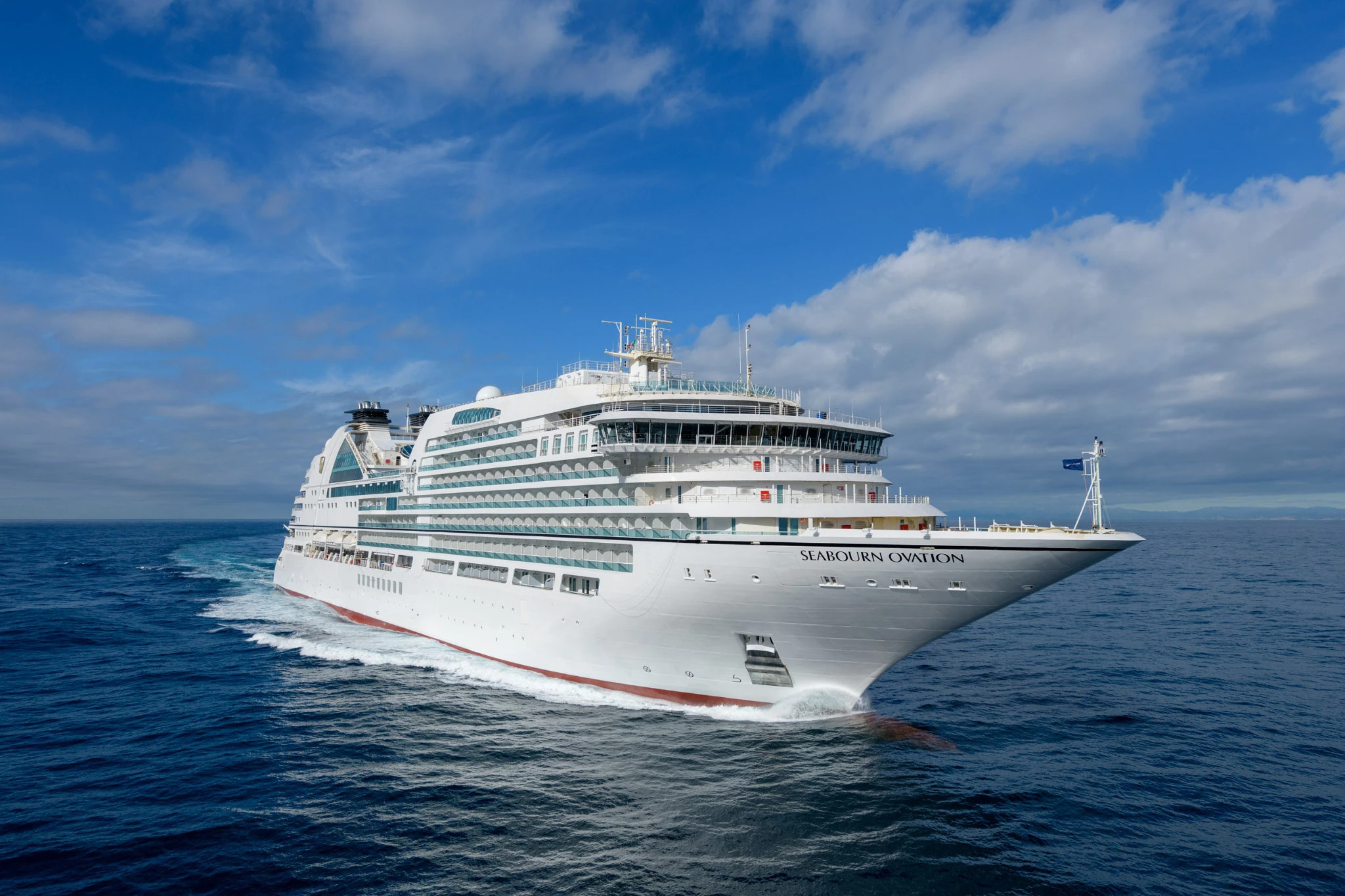
14 nightsFrom Athens (Piraeus), Greece12 ports of call
14-Day Adriatic Explorer: Italy, Greek Isles & Croatia
Seabourn · Seabourn Ovation
Overview
A 14-night voyage aboard Seabourn Ovation, departing Athens (Piraeus), Greece on 14 Jul 2029 and arriving in Dubrovnik, calling at 12 destinations along the way.
Athens (Piraeus), GreeceGythionIteaSami, Cephalonia, GreeceKotorDubrovnikKotorKoperRijekaHvarKorculaDubrovnik
Cabin prices
Live prices per person based on two sharing. Select a grade to see its fare options.
Loading live cabin prices…
Itinerary
14 nights · 15 ports of call- 1
Day 1 ·Piraeus (Athens), GreeceEmbark
14 Jul 2029Depart 20:00Piraeus has been the port for Athens since 482 BC. The busy harbor is filled with ferries and cruise ships making their way to the Greek Islands and other Mediterranean cities. The busy metropolis of Athens and its treasure trove of antiquities lie just a few miles from the port. Even as the reality of the modern city took hold, with its high-rise apartments, crowded sidewalks and bustling traffic, the beauty of the Acropolis, the outstanding museums, charming cafés, sidewalk markets and startling views come together in a cultural mosaic for all to enjoy. - 2
Day 2 ·Gythion (Sparta), Greece
15 Jul 2029Arrive 08:00Depart 18:00Gythion, the small port town for Sparta, edges its way up the hillside, which surrounds the harbor. According to Homer, Paris and Helen spent their first night together here, on a tiny islet in the bay. To commemorate the occasion, Paris erected a shrine to Aphrodite, goddess of love, only to have it torn down by the vengeful Menelaus after he recaptured Helen. In its place Menelaus erected statues honoring Praxidica (Punishment) and Themis (Justice). Not far away, at the tip of the Peloponnese, lies the Mani, a distinctive area unlike anything else in Greece. This desolate region of underground lakes and rivers and windswept landscapes is strangely beautiful. To the north of Gythion lie Sparta and Mystra, well worth a visit. - 3
Day 3 ·At Sea
16 Jul 2029 - 4
Day 4 ·Itea (Delphi), Greece
17 Jul 2029Arrive 08:00Depart 18:00Itea is a small bathing resort and port at the end of a bay not too far from the ancient port of Delphi. The hills are covered with olive trees belonging to the sanctuary of Apollo in ancient times. Referred to as a "sea of olives," their production is now an important part of the local economy. - 5
Day 5 ·Sami, Cephalonia, Greece
18 Jul 2029Arrive 08:00Depart 18:00Located on the east coast of Kefalonia, Sami is home to beautiful beaches and pleasant cafés and tavernas around the harbor that provide an ideal setting to soak up the traditional Greek atmosphere. Situated on a hill to the south of town are the ruins of ancient Sami, where visitors will find a fascinating site consisting of artifacts spanning several different civilizations over thousands of years. - 6
Day 6 ·Brindisi (Lecce), Italy
19 Jul 2029Arrive 08:00Depart 18:00Set on a peninsula between two arms of the Adriatic Sea, Brindisi was an important port of the Roman Empire, and later for the East India Company. In the 2nd century BC the Appian Way was built, linking the port to Rome, and a column near the harbor marks the end of that famous route. It is here that in 71 BC, the gladiator Spartacus led thousands of rebel slaves in an unsuccessful escape. Today visitors find Romanesque churches, a 13th-century castle and, in the surrounding Apulia region, remains of ancient Messapian culture. - 7
Day 7 ·Kotor, Montenegro
20 Jul 2029Arrive 08:00Depart 23:00One of the best preserved medieval towns of the Adriatic, Kotor is protected by UNESCO. Between 1420 and 1797, the area was under the rule of the Republic of Venice and the Venetian influence can be seen in its architecture. The Gulf of Kotor is sometimes called the southernmost fjord in Europe, although it is actually a submerged river canyon. The overhanging limestone cliffs of Orjen and Lovcen complete one of the Mediterranean's most beautiful landscapes. - 8
Day 8 ·Dubrovnik, Croatia
21 Jul 2029Arrive 07:00Depart 23:00Founded in the 7th century, Dubrovnik rose to greatness as a merchant state, independent republic and cultural crossroads. The traffic-free Old Town has been called a Croatian Athens. This UNESCO designated World Heritage Site is a living museum of the ages with fortifications, chapels, monastic cloisters and Europe's second-oldest synagogue crowded into its ancient walls. Relax at a sidewalk café, listen to the chimes of the 14th-century bell tower or join the promenade down the palace-lined avenue known as the Stradun. - 9
Day 9 ·Kotor, Montenegro
22 Jul 2029Arrive 07:00Depart 18:00One of the best preserved medieval towns of the Adriatic, Kotor is protected by UNESCO. Between 1420 and 1797, the area was under the rule of the Republic of Venice and the Venetian influence can be seen in its architecture. The Gulf of Kotor is sometimes called the southernmost fjord in Europe, although it is actually a submerged river canyon. The overhanging limestone cliffs of Orjen and Lovcen complete one of the Mediterranean's most beautiful landscapes. - 10
Day 10 ·At Sea
23 Jul 2029 - 11
Day 11 ·Koper, Slovenia
24 Jul 2029Arrive 07:00Depart 18:00Located on the tip of Istria, Slovenia's main port was an island until the 19th century, but local history goes back much further. Called Aegida by the Greeks, Capris by the Romans and Justinopolis in Byzantine times, Koper was the influential city in the Venetian Empire and five mayors sat on the throne of the Venetian doges. Today monuments of this Golden Age line the cobblestone streets of an Old Town that boasts a wealth of architecture, cultural monuments and intriguing shops. - 12
Day 12 ·Rijeka, Croatia
25 Jul 2029Arrive 08:00Depart 18:00Tucked into Kvarner Bay off the Dalmatian Coast of the Adriatic, Rijeka is Croatia’s premier seaport and third largest city. It is a mix of modern structures and grand old buildings from the heyday of the Austro-Hungarian Empire. The city skyline is dominated by the 13th century Trsat Castle, believed to be the oldest fortification on Croatia’s coast, and now a tourist visitor center. The traditional entry to the medieval city is the round, yellow City Tower with its 18th century clock. The Our Lady of Trsat Sanctuary has been a pilgrimage site since the 14th century, when a pope gifted the church with an icon of the Virgin, which still graces the altar. It can be reached by the 16th century Petar Kruzic Stairway, and also contains an extensive collection of sacral art and artifacts. The Habsburg-era Governor’s Palace hosts a Maritime and Historic Museum, and the unique, round St. Vitus Cathedral is from the same period. Stroll the main city market, the Placa, to get a feel of the city and its people. Although the city itself does not have much to offer in the way of beaches, it is the gateway to the fabulous Dalmatian islands playgrounds just offshore. - 13
Day 13 ·Hvar, Croatia
26 Jul 2029Arrive 08:00Depart 18:00Beautifully situated on a large natural bay, the ancient town of Hvar, on the island of the same name, served as an important harbor for Venice's Adriatic fleet from the 12th through the 18th centuries. Vestiges of this momentous time are reflected in the fortifications that still stand guard over the harbor, and in the very heart of the port, a large arsenal. Hvar today is a quiet spot reminiscent of the French Riviera at the turn-of-the-last-century. Sail and fishing boats bob and sway in the harbor and a 17th-century bell tower marks off the hours. Winding limestone lanes converge onto an expansive piazza, the largest in Dalmatia, which connects the older part of town to the ""modern"" side - that built after the 15th century. Inland, Hvar's green hills are woven with vineyards and lavender fields, and offshore tiny islets are scattered like pearls in a clear cobalt sea. - 14
Day 14 ·Korcula, Croatian Isle
27 Jul 2029Arrive 08:00Depart 18:00"The gods wanted to crown their creation so on the last day they turned tears, stars and the sea breeze into the isles of Kornati." Thus wrote George Bernard Shaw referring to the largest archipelago in the Mediterranean, the islands, islets, and reefs of the Dalmatian coast.
Korcula, the town and port on an island of the same name, could be called a Dubrovnik in miniature. Situated at the most strategic point of the island, along ancient sea trade routes, it has always attracted travellers and settlers. It is a window onto thousands of years of European culture; down through the centuries Hellenic, Roman, Illyrian, Croatian and Venetian civilizations have all left their mark. The Trojan hero Antenor was the legendary founder of the island, and it is well known as the birthplace of that great traveler, seaman, and explorer - Marco Polo.
Inside the town walls is a diversity of architecture which has remained untouched through the centuries. Wander through its narrow lanes, visit the gothic cathedral of St. Marco, take a peek at Marco Polo's birthplace, or climb one of the impressive towers built into the city walls. - 15
Day 15 ·Dubrovnik, CroatiaDisembark
28 Jul 2029Arrive 07:00Founded in the 7th century, Dubrovnik rose to greatness as a merchant state, independent republic and cultural crossroads. The traffic-free Old Town has been called a Croatian Athens. This UNESCO designated World Heritage Site is a living museum of the ages with fortifications, chapels, monastic cloisters and Europe's second-oldest synagogue crowded into its ancient walls. Relax at a sidewalk café, listen to the chimes of the 14th-century bell tower or join the promenade down the palace-lined avenue known as the Stradun.
Your ship: Seabourn Ovation
Explore Seabourn Ovation's cabins, dining and onboard facilities.