
21 nightsFrom Monte Carlo19 ports of call
21-Day Treasures Of The Riviera & Adriatic
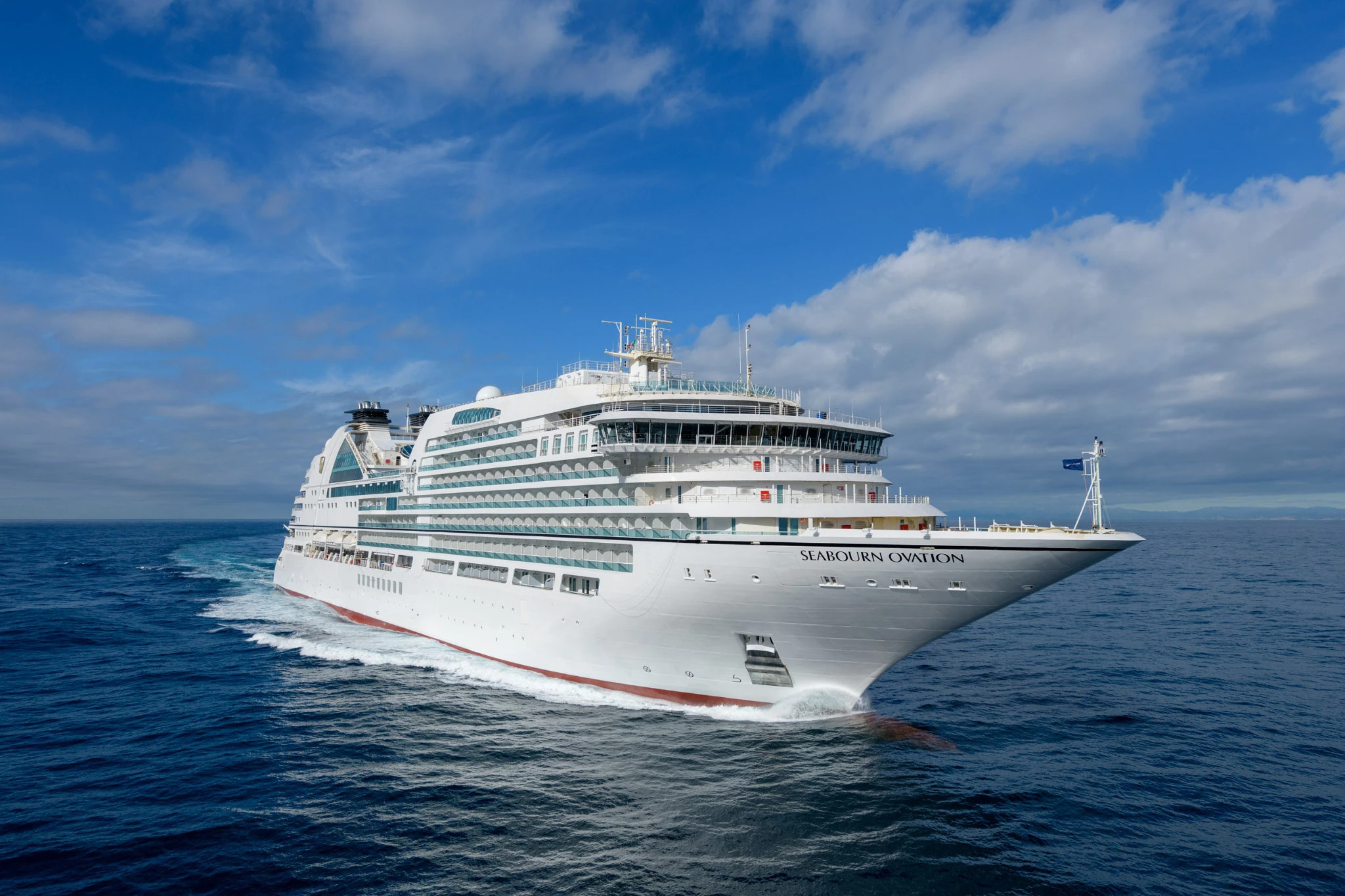
Seabourn · Seabourn Ovation
Overview
A 21-night voyage aboard Seabourn Ovation, departing Monte Carlo on 9 Jun 2029 and arriving in Venice (Fusina), Italy, calling at 19 destinations along the way.
Monte CarloPortofinoSt. Tropez, FranceSanary-Sur-Mer, FranceRoses, SpainMahon, SpainBarcelonaPalamosSete, FranceMarseille, FranceFrejus, FrancePortofinoCivitavecchia, RomeSorrentoLipari IslandsTrogirZadar, CroatiaRovinj, CroatiaVenice (Fusina), Italy
Cabin prices
Live prices per person based on two sharing. Select a grade to see its fare options.
Loading live cabin prices…
Itinerary
21 nights · 22 ports of call- 1
Day 1 ·Monte Carlo, MonacoEmbark
9 Jun 2029Depart 22:00The Principality of Monaco is the epitome of Riviera chic. This tiny enclave of 370 acres surrounds a sheltered harbor that draws yachts from around the world to enjoy the beautiful scenery, mild weather and elegant casino. Glamorous Monte Carlo is one of Monaco's four quarters, which also include La Condamine, the business district; Monaco-ville, the capital; and Fontvieille, an area built on reclaimed land. Ruled by Prince Albert II, Monaco has a population of over 32,000, of which about 16 percent are citizens, or Monégasques. - 2
Day 2 ·Portofino, Italy
10 Jun 2029Arrive 08:00Depart 18:00Portofino is a charming, popular resort village on the Italian Riviera, a favorite with artists and seasoned travelers. Situated on a beautiful bay, the surrounding mountains covered with dense vegetation of olive and cypress trees, form a unique setting of incomparable beauty. The ship will anchor in the bay and tenders will transport you to this tiny resort village, which is closed to vehicle traffic. Everything is concentrated around a small square offering an opportunity to stroll around on foot, shop, or just relax at one of the many open-air cafes. - 3
Day 3 ·St Tropez, France
11 Jun 2029Arrive 08:00Depart 18:00On the southern shore of one of the most beautiful bays of the Riviera, the little port of St. Tropez has become one of the best known resorts in Europe, a crossroads where journalists, photographers, writers, artists and celebrities meet. Guy de Maupassant discovered the town, but it was the painters who made it more widely known - Signac, Matisse, Bonnard, Marquet, Camoin - who all stayed for varying amounts of time. The harbor teems with life. Fishing boats, excursion craft and hundreds of yachts share the harbor. On the waterfront are old pink and yellow houses, which have been converted into cafes, cabarets and restaurants, luxury boutiques, galleries and antique shops. A picturesque and cosmopolitan crowd strolls the streets in season. - 4
Day 4 ·Sanary-Sur-Mer, France
12 Jun 2029Arrive 08:00Depart 18:00Along the Cote d'Azur, nothing is so rare as a genuine, old-fashioned fishing village. Strolling the inner harbour here, you'll see the men of the working fishing fleet going about their business as if they weren't a part of the world's most glamorous seacoast. Simply put, Sanary and her old streets and charming quay invite discovery. - 5
Day 5 ·Rosas (Roses), Spain
13 Jun 2029Arrive 08:00Depart 18:00Founded by Greeks in the pre-Christian era, the Catalan town is set on a lovely curve of beaches on Spain’s Costa Brava. It is crowned by the Castell de la Trinitat, which anchored the wall that encircled the entire town in medieval times. It was the site, until 2011, of Ferran Adria’s Michelin three-star restaurant El Bulli, which will reportedly reopen in 2014 as a culinary creativity center. Shop for a souvenir from the back of a street hawker’s donkey, or wander to nearby Figueres or Cadaques to visit one of Salvador Dali’s museums. - 6
Day 6 ·Mahon, Menorca, Spain
14 Jun 2029Arrive 08:00Depart 18:00Mahon is the capital of Menorca, second largest of the Balearic Islands. It stands out from the others because of the abundance of prehistoric structures, and because its culture was influenced by British occupation in the 18th century. The people who built the prehistoric constructions are believed to have been responsible for similar works in Sardinia, and for Stonehenge in England. Believed to have been founded by the Carthaginian General Mago, Mahon was held by the Moors from the 8th to the 13th century and in turn occupied by the English, the French and the Spanish. Mahon was finally ceded to Spain by the Treaty of Amiens in 1802. - 7
Day 7 ·At Sea
15 Jun 2029 - 8
Day 8 ·Barcelona, Spain
16 Jun 2029Arrive 07:00Depart 23:00Barcelona, the capital of Catalonia, is said to have been founded by the Phoenicians, and was once the rival of the powerful states of Venice and Genoa for control of the Mediterranean trade. Today, it is Spain's second largest city and has long rivaled, even surpassed Madrid in industry and commerce. The medieval atmosphere of the Gothic Quarter and the elegant boulevards combine to make the city one of Europe's most beautiful. Barcelona's active cultural life and heritage brought forth such greats as the architect Antonio Gaudi, the painter Joan Miro, and Pablo Picasso, who spent his formative years here. Other famous native Catalan artists include cellist Pau Casals, surrealist Salvador Dali, and opera singers Montserrat Caballe and Josep Carreras. Barcelona accomplished a long-cherished goal with the opportunity to host the Olympics in 1992. This big event prompted a massive building program and created a focal point of the world's attention. - 9
Day 9 ·Palamos, Spain
17 Jun 2029Arrive 08:00Depart 18:00Located at the foot of the mountains on Spain's rugged Costa Brava, Palamos boasts seven superb beaches, Iberian archeological remains from the year 6 BC, and the Church of Sant Esteve on the beach. Highlighting the town center is its 16th-century cathedral. - 10
Day 10 ·Sete, France
18 Jun 2029Arrive 08:00Depart 23:00The port town of Sete hugs the tiny Mont St. Clair, and is caught between the Mediterranean and the Bassin de Thau, a salt lake directly behind it. It is crisscrossed by numerous canals which link the lake to the sea, and connected by 12 bridges. Along the quay, renovated buildings provide a multitude of architectural details from the 18th and 19th centuries. The life of the town is found in its squares: Place Leon Blum, with its fountain and Wednesday morning flower market; Place Aristide, with its old fashioned bandstand; and Place de la Republique, with its huge retaining walls and vaulted loggias. Sete retains its historic purpose as a fishing boat haven for North African trade; the old harbor dates from the time of Louis XIV. - 11
Day 11 ·La Joliette (Marseille),France
19 Jun 2029Arrive 08:00Depart 18:00Marseille is the second largest city in France after Paris. It is also one of the oldest continuously inhabited cities in the Mediterranean. Cave paintings in the nearby Calanques are estimated to be 30,000 years old, and remains of brick habitations date from 6,000 BCE. The more recent history begins with a Hellenic port in about 600 BCE, some remains of which are on view at the city’s History Museum. It has been one of the world’s major seaports almost from its founding, and served as the main European terminus of the French colonial empire in Africa and the Far East. It is located in the Provence-Alpes-Cote d’Azur region and is the capital of the Bouches-du-Rhone department. On an island in the expansive bay of Marseille stands the prison of Chateau d’If made famous by the Alexandre Dumas novel “The Count of Monte Cristo.” The Vieux-Port with its atmospheric buildings and wharves is the area where visitors can search for the perfect example of the local specialty bouillabaisse, a rich fish stew containing at least three, and often more varieties of local fishes. Marseille’s newly renovated port at the venerable Joliette Docks is situated very close to the striking Cathédrale de la Major and the fascinating collections at the Museum of African, Oceanic and American Indian Arts. - 12
Day 12 ·Frejus, France
20 Jun 2029Arrive 08:00Depart 18:00Although today it is cut off from the sea, Fréjus was the second-largest naval port in the Roman empire in the 1st Century B.C. The town’s name descends from Forum Julii, the retirement center for the 8th Legion. The Roman ruins in the area are what draws most visitors today, and the massive pillars of the aqueducts, sections of walls and the crumbling remains of the tree-shaded theater and amphitheater are picturesquely situated and satisfying. In the town center, a central square faces the medieval stone cathedral and its adjacent cloisters, with impressive doors, handsomely carved woodwork and elaborate ceilings. Outside town, the 1889 Palladian Villa Aurelienne sits amid 60 acres of Mediterranean gardens. Fréjus suffered a terrible flood in 1959 when runoff from unprecedented rains swept down the mountains and broached the dam at Malpasset. The ruined site is a reminder of man’s fragility in the face of Nature’s power. On another hilltop, the small, octagonal Chapel of Notre Dame de Jerusalem is richly decorated with stained glass windows and colorful frescoes designed by the artist Jean Cocteau and completed after his death. - 13
Day 13 ·Portofino, Italy
21 Jun 2029Arrive 07:00Depart 18:00Portofino is a charming, popular resort village on the Italian Riviera, a favorite with artists and seasoned travelers. Situated on a beautiful bay, the surrounding mountains covered with dense vegetation of olive and cypress trees, form a unique setting of incomparable beauty. The ship will anchor in the bay and tenders will transport you to this tiny resort village, which is closed to vehicle traffic. Everything is concentrated around a small square offering an opportunity to stroll around on foot, shop, or just relax at one of the many open-air cafes. - 14
Day 14 ·At Sea
22 Jun 2029 - 15
Day 15 ·Civitavecchia (Rome), Italy
23 Jun 2029Arrive 07:00Depart 18:00Originally built by Emperor Trajan who had a villa here, Civitavecchia has flourished as a major port for Rome since the 13th century. Today it is an important ferry terminal and for many travelers the gateway to the Eternal City, Rome. The Renaissance fortifications that surround the harbor area were begun by Bramante and completed by Michelangelo in 1535. - 16
Day 16 ·Sorrento, Italy
24 Jun 2029Arrive 08:00Depart 18:00With an idyllic cliff-top location on the Bay of Naples, Sorrento has inspired legends for centuries. In Greek mythology, the Sirens were said to live here, luring sailors onto the rocks. Today, citrus trees scent the air and add zest to the city's limoncello liqueur. Sorrento is an ideal place to savor the local color, and to shop for embroidered linens, cameos and Capodimonte ceramics, all of which can be found in Old Town and along the pedestrian-only Via San Cesareo. - 17
Day 17 ·Lipari, Italy
25 Jun 2029Arrive 08:00Depart 18:00Lipari is the largest of the seven major islands making up the Aeolian Islands. They were originally named after Aeolus, the mythical god of wind who the ancients believed made his home in a cave here. Recently renamed the Lipari Islands, they were created by volcanic eruptions thousands of years ago and have a primitive rocky beauty accented by Mediterranean greenery. Their natural beauty and easy lifestyle have made the islands increasingly popular for those who wish to escape the modern world and its stresses. The crystal clear aqua-blue waters and the volcanic beaches are some of the most inviting in Italy. Many are inaccessible except by fishermens' boats. An abundance of fish and shell fish makes for some very good restaurants specializing in seafood. - 18
Day 18 ·At Sea
26 Jun 2029 - 19
Day 19 ·Trogir (Split), Croatia
27 Jun 2029Arrive 08:00Depart 18:00Trogir is a town on the central Adriatic coast of Croatia. Its preserved old town, known for its mix of Renaissance, baroque and Romanesque buildings, lies on a small island connected to the mainland and the island of Čiovo by bridges. The 13th-century Cathedral of St. Lawrence houses the Renaissance Chapel of St. John and offers sweeping views from its bell tower. Parts of the medieval city walls remain intact. - 20
Day 20 ·Zadar, Croatia
28 Jun 2029Arrive 08:00Depart 18:00Located in central Dalmatia Zadar is one of the Adriatic's most historically interesting towns with a wealth of sightseeing and exciting nightlife. Zadar was founded by the Romans, attacked by the Turks, ruled by the Austrians and made part of Italy until 1943 when the Germans moved in. Allied bombing destroyed much of the historic centre which was rebuilt after the war only to suffer more attacks by Yugoslav forces in 1991. In recent years Zadar has undergone a startling revival. Cafes and bars are filled, museums and churches have been restored and tourists pour in to take boats to nearby islands. - 21
Day 21 ·Rovinj, Croatia
29 Jun 2029Arrive 08:00Depart 18:00Nestled among the myriad islets of the Istrian coast in the Gulf of Venice, the charming harbor of Rovinj is comprised of candy-colored buildings, fringed with marinas and dominated by the fairytale spire of the Cathedral of Saint Euphemia, modeled on St. Marks' in Venice. The old town is a treasury of historic monuments - a 13th-century Romanesque baptistry, a baroque City Hall, and an 18th-century monastery - all tucked among cobbled streets that invite exploration. Known as the "Montmartre of Istria," this is an artists' colony with many galleries. - 22
Day 22 ·Fusina (Venice), ItalyDisembark
30 Jun 2029Arrive 07:00
Your ship: Seabourn Ovation
Explore Seabourn Ovation's cabins, dining and onboard facilities.