
16 nightsFrom Lisbon14 ports of call
16-Day Andalusian Gems, French & Italian Yacht Harbors
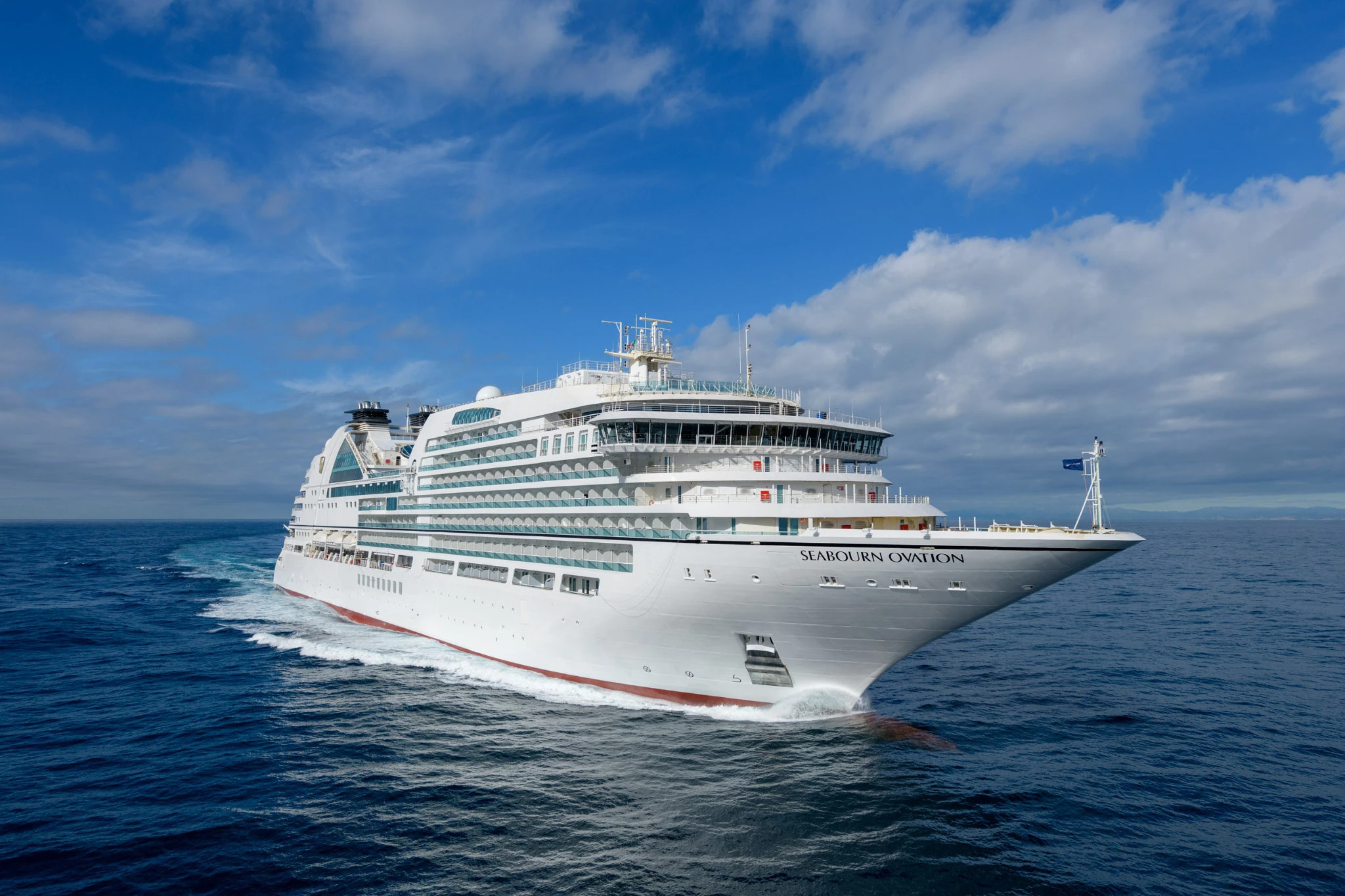
Seabourn · Seabourn Ovation
Overview
A 16-night voyage aboard Seabourn Ovation, departing Lisbon on 5 Apr 2029 and arriving in Civitavecchia, Rome, calling at 14 destinations along the way.
LisbonTangier, MoroccoMelillaCartagena, SpainCastellon de la PlanaMahon, SpainTarragonaBarcelonaPalamosSete, FranceMarseille, FranceFrejus, FrancePortofinoCivitavecchia, Rome
Cabin prices
Live prices per person based on two sharing. Select a grade to see its fare options.
Loading live cabin prices…
Itinerary
16 nights · 17 ports of call- 1
Day 1 ·Lisbon, PortugalEmbark
5 Apr 2029Depart 23:00The great period of "the Discoveries" accounted for phenomenal wealth brought back from India, Africa and Brazil by the great Portuguese navigators. Gold, jewels, ivory, porcelain and spices helped finance grand new buildings and impressive monuments in Lisbon, the country's capital city. As you sail up the Tagus River, be on deck to admire Lisbon's panorama and see some of the great monuments lining the river. Lisbon is one of Europe's smallest capital cities but considered by many visitors to be one of the most likeable. Spread over a string of seven hills, the city offers a variety of faces, including a refreshing no-frills simplicity reflected in the people as they go unhurriedly through their day enjoying a hearty and delicious cuisine accompanied by the country's excellent wines. - 2
Day 2 ·At Sea
6 Apr 2029 - 3
Day 3 ·Tangier, Morocco
7 Apr 2029Arrive 08:00Depart 23:00Situated just across the narrow Strait of Gibraltar from Europe, Tangier has long comprised a hybrid culture that is nearly as European as it is African. Standing atop Cap Spartel, one can gaze down on the place where the Atlantic meets the Mediterranean. The “Hollywood” district where the foreign embassies have traditionally been located reflects the European influence. But ascending the hill above the waterfront, one enters the narrow, winding alleys of the Kasbah, the city’s oldest, most Moroccan section. Down the coast, nearby Tetouan retains a nearly untouched walled medina, with sections originally occupied by Andalusian, Berber and Jewish populations. It is small enough that visitors can explore it without risking becoming lost, making it a perfect choice as a UNESCO World Heritage Site. - 4
Day 4 ·Puerto Banus, Spain
8 Apr 2029Arrive 08:00Depart 18:00 - 5
Day 5 ·Melilla, Spanish Morocco, Spain
9 Apr 2029Arrive 08:00Depart 18:00 - 6
Day 6 ·Cartagena, Spain
10 Apr 2029Arrive 08:00Depart 18:00Founded by Carthaginians in the third century BC, this ancient Mediterranean port city exemplifies the region's tumultuous history. Romans, Visigoths, Castilians and Moors have all left their marks. Under King Philip II, Cartagena's naturally deep, sheltered harbor was developed into the nation's premier naval base, a position it still enjoys today. Ancient ramparts remain, as does a lighthouse erected in Moorish times. - 7
Day 7 ·Castellon de la Plana, Spain
11 Apr 2029Arrive 07:00Depart 17:00 - 8
Day 8 ·Mahon, Menorca, Spain
12 Apr 2029Arrive 09:00Depart 18:00Mahon is the capital of Menorca, second largest of the Balearic Islands. It stands out from the others because of the abundance of prehistoric structures, and because its culture was influenced by British occupation in the 18th century. The people who built the prehistoric constructions are believed to have been responsible for similar works in Sardinia, and for Stonehenge in England. Believed to have been founded by the Carthaginian General Mago, Mahon was held by the Moors from the 8th to the 13th century and in turn occupied by the English, the French and the Spanish. Mahon was finally ceded to Spain by the Treaty of Amiens in 1802. - 9
Day 9 ·Tarragona, Spain
13 Apr 2029Arrive 08:00Depart 23:00This quaint city on the Costa Dorada recalls the glory of the Roman Empire, and promises rich classical remains- she does not disappoint. Its ancient amphitheatre, circus and walls are clustered high on a hill, with a beautiful beach hidden below. As capital of the Roman province of Tarraconensis (from 218 BC), Tarraco, as it was then called, formed the empire's principal stronghold in Spain. Tarragona hosted the 1993 World Archaeology Conference and is clearly divided into old and new by the wide Rambla Vella boulevard. - 10
Day 10 ·Barcelona, Spain
14 Apr 2029Arrive 07:00Depart 23:00Barcelona, the capital of Catalonia, is said to have been founded by the Phoenicians, and was once the rival of the powerful states of Venice and Genoa for control of the Mediterranean trade. Today, it is Spain's second largest city and has long rivaled, even surpassed Madrid in industry and commerce. The medieval atmosphere of the Gothic Quarter and the elegant boulevards combine to make the city one of Europe's most beautiful. Barcelona's active cultural life and heritage brought forth such greats as the architect Antonio Gaudi, the painter Joan Miro, and Pablo Picasso, who spent his formative years here. Other famous native Catalan artists include cellist Pau Casals, surrealist Salvador Dali, and opera singers Montserrat Caballe and Josep Carreras. Barcelona accomplished a long-cherished goal with the opportunity to host the Olympics in 1992. This big event prompted a massive building program and created a focal point of the world's attention. - 11
Day 11 ·Palamos, Spain
15 Apr 2029Arrive 08:00Depart 18:00Located at the foot of the mountains on Spain's rugged Costa Brava, Palamos boasts seven superb beaches, Iberian archeological remains from the year 6 BC, and the Church of Sant Esteve on the beach. Highlighting the town center is its 16th-century cathedral. - 12
Day 12 ·Sete, France
16 Apr 2029Arrive 08:00Depart 23:00The port town of Sete hugs the tiny Mont St. Clair, and is caught between the Mediterranean and the Bassin de Thau, a salt lake directly behind it. It is crisscrossed by numerous canals which link the lake to the sea, and connected by 12 bridges. Along the quay, renovated buildings provide a multitude of architectural details from the 18th and 19th centuries. The life of the town is found in its squares: Place Leon Blum, with its fountain and Wednesday morning flower market; Place Aristide, with its old fashioned bandstand; and Place de la Republique, with its huge retaining walls and vaulted loggias. Sete retains its historic purpose as a fishing boat haven for North African trade; the old harbor dates from the time of Louis XIV. - 13
Day 13 ·La Joliette (Marseille),France
17 Apr 2029Arrive 08:00Depart 18:00Marseille is the second largest city in France after Paris. It is also one of the oldest continuously inhabited cities in the Mediterranean. Cave paintings in the nearby Calanques are estimated to be 30,000 years old, and remains of brick habitations date from 6,000 BCE. The more recent history begins with a Hellenic port in about 600 BCE, some remains of which are on view at the city’s History Museum. It has been one of the world’s major seaports almost from its founding, and served as the main European terminus of the French colonial empire in Africa and the Far East. It is located in the Provence-Alpes-Cote d’Azur region and is the capital of the Bouches-du-Rhone department. On an island in the expansive bay of Marseille stands the prison of Chateau d’If made famous by the Alexandre Dumas novel “The Count of Monte Cristo.” The Vieux-Port with its atmospheric buildings and wharves is the area where visitors can search for the perfect example of the local specialty bouillabaisse, a rich fish stew containing at least three, and often more varieties of local fishes. Marseille’s newly renovated port at the venerable Joliette Docks is situated very close to the striking Cathédrale de la Major and the fascinating collections at the Museum of African, Oceanic and American Indian Arts. - 14
Day 14 ·Frejus, France
18 Apr 2029Arrive 08:00Depart 18:00Although today it is cut off from the sea, Fréjus was the second-largest naval port in the Roman empire in the 1st Century B.C. The town’s name descends from Forum Julii, the retirement center for the 8th Legion. The Roman ruins in the area are what draws most visitors today, and the massive pillars of the aqueducts, sections of walls and the crumbling remains of the tree-shaded theater and amphitheater are picturesquely situated and satisfying. In the town center, a central square faces the medieval stone cathedral and its adjacent cloisters, with impressive doors, handsomely carved woodwork and elaborate ceilings. Outside town, the 1889 Palladian Villa Aurelienne sits amid 60 acres of Mediterranean gardens. Fréjus suffered a terrible flood in 1959 when runoff from unprecedented rains swept down the mountains and broached the dam at Malpasset. The ruined site is a reminder of man’s fragility in the face of Nature’s power. On another hilltop, the small, octagonal Chapel of Notre Dame de Jerusalem is richly decorated with stained glass windows and colorful frescoes designed by the artist Jean Cocteau and completed after his death. - 15
Day 15 ·Portofino, Italy
19 Apr 2029Arrive 07:00Depart 18:00Portofino is a charming, popular resort village on the Italian Riviera, a favorite with artists and seasoned travelers. Situated on a beautiful bay, the surrounding mountains covered with dense vegetation of olive and cypress trees, form a unique setting of incomparable beauty. The ship will anchor in the bay and tenders will transport you to this tiny resort village, which is closed to vehicle traffic. Everything is concentrated around a small square offering an opportunity to stroll around on foot, shop, or just relax at one of the many open-air cafes. - 16
Day 16 ·At Sea
20 Apr 2029 - 17
Day 17 ·Civitavecchia (Rome), ItalyDisembark
21 Apr 2029Arrive 07:00Originally built by Emperor Trajan who had a villa here, Civitavecchia has flourished as a major port for Rome since the 13th century. Today it is an important ferry terminal and for many travelers the gateway to the Eternal City, Rome. The Renaissance fortifications that surround the harbor area were begun by Bramante and completed by Michelangelo in 1535.
Your ship: Seabourn Ovation
Explore Seabourn Ovation's cabins, dining and onboard facilities.