
28 nightsFrom Lisbon21 ports of call
28-Day Normandy'S Shores, Spain & Norway'S North Cape
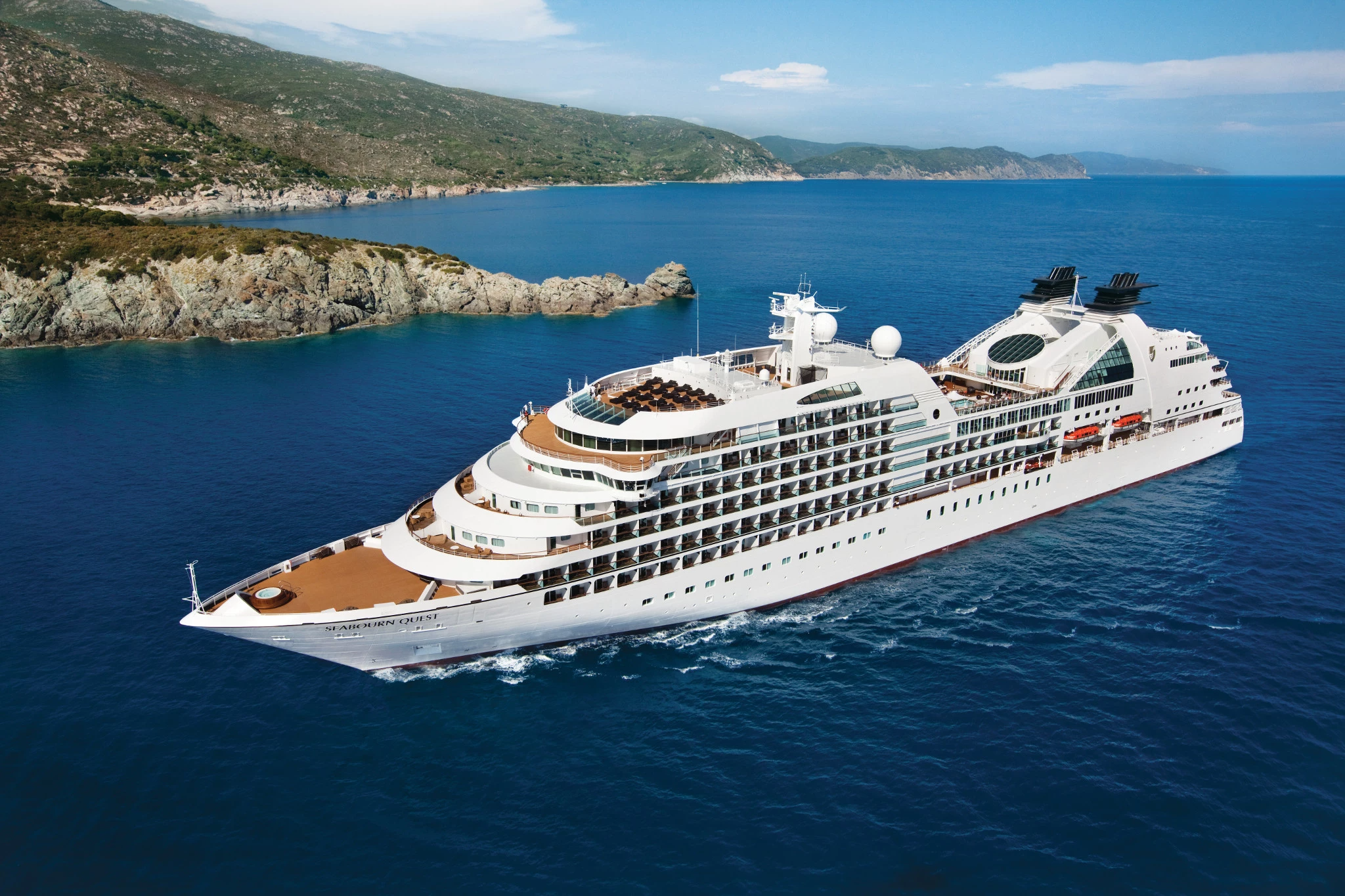
Seabourn · Seabourn Quest
Overview
A 28-night voyage aboard Seabourn Quest, departing Lisbon on 26 May 2029 and arriving in Copenhagen, Denmark, calling at 21 destinations along the way.
LisbonLeixoes, PortugalLa Coruna, SpainGijonBilbaoBordeauxSt Malo, FranceRouen, FranceHonfleurCherbourgPortsmouth,DominicaDover, UKStavanger, NorwayFloro/KinnBronnoysundSvolvaerTromso, NorwayAlta, NorwayHonningsvag, NorwaySkagenCopenhagen, Denmark
Cabin prices
Live prices per person based on two sharing. Select a grade to see its fare options.
Loading live cabin prices…
Itinerary
28 nights · 29 ports of call- 1
Day 1 ·Lisbon, PortugalEmbark
26 May 2029Depart 17:00The great period of "the Discoveries" accounted for phenomenal wealth brought back from India, Africa and Brazil by the great Portuguese navigators. Gold, jewels, ivory, porcelain and spices helped finance grand new buildings and impressive monuments in Lisbon, the country's capital city. As you sail up the Tagus River, be on deck to admire Lisbon's panorama and see some of the great monuments lining the river. Lisbon is one of Europe's smallest capital cities but considered by many visitors to be one of the most likeable. Spread over a string of seven hills, the city offers a variety of faces, including a refreshing no-frills simplicity reflected in the people as they go unhurriedly through their day enjoying a hearty and delicious cuisine accompanied by the country's excellent wines. - 2
Day 2 ·Leixoes (Porto), Portugal
27 May 2029Arrive 08:00Depart 17:00The commercial center of northern Portugal and hub of the port wine trade, Porto is a gracious, cosmopolitan city noted for its 12th century cathedral and medieval churches, picturesque narrow streets and wine lodges at Vila Nova de Gaia. It is clustered on hills overlooking a river, and is a northern European style city with granite church towers, narrow streets and hidden Baroque treasures. - 3
Day 3 ·A Coruna, Spain
28 May 2029Arrive 10:00Depart 20:00A Coruna is the largest Galician city with a culture uniquely its own, a rich folkloric tradition and its own language. Of historically remote origin, A Coruna has preserved a considerable heritage of monuments and ancient buildings, among which are Romanesque churches and a Roman lighthouse. Its most beautiful and original feature is perhaps the characteristic façade of its houses, which are completely covered by mirador windows. - 4
Day 4 ·Gijon, Spain
29 May 2029Arrive 08:00Depart 18:00This ancient port city on the green Atlantic coast of Spain has a history of some 3,000 years. From its humble beginnings the city has grown to become an important port city in Spain. Its old historic fishing village Cimadevilla with its picturesque cobble stoned streets and old-world architecture remains today its main tourist attraction. - 5
Day 5 ·Bilbao, Spain
30 May 2029Arrive 07:00Depart 17:00Straddling the banks of an estuary opening into the Bay of Biscay, Bilbao is the largest city in Spain’s northeastern Basque Country. Its earliest beginnings are preserved in the Casco Viejo, seven medieval streets that used to be guarded by walls. There visitors will find the city’s old churches, a large market, a public theater and the Academy of the Basque Language. Nearby sources of iron ore made Bilbao an important industrial and shipping center from the 14th century onward. The Spanish Civil War also started here. Today the city is being transformed by a growing service economy, and its prominence on the global traveler’s radar may be dated from the 1997 inauguration of the striking Frank Gehry-designed Guggenheim Museum Bilbao. In fact, the estuary town has become a veritable magnet for architects, boasting notable masterworks including Santiago Calatrava’s beautiful Zubizuri (“White Bridge” in Basque) and airport complex, the 541-foot Iberdrola Tower by the Argentine Cesar Pelli, a subway system by Norman Foster, the 1909 wine warehouse called Alhóndiga, converted a century later by designer Philippe Starck and the Euskalduna Conference Centre and Concert Hall by Federico Soriano and Dolores Palacios. The Zorrozuarre area is also being redeveloped, following a 2007 master plan by the Iraqi architect Zaha Hadid. For views of all of this, take the funicular from the city center to the top of Mt. Artxanda, where a sports complex, restaurants and a balcony await you. - 6
Day 6 ·Bordeaux, France
31 May 2029Arrive 11:30Bordeaux is the starting point for many exciting excursions into the surrounding wine country. The patricians of Bordeaux have always been merchants and shipbuilders. Under the Romans the city had a flourishing trade with Spain and Britain. In 1154, as a part of the dowry of Eleanor of Aquitaine, it became English and remained so until 1453. In the 18th century, Bordeaux prospered from the slave trade, and later in commerce with French colonies in Africa. Since Roman times the quality of the region's vines and wines has been zealously maintained. - 7
Day 7 ·Bordeaux, France
1 Jun 2029Depart 22:15Bordeaux is the starting point for many exciting excursions into the surrounding wine country. The patricians of Bordeaux have always been merchants and shipbuilders. Under the Romans the city had a flourishing trade with Spain and Britain. In 1154, as a part of the dowry of Eleanor of Aquitaine, it became English and remained so until 1453. In the 18th century, Bordeaux prospered from the slave trade, and later in commerce with French colonies in Africa. Since Roman times the quality of the region's vines and wines has been zealously maintained. - 8
Day 8 ·At Sea
2 Jun 2029 - 9
Day 9 ·St Malo (Le Mont Saint Michel), France
3 Jun 2029Arrive 09:30Depart 20:30Saint-Malo is a port city in Brittany, in France's northwest. Tall granite walls surround the old town, which was once a stronghold for privateers (pirates approved by the king). The Saint-Malo Cathedral, in the center of the old town, is built in Romanesque and Gothic styles and features stained-glass windows depicting city history. Nearby is La Demeure de Corsaire, an 18th-century privateer’s house and museum. - 11
Day 11 ·Rouen (Paris), France
4 Jun 2029Arrive 20:30The capital of upper Normandy and fifth largest port in France, picturesque and historic Rouen is renowned as a treasury of medieval architecture. With a large part of the city destroyed during World War II resulting in massive postwar reconstruction, Rouen today appears as an interesting blend of ancient and modern. Fortunately, it has kept its medieval character with still-inhabited houses dating from the 15th century, which line its narrow cobblestone streets. Among the city's most noteworthy attractions are the magnificent Cathedrale Notre-Dame built during the 13th century, and the famous Gros-Horloge, a giant Renaissance clock looming over the renowned pedestrian street of the same name. Two blocks away is the Place du Vieux Marche, or old market square, where Joan of Arc was burned at the stake in 1431. She is publicly commemorated at the site on the last Sunday of each May. The "City of a Hundred Spires" as Rouen is known, was an inspiration for Monet's impressionistic cathedral paintings. Rouen also makes an excellent point of departure for a visit to Paris, the "City of Light." - 11
Day 11 ·Rouen (Paris), France
5 Jun 2029Depart 23:00The capital of upper Normandy and fifth largest port in France, picturesque and historic Rouen is renowned as a treasury of medieval architecture. With a large part of the city destroyed during World War II resulting in massive postwar reconstruction, Rouen today appears as an interesting blend of ancient and modern. Fortunately, it has kept its medieval character with still-inhabited houses dating from the 15th century, which line its narrow cobblestone streets. Among the city's most noteworthy attractions are the magnificent Cathedrale Notre-Dame built during the 13th century, and the famous Gros-Horloge, a giant Renaissance clock looming over the renowned pedestrian street of the same name. Two blocks away is the Place du Vieux Marche, or old market square, where Joan of Arc was burned at the stake in 1431. She is publicly commemorated at the site on the last Sunday of each May. The "City of a Hundred Spires" as Rouen is known, was an inspiration for Monet's impressionistic cathedral paintings. Rouen also makes an excellent point of departure for a visit to Paris, the "City of Light." - 12
Day 12 ·Honfleur, France
6 Jun 2029Arrive 05:30Depart 18:00Colorful Honfleur, located on the Seine estuary, epitomizes Normandy for many people. Birthplace of impressionism and of romanticism, this picturesque port acquired its stature through maritime relations with the Americas: it was from here that Samuel de Champlain and Cavelier de la Salle set sail. Today Honfleur is one of the most popular vacation spots in northern France. During the summer the town is packed with scores of visitors who come to enjoy this living museum of half-timbered houses and cobbled streets. The 17th century harbor is fronted on one side by two-story stone houses with low, sloping roofs and on the other by tall, narrow buildings whose wooden fa\ccades are topped by slate roofs. A rich collection of pre-impressionist and contemporary paintings by Norman artists can be found in the Eugene Boudin Museum. The Maritime Museum features interesting exhibits of model ships and maritime objects which bear witness to seafarers of past centuries. A striking site in the town center is the wooden St. Catherine's Church and its separate bell tower covered by unique chestnut-wood shingles. A number of narrow cobblestone streets lead off from the center square, each one a delightful surprise and an irresistible temptation for the avid photographer. - 13
Day 13 ·Cherbourg (Normandy), France
7 Jun 2029Arrive 07:00Depart 18:00The seaport and naval station of Cherbourg is situated along the English Channel northwest of Paris at the mouth of the Divette River. Believed to rest on the site of an ancient Roman station, Cherbourg has been occupied since ancient times and was frequently contested by the French and English in the Middle Ages because of its strategic location. Most recently passed to France in the late 18th century, the town was extensively fortified by Louis XVI. During WWII the Germans held Cherbourg until it was captured by the American forces shortly after the Normandy landings. Following a vast rehabilitation program that returned it to working condition, Cherbourg became an important Allied supply port. Today, Cherbourg is important for transatlantic shipping, shipbuilding, electronics and telephone equipment manufacturing, yachting and commercial fishing. - 14
Day 14 ·Portsmouth, UK
8 Jun 2029Arrive 07:00Depart 17:00Portsmouth is a port city and naval base on England’s south coast, mostly spread across Portsea Island. It’s known for its maritime heritage and Portsmouth Historic Dockyard. The dockyard is home to the interactive National Museum of the Royal Navy, the wooden warship HMS Victory, where Nelson died in the Battle of Trafalgar, and HMS Warrior 1860. The Tudor ship Mary Rose is also conserved in a dockyard museum. - 15
Day 15 ·Dover (London), England
9 Jun 2029Arrive 07:00Depart 17:00Crossing the English Channel from continental Europe to Great Britain, the first view of England is the milky-white strip of land called the White Cliffs of Dover. As you get closer, the coastline unfolds before you in all its striking beauty. White chalk cliffs with streaks of black flint rise straight from the sea to a height of 350’ (110 m).
Numerous archaeological finds reveal people were present in the area during the Stone Age. Yet the first record of Dover is from Romans, who valued its close proximity to the mainland. A mere 21 miles (33 km) separate Dover from the closest point in France. A Roman-built lighthouse in the area is the tallest Roman structure still standing in Britain. The remains of a Roman villa with the only preserved Roman wall mural outside of Italy are another unique survivor from ancient times which make Dover one of a kind. - 16
Day 16 ·At Sea
10 Jun 2029 - 17
Day 17 ·Stavanger, Norway
11 Jun 2029Arrive 08:00Depart 17:00A Romanesque cathedral and old medieval lanes blend beautifully with Stavanger's modern city and spectacular countryside. In 872, when Harald Fairhair won the Battle of Hafrsfjord near Stavanger, he united Norway for the first time. Huge harvests of brisling, herring and sardines have made the key of a sardine can the city symbol. Today, the town is the center of Norway's oil industry, and has become one of the country's most cosmopolitan cities. - 18
Day 18 ·Floro, Norway
12 Jun 2029Arrive 09:00Depart 18:00Florø is a town and the administrative centre of Kinn Municipality in Vestland county, Norway. The town was founded by royal decree in 1860 as a ladested on the island of Florelandet, located between the Botnafjorden and Solheimsfjorden. Florø is Norway's westernmost town. - 19
Day 19 ·Froya, Norway
13 Jun 2029Arrive 09:00Depart 18:00 - 20
Day 20 ·Bronnoysund, Norway
14 Jun 2029Arrive 07:00Depart 17:00A coastal city, Brønnøysund’s origin dates back to its 13th century Viking heritage. In the intervening centuries, it has been settled by immigrants from southern Norway and Sweden, and its local Swedish-like dialect still carries echoes of this past.
Brønnøysund sits on a narrow peninsula from the mainland, is surrounded by waterways dotted with a maze of small scenic islands. In this fairytale setting, picturesque, colorful houses are set amidst thick lush greenery, turquoise blue water and shallow bays. Towering above the town like a giant troll’s hat is the massive granitic monolith of Torghatten Mountain. Here can be found one of the great natural curiosities of the area, a 520’ (160 m) hole piercing completely through the center of the mountain. The Viking sagas surmised that it was the impact of a warrior horseman’s arrow that created the wound. However, it was actually formed during the last Ice Age by erosion from ice and water. - 21
Day 21 ·Svolvaer (Lofoten), Norway
15 Jun 2029Arrive 08:00Depart 17:00Huddled together in what appears to be a wall of solid rock, the Lofotens are actually several islands. Their scenery, revealed when the ice disappeared from the last Ice Age, is held to be among the most dramatic in Norway. Svolvaer, located on the island of Austvaagoey, received town status in 1996, and is the Lofotens' most important city with about 4,500 residents. Dominating the town is the mountain peak called Svolvaergeita, a beacon for climbers. Fishermen flock here when the Norwegian Arctic cod enters the Vestfjord to spawn. Artists prize the picturesque setting and extraordinary light conditions. - 22
Day 22 ·Tromso, Norway
16 Jun 2029Arrive 10:00Depart 22:00Many a polar expedition has begun from Tromso. The town was founded in 1794, but its roots go back to Hanseatic and, even earlier to Viking times. Situated inside the Arctic Circle on the forest-clad island of Troms, this spirited city is linked to the mainland by the spectacular Tromsobrua Bridge, built in 1960. During WWII, Tromso was one of the few places in northern Norway to escape bombing, and a number of old wood buildings still remain. At the Tromso Museum, the exhibits include an extensive display on the people of Lapland. The town also boasts both the world's northernmost university and brewery. - 23
Day 23 ·Alta, Norway
17 Jun 2029Arrive 08:00Depart 22:00Alta is a town on Norway’s northern coast, at the head of Alta Fjord. It’s known for views of the Northern Lights, which inspired the cascading architecture of the Northern Lights Cathedral, built in 2013. Thousands of prehistoric rock carvings are at nearby Hjemmeluft Bay, where there are viewing paths and the World Heritage Rock Art Centre. South of town, the Alta River runs through steep Alta Canyon. - 24
Day 24 ·Honningsvag, Norway
18 Jun 2029Arrive 08:00Depart 18:00The perpendicular cliffs of Nordkapp, or the North Cape, mark the very top of the European continent. This ultimate destination has long drawn adventurous royalty including Oscar II, King of Norway and Sweden, who visited in 1873, and followed by the King of Siam in 1907. The North Cape is located on the island of Mageroey, a name derived from a word that means "meager." While the landscape may have a lunar appearance, it is not really so isolated. Just 21 miles away, the main town, Honningsvåg, has some 4,000 inhabitants. In summer that number swells when the Sami people and their reindeer settle on the outskirts of town. - 25
Day 25 ·At Sea
19 Jun 2029 - 26
Day 26 ·At Sea
20 Jun 2029 - 27
Day 27 ·At Sea
21 Jun 2029 - 28
Day 28 ·Skagen, Denmark
22 Jun 2029Arrive 09:00Depart 18:00At the tip of the flat, sandy Jutland peninsula, Skagen is Denmark’s northernmost town and a popular holiday destination for Danes. It was long Denmark’s most important fishing port, but its popularity as a recreation area began at the end of the 19th Century when Queen Alexandrine, the wife of King Christian X, fell in love with the rustic character of the place and built the summer residence Klitgaarden. The royal couple invited other Scandinavian and European royalty to share holidays with them and Skagen’s reputation grew. At the same time, the Skagensbanen railway made travel to Jutland easier. Impressionist artists were attracted by the exotic sand- and seascapes and the vivid light reflected from the sea, and a school of Skagen Painters thrived in the first quarter of the 20th century. Arts and crafts still remain an important local tradition, and the town has many shops and galleries offering handmade goods to visitors. There is a venerable lighthouse near the peninsula’s tip, where the North Sea and the Baltic Sea meet, but due to their differing densities, their margins can clearly be seen. A St. Lawrence’s Church was built in Skagen in the 14th century, but it was eventually inundated by drifting sand dunes. The Skagen Church of today was built in 1841. - 29
Day 29 ·Copenhagen, DenmarkDisembark
23 Jun 2029Arrive 07:00Denmark's capital is arguably one of the world's best-loved cities, and certainly the liveliest of all the Scandinavian capitals. It is a gracious and comfortable place, with a decidedly friendly, hospitable and fun-loving atmosphere. If there is such a thing as a cozy city, Copenhagen is it. From the lingering memory of the tales of Hans Christian Andersen to the colored lights of Tivoli Gardens, there is a delightful ambience that surrounds the visitor everywhere. Tidy, narrow streets are lined with tempting restaurants and cafes, and the pedestrian-only Stroget abounds with stylish shops. The spirited Copenhageners are imaginative and unconventional and exude a "do-what-you-want" philosophy that embraces and respects almost all aspects of life. Every friendly Dane you meet further illustrates the city's motto "Wonderful, wonderful, Copenhagen."
Your ship: Seabourn Quest
Explore Seabourn Quest's cabins, dining and onboard facilities.