
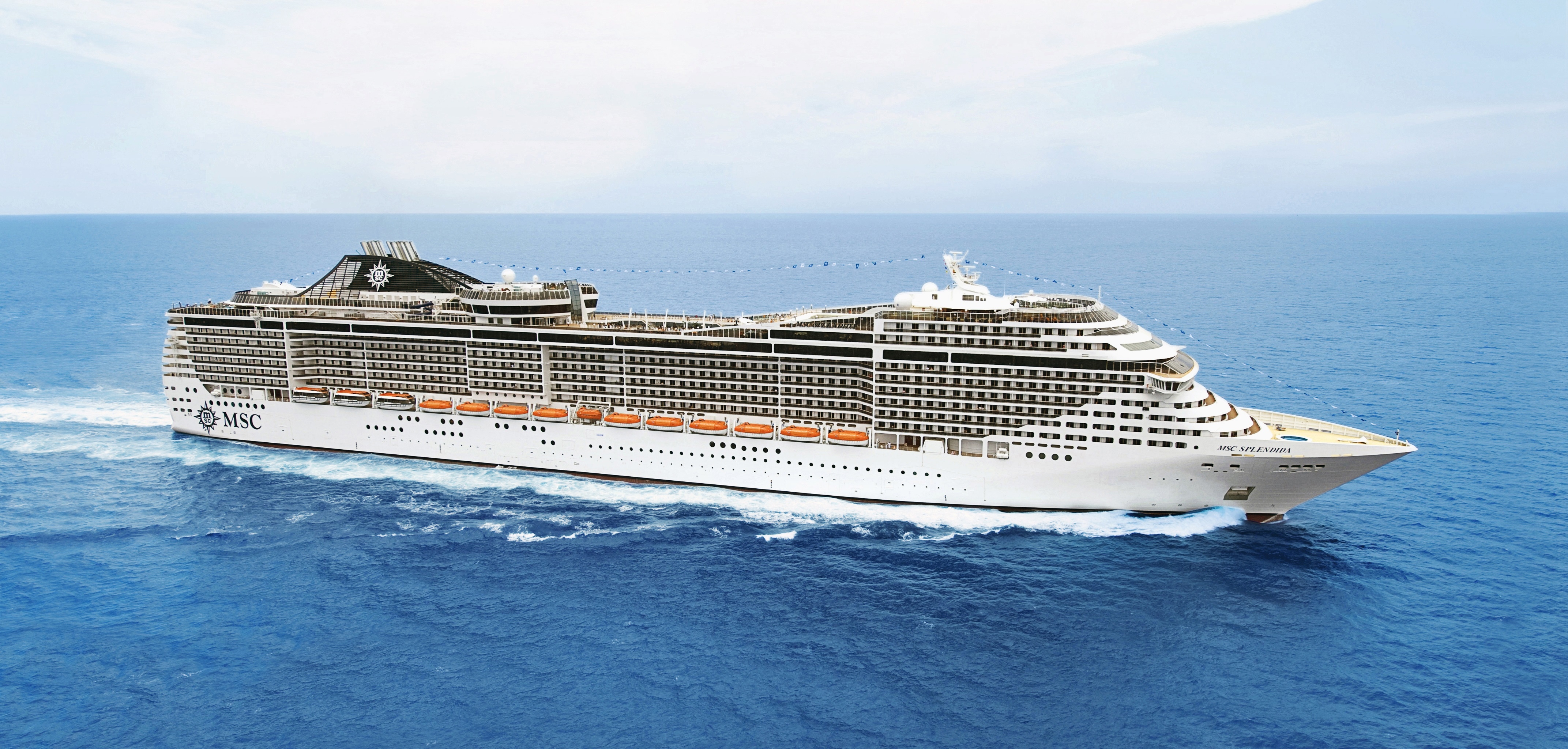
24 nightsFrom Buenos Aires12 ports of call
24 nights South America from Buenos Aires
MSC Cruises · MSC Splendida
Overview
A 24-night voyage aboard MSC Splendida, departing Buenos Aires on 1 Apr 2028 and arriving in Warnemunde, calling at 12 destinations along the way.
Buenos AiresRio de JaneiroLas Palmas,Gran CanariaArrecife, Lanzarote, Canary IslandsFunchalCadizLa Coruna, SpainBilbaoLa Rochelle, FranceBrestCherbourgWarnemunde
Cabin prices
Live prices per person based on two sharing. Select a grade to see its fare options.
Loading live cabin prices…
Itinerary
24 nights · 25 ports of call- 1
Day 1 ·Buenos AiresEmbark
1 Apr 2028Depart 17:00Buenos Aires is a must-see on your MSC South America cruise to Argentina. Its heart is the spacious, palm-dotted Plaza de Mayo, the ideal place to begin a tour of the area and explore its historical and political connections; its mismatched medley of buildings includes the famous Casa Rosada, or government house.
An amble westwards from the plaza will take you along Avenida de Mayo, the city’s major boulevard, offering an impressive display of Art Nouveau and Art Decoarchitecture. At its western end, Avenida de Mayo opens onto the Plaza del Congreso, presided over by the Congreso Nacional building, the seat of the federal parliament.
Casa Rosada, a typically Argentine blend of French and Italian Renaissance styles, stands on the site of the city’s Spanish fort, begun in 1594 and converted in 1776 to the viceroy’s palace. In 1862, President Bartolomé Mitre moved the government ministries to the building, remodelling it once again.
The final touch was added in 1885, when the central arch was added, unifying the facade. Behind the Casa Rosada, the Plaza Colón features a gigantic Argentine flag and a Carrara marble statue of Christopher Columbus, looking out to the river and towards the Old World.
MSC South America cruises also offer excursions to the north of Buenos Aires, where the four residential barrios of most interest to visitors – Retiro, Recoleta, Palermo and Belgrano – each retain a distinctive character. Nearest to the centre, Retiro and Recoleta – known jointly as Barrio Norte – have chic streets lined with boutiques, art galleries and smart cafés. Recoleta is associated primarily with its magnificent cemetery where, among other national celebrities, Evita is buried.
Both barrios also share an extraordinary concentration of French-style palaces, tangible proof of the obsession of the city’s elite at the beginning of the twentieth century with established European cities - 2
Day 2 ·At Sea
2 Apr 2028 - 3
Day 3 ·At Sea
3 Apr 2028 - 4
Day 4 ·Rio de Janeiro
4 Apr 2028Arrive 08:00Depart 17:00As you’ll be able to appreciate when you cruise the Atlantic Ocean with MSC Cruises, in its position on the southern shore of the magnificent Guanabara Bay, Rio de Janeiro has, without a shadow of a doubt, one of the most stunning settings in the world.
Extending for 20km along an alluvial strip, between an azure sea and forest-clad mountains, the city’s streets and buildings have been moulded around the foothills of the mountain range that provides its backdrop, while out in the bay there are many rocky islands fringed with white sand.
The aerial views over Rio are breathtaking, and even the concrete skyscrapers that dominate the city’s skyline add to the attraction. As the former capital of Brazil and now its second-largest city, Rio has a remarkable architectural heritage, some of the country’s best museums and galleries, superb restaurants and a vibrant nightlife – in addition to its legendary beaches. A shore excursion on your MSC South America cruise can be the opportunity to visit the Pão de Açúcar.
The Sugar Loaf Mountain rises where Guanabara Bay meets the Atlantic Ocean. Its name may simply reflect a resemblance to the moulded loaves in which sugar was once commonly sold. Alternatively, it may be a corruption of the indigenous Tamoya word Pau-nh-Açuquá, meaning “high, pointed or isolated hill”. On the top of Corcoavado Mountain instead the Art Deco statue of Cristo Redentor (Christ the Redeemer), arms outstretched in welcome, stands 30m high and weighs over 1000 tonnes. It was supposed to be completed for Brazil’s centenary independence celebrations in 1922, but wasn’t actually finished until 1931.
In clear weather, fear no anticlimax: climbing to the statue is a stunning experience, with the whole of Rio and Guanabara Bay laid out before you. - 5
Day 5 ·At Sea
5 Apr 2028 - 6
Day 6 ·At Sea
6 Apr 2028 - 7
Day 7 ·At Sea
7 Apr 2028 - 8
Day 8 ·At Sea
8 Apr 2028 - 9
Day 9 ·At Sea
9 Apr 2028 - 10
Day 10 ·At Sea
10 Apr 2028 - 11
Day 11 ·At Sea
11 Apr 2028 - 12
Day 12 ·Las Palmas de G.Canaria (Canary Is.), Spain
12 Apr 2028Arrive 11:00Depart 20:00Las Palmas de Gran Canaria Las Palmas is a city (and municipality) on the island, Gran Canaria, which is one of the Canary Islands (Spain) located 210 kilometers off the northwestern coast of the African continent within the Atlantic Ocean. It is also the capital city of the province of Las Palmas and the co-capital of the autonomous community of the Canary Islands, sharing this status with Santa Cruz de Tenerife. The city was founded on June 24, 1478, with the name "Real de Las Palmas" by Juan Rejón, head of the invading Castilian army, before engaging in war with the local Guanches (aboriginal people of the Canary Islands). In 1492, Christopher Columbus anchored in the Port of Las Palmas (and spent some time on the island) on his first trip to the Americas. He also stopped on the way back to Spain. Today, a museum is named after him -Casa Colón - in the Vegueta area of the city. Las Palmas de Gran Canaria is today a cosmopolitan city. It has five beaches (Las Canteras, Las Alcaravaneras, San Cristobal, El Confital and La Laja) and a big seaport (Puerto de la Luz harbor) that was very important during the 70s and early 90s (and benefited greatly from the closure of the Suez Canal during the Arab-Israeli conflict). - 13
Day 13 ·Arrecife de Lanzarote
13 Apr 2028Arrive 08:00Depart 16:00Arrecife is a city in the Canary Islands (Spain) situated in the east of the island of Lanzarote of which it has been the capital since 1852. The city gives its name to the nearby international airport. Lanzarote, the northernmost and easternmost of the Canary Islands, is situated in the Atlantic Ocean, 115 kilometres off the coast of Africa. The climate, dry and mild throughout the year, is highly suitable for all kind of outdoor sports. Lanzarote is different, not only compared to the other islands, but to everything else on this planet. This extraordinary landscape seems to be of another world, and the inhabitants of the islands use to say that God forgot of Lanzarote on the Seventh Day of the Creation.
Lanzarote is of volcanic origin, as the other islands of the archipelago as well, but here volcanoes have been active still in 18th and 19th century. Great parts of its surface are covered with ashes and lava, and Lanzarote's inhabitants made a great effort to cultivate this land, where today it is possible to find large plantations of fruits and vegetables. Most surprising is perhaps the region of Geria, with vineyards between volcanic craters. Not to forget about are also the works of a Canarian architect and artist, Cesar Manrique, adding more attractions to this unique island. - 14
Day 14 ·Funchal
14 Apr 2028Arrive 09:00Depart 18:00As you arrive in Funchal on an MSC cruise, your ship will cast anchor in a bay protected by mountains rising straight up behind the port. The name, Funchal, derives from that of the fennel plant, the funcho still used today in the traditional sweets known as rebuçados de funcho, that one can find anywhere on the island of Madeira.
An excursion will take you around the town centre, to visit historic churches, from the A Sé Cathedral, with its inlaid ceiling, to the majestic Church of the Incarnation, to the church of Carmo without a vault.
Another MSC excursion will take you up to the village of Monte, from where one can admire a spectacular view of the Funchal bay. You can visit its 18th century church and the tomb of the last Austrian emperor, Charles I, and stroll around the magnificent botanic gardens. But if you like heights, there’s nothing more impressive than the Cabo Girão and its 589 metre tall cliffs, amongst the highest in the world, at the foot of which lie the cultivated lands known as Fajãs do Cabo Girão.
If you’re looking for an equipped beach during your MSC cruise, another excursion will take you to Machico. Founded in the 15th century, it hosts the oldest religious building on the island, the Capela dos Milagres, and the fortresses of São João Baptista and Nossa Senhora do Amparo built in the beginning of the 16th century.
The more lively tourist attraction is instead in Calheta, on the south-west coast. Splendid yachts cruising across the Atlantic are moored in the port and if you want to go for a swim there are two beautiful beaches of golden sand; in spite of the modern structures Calheta dates back to the mid-15th century. This is where they make the “Aguardente”, the best white rhum, and fundamental ingredient of Madeira’s typical drink, the “Poncha” . - 15
Day 15 ·At Sea
15 Apr 2028 - 16
Day 16 ·Cadiz
16 Apr 2028Arrive 07:00Depart 18:00Cádiz is among the oldest settlements in Spain and one of the country’s principal ports.
On an MSC Mediterranean cruise excursion, you can visit its old town, built on a peninsula-island, and remaining much as it must have looked in those days, with grand, open squares, sailors’ alleyways and high, turreted houses.
Literally crumbling from the effect of the sea air on its soft limestone, it has a tremendous atmosphere – while slightly seedy, definitely in decline, it is nevertheless full of mystique.
The Museo de Cádiz, the province’s most important, overlooks the leafy Plaza de Mina and incorporates the archaeological museum on the ground floor with many important finds and artefacts from the city’s lengthy history. Almost irresistible, even if you don’t normally go for High Baroque, is the attraction of the huge and seriously crumbling eighteenth-century Catedral Nueva.
Cádiz is one of Spain’s top holiday cruise destinations for its cathedral, too, decorated entirely in stone, with no gold in sight, and in absolutely perfect proportions. On the edge of the Barrio del Populo, the city’s oldest quarter dating from the Middle Ages, lies the “old” or original cathedral, Santa Cruz.
This was one of the buildings severely knocked during the English assault on Cádiz in 1596, causing the thirteenth-century church to be substantially rebuilt. A fine Gothic entry portal survived, and inside there’s a magnificent seventeenth-century retablo with sculptures by Martínez Montañés. A first-century-BC Roman theatre has been excavated behind.
Much closer to us in time, instead, is the eighteenth-century mansion, Torre Tavira, with the tallest tower in the city, from where there are great views over the rooftops to the sea beyond. In addition, one of the most impressive Baroque buildings in the city, the chapel of the Hospital de las Mujeres, houses a brilliant El Greco painting. - 17
Day 17 ·At Sea
17 Apr 2028 - 18
Day 18 ·La Coruna
18 Apr 2028Arrive 07:00Depart 17:00The fine port of La Coruña centres on a narrow peninsula that juts from Spain’s northern coast, 64km north of Santiago.
A broad headland curves in both directions from the end of that peninsula to create two large bays: one facing across to Ferrol, and sheltering a large harbour, the other lying open to the Atlantic, lined by a long sandy beach.
In the dynamic city in between, a five-minute walk by way of old stone alleyways, with tantalizing restaurants, tapas bars and nightspots jostling for attention, takes you from bustling modern port – where your MSC cruise ship awaits your return – to relaxed resort. The heart of La Coruña, poised between the old city and its modern sprawl just inland from the port, is the colonnaded Praza de María Pita. The narrow and atmospheric streets of the old town wind around the Romanesque churches of Santiago and Santa María del Campo, and are shielded from the sea by a high wall.
The distinctive glass-fronted galleries of the sea-facing buildings, rising six storeys high along the Avenida da Marina in front of the port, form a magnificent ensemble
. They were originally designed so local residents, whose lives were intertwined with the ocean, could watch the activity of the harbour in shelter.
When sailing the Nothern Europe with MSC Cruises, the most obvious excursion from La Coruña is Santiago de Compostela, which ranks among the most beautiful cities in all Spain. A superb mix of twisting stone lanes, majestic squares and ancient churches, interspersed with countless hidden nooks and crannies, Santiago’s medieval core remains a remarkably integrated whole, all the better for being very largely pedestrianized. - 19
Day 19 ·Bilbao
19 Apr 2028Arrive 09:00Depart 18:00Bilbao is one of Spain's hidden gems. This wonderful Basque city will surprise you with its cultural heritage, fine food and go-ahead attitude. - 20
Day 20 ·La Rochelle, France
20 Apr 2028Arrive 08:00Depart 18:00La Rochelle on France's Atlantic coast is a modern city with a turbulent wartime history. - 21
Day 21 ·Brest, France
21 Apr 2028Arrive 09:00Depart 18:00Brest is a port town in the Brittany region on the west coast of France. Your MSC cruise will take you on the discovery of a place full of charm, history and culture, set in a natural inlet whose beauty will leave you breathless.
There are many things to be seen in Brest, including the Tanguy Tower which houses historical findings from the city dating from ancient times to the period of World Wars. Another institution worth visiting is the National Maritime Museum located inside Château de Brest containing a real submarine.
To start your tour of Brest, you can walk along Rue de Siam, a lively commercial district. The look of the road is severe, in full 1950s style. Both here and the entire district found between Pont deRecouvrance and the Town Hall is filled with large multi-story residential buildings, symmetrically arranged on a perfectly straight axis.
Pont de Recouvrance, which dominates the docks and military port, was built in 1954 with a vertical lifting device. For a long time, it was the largest lifting bridge in Europe and is undoubtedly a stop not to be missed
on your visit to Brest during an MSC cruise.
Another really interesting place found at the docks is Les Ateliers des Capucins, a series of buildings that face the sea, built during the 19th century. In 2009, they were converted into a cultural and commercial center. In the bay of Brest, you can also see the delightful Phare du Petit Minou, a lighthouse built in 1848 that stands in front of the fort with the same name and is connected to the mainland by a stone bridge in the commune of Plouzané. Aligned with the Portziclighthouse, the Petit Minou had guided ships for over one hundred and fifty years along the safest route to make their way through the natural channel that unites Brest to the Atlantic Ocean. - 22
Day 22 ·Cherbourg
22 Apr 2028Arrive 08:00Depart 18:00Cherbourg Originally a little fishing village. Cherbourg developed into the historic port designed by Vauban. This was also a strategic naval port during the Napoleonic wars, there is a marina with over 1000 moorings. Cap de la Hague is to the West and the Pointe de Barfleur to the East. It belongs to Normandy, a region that has provided inspiration for countless artists and writers, is the land of apple orchards and rolling farmland dotted with villages of half-timbered houses. Boasting a wealth of abbeys and chateaux, as well as a superb coastline, it offers something for everyone. - 23
Day 23 ·At Sea
23 Apr 2028 - 24
Day 24 ·At Sea
24 Apr 2028 - 25
Day 25 ·WarnemundeDisembark
25 Apr 2028Arrive 07:00The Warnemünde quarter in Rostock is a famous German seaside resort that you can visit when you reach the German coasts on your MSC cruise of northern Europe.
At the mouth of the river Warnow, in the Baltic Sea, Warnemünde will surprise you with its villas, hotels and the large white and silver beach. Its heart is Am Strom, next to the port, where the homes of old captains and fishermen have been turned into coffee shops and boutiques. With an excursion during the cruise, you can continue towards Schwerin.
Surrounded by lakes and with a fairytale Schloss that tickles the imagination, the town represents a pleasant surprise, given by the architecture and spirit of a historic capital. Continuing the excursion you can admire Lubeck, one of the few cities along Europe's northern coasts that preserves the glory of medieval times.
For more than two centuries the standard bearer of the Hanseatic League, this was one of the wealthiest and most powerful of European cities, the Venice of the Baltic. The commercial opulence is best expressed in its architecture: from the oldest Rathaus in Germany to the churches with the tallest bell-towers to the merchants’ mansions.
Lubecca is the first city in Northern Europe to be included in the list of UNESCO world heritage sites in 1987. Finally, you should not leave out a visit to the cosmopolitan Berlin, the largest and liveliest city in Germany. Amongst the monuments to visit are the Brandebourgh Gate. Situated close to the Reichstag, the seat of the German parliament, the monument, designed on the model of Athens’ Acropolis, was built as the city’s arch of triumph in 1791 and soon became the symbol of unified Germany.
The Brandenburg Gate looms over the ornamental gardens in Pariser Platz which extends eastwards towards the wide, tree-lined Unter den Linden avenue, that means “Beneath the linden trees”, flanked by shops and cafés.
Your ship: MSC Splendida
Explore MSC Splendida's cabins, dining and onboard facilities.