
12 nightsFrom Lisbon15 ports of call
Lisbon to Leith
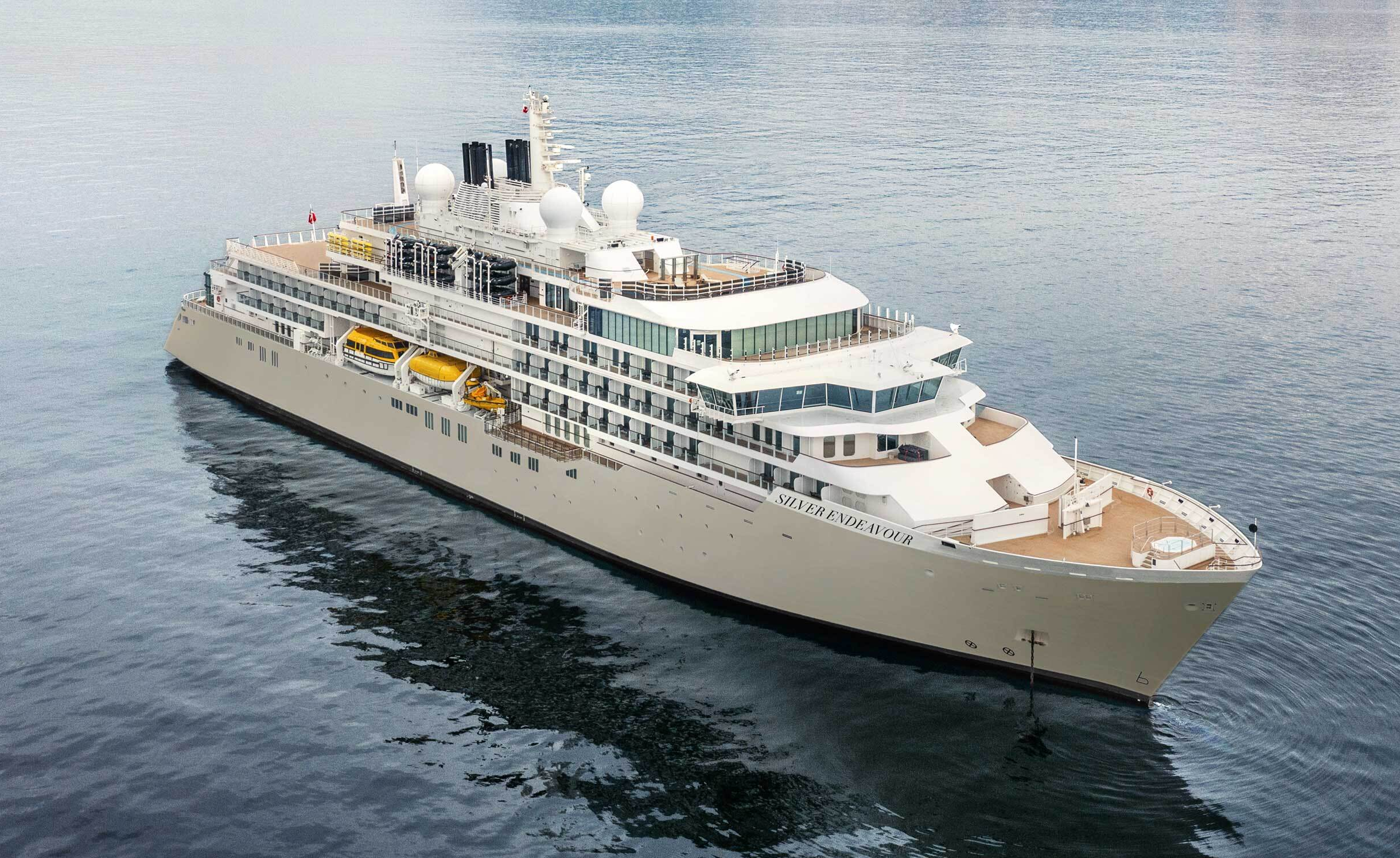
Silversea · Silver Endeavour
Overview
A 12-night voyage aboard Silver Endeavour, departing Lisbon on 26 Apr 2028 and arriving in Edinburgh, UK, calling at 15 destinations along the way.
LisbonTresco, Isles of ScillySt. Mary's, Isles of ScillyPort St Mary, Isle of ManIonaLunga, Trishnish IslandSt Kilda, AustraliaShiant Islands, Scotland, United KingdomLoch EweKirkwall, ScotlandLerwick, ScotlandIsle of NossFair IsleFarne IslandsEdinburgh, UK
Cabin prices
Live prices per person based on two sharing. Select a grade to see its fare options.
Loading live cabin prices…
Itinerary
12 nights · 19 ports of call- 2
Day 2 ·LisbonEmbark
26 Apr 2028Arrive 18:00Depart 20:00Lisbon, the capital of Portugal, is a city open to the sea and carefully planned with 18th-century elegance. Its founder is said to be the legendary Ulysses, but the theory of an original Phoenician settlement is probably more realistic. Known in Portugal as Lisboa, the city was inhabited by the Romans, Visigoths and, beginning in the 8th century, the Moors. Much of the 16th century was a period of great prosperity and overseas expansion for Portugal. Tragedy struck on All Saints' Day in 1755 with a devastating earthquake that killed about 40,000 people. The destruction of Lisbon shocked the continent. As a result, the Baixa (lower city) emerged in a single phase of building, carried out in less than a decade by the royal minister, the Marques de Pombal. His carefully planned layout of a perfect neo-classical grid survived to this day and remains the heart of the city. Evidence of pre-quake Lisbon can still be seen in the Belém suburb and the old Moorish section of the Alfama that sprawls below the Castle of St. George.
Lisbon is a compact city on the banks of the Tagus River. Visitors find it easy to get around as many places of interest are in the vicinity of the central downtown area. There is a convenient bus and tram system and taxis are plentiful. Rossio Square, the heart of Lisbon since medieval times, is an ideal place to start exploring. After a fire destroyed parts of the historic neighborhood behind Rossio in 1988, many of the restored buildings emerged with modern interiors behind the original façades.
The city boasts a good many monuments and museums, such as the Jeronimos Monastery, Tower of Belém, the Royal Coach Museum and the Gulbenkian Museum. High above the Baixa is the Bairro Alto (upper city) with its teeming nightlife. The easiest way to connect between the two areas is via the public elevator designed by Gustave Eiffel.
Cruising up the Tagus River to the ship's berth, you can already spot three of Lisbon's famous landmarks: the Monument to the Discoveries, the Tower of Belém and the Statue of Christ, which welcomes visitors from its hilltop location high above Europe's longest suspension bridge. - 2
Day 2 ·At Sea
27 Apr 2028 - 3
Day 3 ·At Sea
28 Apr 2028 - 5
Day 5 ·Tresco, Isles of Scilly
29 Apr 2028Arrive 12:00Depart 12:30For many visitors Tresco is the most attractive of the Isles of Scilly. This is especially due to its Abbey Garden, which is home to thousands of exotic plant species from around 80 different countries. Plant collector Augustus Smith began the gardens in the 1830s on the site of an old Benedictine Abbey by channelling the weather up and over a network of walled enclosures built around the Priory ruins. He had three terraces carved from the rocky south slope and maximised Tresco’s mild Gulf Stream climate. View less
Even in mid-winter there still are hundreds of plants flowering here. Another surprising attraction at the Abbey Garden is the collection of figureheads from ships that wrecked among the Isles of Scilly. - 5
Day 5 ·St Mary's (Isles of Scilly)
29 Apr 2028Arrive 18:30Depart 19:00Scattered 30 miles offshore from England’s most south-westerly point – Land’s End – the Isles of Scilly are home to rich wildlife, and green land sloping to powdery white beaches. The Isles of Scilly’s biggest island harbours around 1,600 people – roughly three-quarters of the total population - and is one of five occupied islands. Isolated and serene, life here hums along at its own pace in this archipelago's bubble, which enjoys the UK’s mildest climate, and some of its most spectacular beaches. View less
Hugh Town is the centre of St Mary’s, and you’ll be warmly welcomed by the incredibly tight-knit local community. A peaceful place, watch out when the waters are suddenly parted by the competition of gig racing – the island’s sporting pride and joy - which sees teams competing in colourful rowboats. Elsewhere, catch sight of Atlantic seals and seabirds like puffins and fulmars, along nine miles of coastline. You can also spot the ghostly shipwrecks strewn around the island’s waters, and the 140 islands and skerries that have made treacherous sailing historically. There's a dense collection of historical sites that belies the islands’ small size – from a former prime minster’s grave to star-shaped fortresses. Tresco Abbey Garden is one of the UK’s most vibrant gardens, with diverse plants bathing in the warmer climate and over 300 species on display. Taste the rewards of the mild weather with a glass of wine from England’s most south-westerly vineyard. - 6
Day 6 ·Port St Mary, Isle of Man
30 Apr 2028Arrive 19:00Depart 19:30 - 7
Day 7 ·Iona
1 May 2028Arrive 13:00Depart 13:30If tiny islands that resonate with peace and tranquillity are your idea of travel heaven, then welcome to Iona. Almost 200 miles east of Edinburgh, set in Scotland’s Inner Hebrides, this magical island has a spiritual reputation that precedes it. And luckily, more than lives up to. The island is miniscule. Just three miles long and only one and a half miles wide, this is not a place that hums with urban attractions. View less
120 people call Iona home (this number rises significantly if the gull, tern and Kittiwake population is added), although residential numbers do go up (to a whopping 175) in summer. The beautiful coastline is lapped by the gulf stream and gives the island a warm climate with sandy beaches that look more Mediterranean than Scottish! Add to that a green field landscape that is just beautiful, and you’ll find that Iona is a place that stays with you long after you leave. Iona’s main attraction is of course its abbey. Built in 563 by Saint Columbia and his monks, the abbey is the reason why Iona is called the cradle of Christianity. Not only is the abbey (today an ecumenical church) one of the best – if not the best – example of ecclesiastical architecture dating from the Middle Ages, but it also serves as an important site of spiritual pilgrimage. St. Martin’s Cross, a 9th century Celtic cross that stands outside the abbey, is considered as the finest example of Celtic crosses in the British Isles. Rèilig Odhrain, or the cemetery, allegedly contains the remains of many Scottish kings. - 7
Day 7 ·Lunga
1 May 2028Arrive 20:00Depart 20:30The stunning Isle of Lunga is the largest island in the Treshnish archipelago. With volcanic origin the isle was populated until the 19th Century, and remains of black houses can be seen around this magnificent coastal jewel. Abundant plant life and exotic birdlife are now the main inhabitants of the area. Fortunate visitors view the magnificent array of birds, especially the great puffins that breed on the islands plateau. One can sit within just a few feet away without disturbing the avian ambassador’s peace. View less
The 81 hectare island is home to many rare and endangered plants such as, primroses and orchids. Views over the landscape and across the ocean can be seen from the 300 foot high cliffs. - 8
Day 8 ·St. Kilda, Australia
2 May 2028Arrive 13:30Depart 14:00 - 8
Day 8 ·Boreray Island cruising
2 May 2028Arrive 16:00Depart 16:30 - 8
Day 8 ·Shiant Islands, Scotland
3 May 2028Arrive 11:00Depart 11:30 - 9
Day 9 ·Loch Ewe
3 May 2028Arrive 19:00Depart 19:30Loch Ewe is the only north facing Loch in Scotland, with an interesting history and a fine scenic landscape this area has a true natural beauty. During WW2 the loch was a convoy collecting point with a strong naval presence; it was therefore protected by light and heavy aircraft guns, a boom net and mine defence system helped to shield this precious settlement - 10
Day 10 ·Kirkwall, Orkney Islands, Scotland
4 May 2028Arrive 19:00Depart 20:00Scattered just off the northern tip of Scotland, Kirkwall is the capital of the Orkney Islands - a scenic archipelago of fascinating, dual heritage. The Viking influence is deep, while a prehistoric past and World War history adds to the endless stories that these dramatic islands have to tell. Sparse and beautiful, let the sweeping seascapes of frothing waves, and dance of the northern lights, enchant you as you explore. Windswept beaches are inhabited by whooping swans, while grassy cliffs hide puffins amid their wavy embrace. View less
Sea caves and crumbling castles - and the dramatic meeting of the North Sea and the Atlantic Ocean add to the romantic beauty of these lands, which may be physically close to the UK, but feel an entire world away. The sandstone St. Magnus Cathedral is the centrepiece of Orkney's main town - a place of winding lanes and atmospheric walks - and Britain's northernmost cathedral is a masterpiece that took 300 years to complete. Started in 1137, the beautiful cathedral is adorned with mesmerising stain-glass windows and has been evocatively named as the Light of the North. Look down over the ruined Bishop’s and Earl’s Palaces nearby from the tip of the cathedral's tower. Or, test out the islands' history-rich distilleries, which produce smokey single malts - said to be the best in the world. You can also venture out to Europe's best-preserved Stone Age Village, at the extraordinary World Heritage Site of Skara Brae, which offers an unparalleled vision into prehistoric life. - 11
Day 11 ·Lerwick, Shetland Islands, Scotland
5 May 2028Arrive 13:30Depart 14:00Adrift between the Scottish and Norwegian coasts, the craggy Shetland Islands form the most northerly point of the British Isles. Sprawling across 100 islands, connected by sandy bridges and crisscrossing ferries, explore the highlights of this scenic archipelago outpost. With incredible Neolithic history, spanning 5,000 years of human heritage, these islands, which sit just shy of the Arctic Circle, are an isolated and immense treasure trove of history and thrilling scenery. Look out over dramatic coastline from atmospheric Iron Age towers. View less
Sweeping, windswept beaches and wisps of sand connect islands and rugged cliffs - stand back as the sounds of the waves smashing against the shore and calling gulls fills the air. The islands are also home to some of the most adorable four-legged creatures you’ll ever meet, the diminutive and wavy-fringed, Shetland Ponies who roam the hills and reach a maximum size of 42 inches. Don't be fooled, though, they are amongst the strongest and toughest of all breeds. Their existence here points to Viking history, as local horses bred with ponies brought ashore by Norse settlers, creating the lovable crossbreed that is an icon of these islands today. The towering Broch of Mousa is perhaps Europe’s best-preserved Iron Age building - and one of the Shetland's finest brochs - a series of round, stone towers, believed to have been constructed around 100 BC. Seals and birdlife ensure that the isolated islands are always well-populated with life - and you can embark on hikes to discover their coastal homes. Lerwick is the islands’ capital, and there's a charming welcome on offer, as you arrive before the waterfront of stone buildings, which cascade down to the shore. - 11
Day 11 ·Isle Of Noss
5 May 2028Arrive 20:00Depart 20:30 - 12
Day 12 ·Fair Isle
6 May 2028Arrive 13:30Depart 14:00Lying mid-way between Shetland and the Orkney islands, Fair Isle is a tiny jewel in the sea. Famous for birds, knitwear and historic shipwrecks, the island offers a warm and friendly welcome to visitors. With a population of only around 70 people this island is truly a beautiful setting and is one of Britain’s most successful communities. View the cloudy light turquoise water as it drifts out to sea beneath the breath-taking Sheep Rock, rising over 100 metres, which is almost an isle of its own. - 13
Day 13 ·At Sea
7 May 2028Arrive 14:00Depart 14:30 - 13
Day 13 ·Farne islands
7 May 2028Arrive 19:30Depart 20:00His favourite place in the UK to see nature at its best, is how David Attenborough described the Farne Islands. The scatter of small islands begins 2.4 kilometres (1.5 miles) off the Northumberland Coast. The islands are dolerite which formed from liquid rock cooling underground. Softer overlying rock has eroded to leave hard rounded columns and fissured dolerite cliffs. The treeless landscape makes viewing of the island wildlife and history easy, even from a boat. The Farnes are cared for by the National Trust. - 14
Day 14 ·Leith (Edinburgh)Disembark
8 May 2028Arrive 23:30Depart 00:19History and beauty unite in this proud capital of Scotland, dubbed "The Athens of the North”. A dramatic balance exists between the high dark buildings of Edinburgh's medieval old town and the classical architecture of its Georgian New Town. The city has an impressive natural setting, overlooked by the dominating mass of "Arthur's Seat," a mountain in miniature.
Edinburgh is the administrative and cultural capital of Scotland. Though evidence suggests habitation as early as the Iron Age, the present city dates from the 11th-century reign of King Malcolm II and Queen Margaret. The Middle Ages were times of continual fluctuation as the citizenry fought against invasion and poverty. As a result, Edinburgh’s early development was greatly impeded.
Your ship: Silver Endeavour
Explore Silver Endeavour's cabins, dining and onboard facilities.