
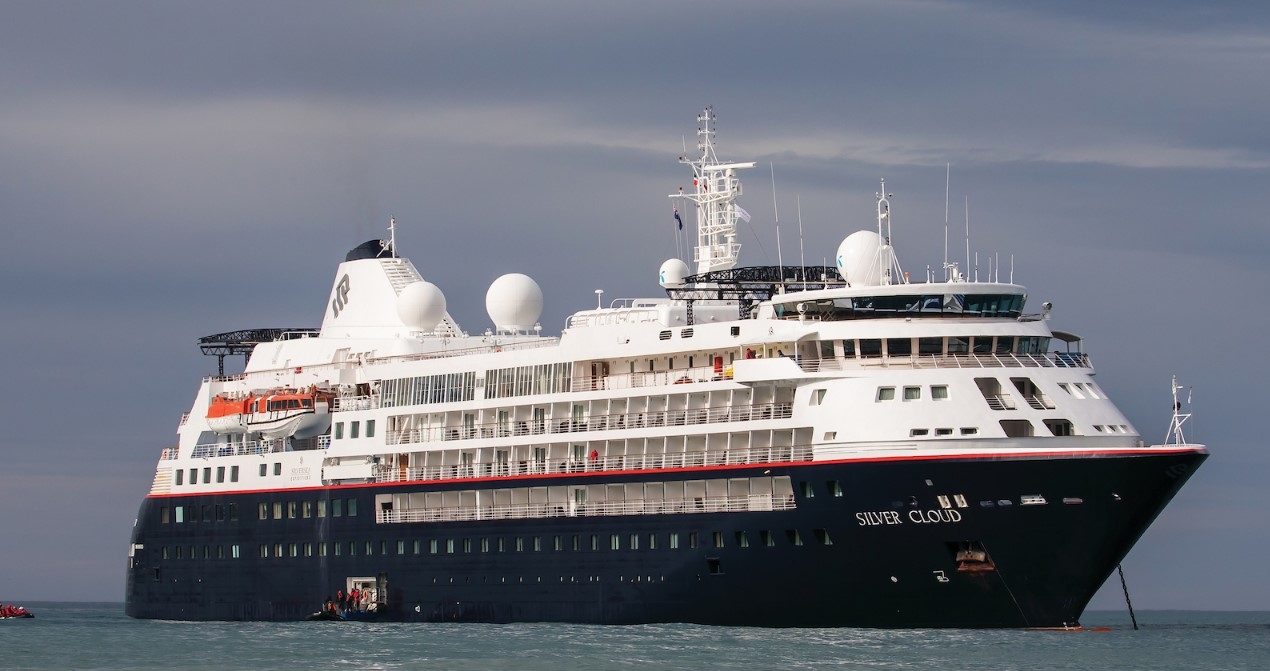
10 nightsFrom Great Darwin Bay, Genovesa Island7 ports of call
Darwin to Darwin
Silversea · Silver Cloud
Overview
A 10-night voyage aboard Silver Cloud, departing Great Darwin Bay, Genovesa Island on 9 Aug 2028 and returning to the same port, calling at 7 destinations along the way.
Great Darwin Bay, Genovesa IslandWyndham, Western AustraliaVansittart Bay, WAAshmore ReefBuccaneer ArchipelagoHunter River, Western AustraliaGreat Darwin Bay, Genovesa Island
Cabin prices
Live prices per person based on two sharing. Select a grade to see its fare options.
Loading live cabin prices…
Itinerary
10 nights · 11 ports of call- 2
Day 2 ·Bahia Darwin, Genovesa, EcuadorEmbark
9 Aug 2028Arrive 20:00Depart 21:00At Genovesa Island the ship tucks into Darwin Bay, an ancient volcanic crater now flooded by the sea. Zodiacs land on a picturesque sandy beach where Galapagos sea lions often rest on the fine, white sand. Explorations along the shore may reveal marine iguanas looking like prehistoric dinosaurs in miniature. By heading inland a short distance visitors could encounter seabirds of all shapes and sizes nesting in the vegetation. Scores of immature Red-footed Boobies perch on branches within an arm’s reach of the path - 2
Day 2 ·At Sea
10 Aug 2028 - 4
Day 4 ·Wyndham , Australia
11 Aug 2028Arrive 18:00Depart 21:15Wyndham is a small settlement with the spirit of a Kimberley outback township. It was established in 1886 with the Halls Creek gold rush and sits on the Cambridge Gulf where several rivers converge. Today Wyndham has a population of roughly 900 people and operates largely as a port exporting cattle, servicing the mining industry and hosting a few small ships. For these vessels Wyndham is a gateway to the breathtaking Bungle Bungle mountain range and the nearby Ord River. View less
The Bungle Bungle Mountains in Purnululu National Park are now a World Heritage Site. In excess of 350 million years have shaped geological formations of giant orange and black striped domes rising out of the ground into a landscape unlike any other. Known to the local Aboriginal people for thousands of years, the Bungles were only discovered by the outside world in the mid-1980s. Conversely, cruising the peaceful and tree-lined Ord River is a chance to look for freshwater crocodiles, fruit bats, short-eared rock wallabies and a variety of birds, including Mangrove Herons and Mangrove Gerygones. Please note: All destinations on voyages in the Kimberley region, and the order in which they are visited, are subject to tidal variations and weather conditions. - 5
Day 5 ·Vansittart Bay
12 Aug 2028Arrive 18:00Depart 18:30Vansittart Bay is located near the northern tip of Western Australia. The bay was named by Phillip Parker King during one of his four surveys of Northern Australia during the early 19th century.
Interesting parts of the bay include Jar Island and the opportunity to view Bradshaw (Gwion Gwion) and Wandjina styles of rock art. For these two different rock art styles there are two sites in close proximity.
An area with an example of a more recent history is the Anjo Peninsula. - 6
Day 6 ·Ashmore Reef, Australia
13 Aug 2028Arrive 17:30Depart 18:00The Territory of Ashmore and Cartier Islands is an uninhabited external territory of Australia consisting of four low-lying tropical islands in two separate reefs, and the 12-nautical-mile territorial sea generated by the islands - 6
Day 6 ·Buccaneer Archipelago
14 Aug 2028Set off the coast of Western Australia, the Buccaneer Archipelago is one of the Kimberley’s finest secrets. The Archipelago, 50 k2 (19 sq mi), is made up of around 800 islands and protect the mainland from the huge 12 metre tides and astonishing speed of the Yampi (or, in traditional Aborigine, “Yampee”) Sound. The speed and power of the water many not make for pleasant bathing, but do however result in fantastic natural phenomena. One fine example is the horizontal reversible waterfall in Talbot Bay.
The tidal pull is responsible for the “reversible” nature of the falls, however, this also hides narrow gaps between the islands, making for treacherous sailing conditions. Isolated graves of sailors and divers are testimony to the danger. William Dampier sighted the Archipelago in 1688 but it would not be until 1821 that the Archipelago would become known as Buccaneer (a term coined by Captain Phillip Parker King) "in commemoration of William Dampier’s visit to this part of the coast ". Commander John Lort Stokes also noted the area in his 1838 record. Enterprising individuals were initially attracted to the Buccaneer Archipelago in the 1800s due to the superior pearling as well as the rich iron ore deposits. Pearling conducted by luggers in the 1880s was concentrated in Cygnet Bay, Cascade Bay, Cone Bay and Strickland Bay. More recently, mining operators established open-cut mines on Koolan Island on the east side of the Sound. Some of the richest iron ore in the world is extracted here to this day. - 8
Day 8 ·Buccaneer Archipelago
15 Aug 2028Arrive 18:00Depart 18:30Set off the coast of Western Australia, the Buccaneer Archipelago is one of the Kimberley’s finest secrets. The Archipelago, 50 k2 (19 sq mi), is made up of around 800 islands and protect the mainland from the huge 12 metre tides and astonishing speed of the Yampi (or, in traditional Aborigine, “Yampee”) Sound. The speed and power of the water many not make for pleasant bathing, but do however result in fantastic natural phenomena. One fine example is the horizontal reversible waterfall in Talbot Bay.
The tidal pull is responsible for the “reversible” nature of the falls, however, this also hides narrow gaps between the islands, making for treacherous sailing conditions. Isolated graves of sailors and divers are testimony to the danger. William Dampier sighted the Archipelago in 1688 but it would not be until 1821 that the Archipelago would become known as Buccaneer (a term coined by Captain Phillip Parker King) "in commemoration of William Dampier’s visit to this part of the coast ". Commander John Lort Stokes also noted the area in his 1838 record. Enterprising individuals were initially attracted to the Buccaneer Archipelago in the 1800s due to the superior pearling as well as the rich iron ore deposits. Pearling conducted by luggers in the 1880s was concentrated in Cygnet Bay, Cascade Bay, Cone Bay and Strickland Bay. More recently, mining operators established open-cut mines on Koolan Island on the east side of the Sound. Some of the richest iron ore in the world is extracted here to this day. - 9
Day 9 ·Hunter River
16 Aug 2028Arrive 18:30Depart 19:00The Hunter River is home to an immense mangrove system surrounded by soaring red sandstone cliffs. Narrow mangrove channels shelter numerous bird species, mudskippers, fiddler crabs and the infamous saltwater crocodile; the most aggressive crocodile species known to man. Naturalist Island at the mouth of the river has a stunning stretch of sandy beach that makes a perfect landing site for small helicopters that can pick up visitors wishing to explore some of the Kimberley’s vast interior. View less
The highlight inland is the famous Mitchell Falls where four tiers of waterfalls plunge into deep pools that flow out into the mighty Mitchell River. The headwaters of the falls are cool and a dip in the fresh water is a welcome reprieve from the heat of the heartland. - 10
Day 10 ·Swift Bay
17 Aug 2028Arrive 18:30Depart 19:00 - 11
Day 11 ·King George River
18 Aug 2028Arrive 12:30Depart 13:00 - 12
Day 12 ·Bahia Darwin, Genovesa, EcuadorDisembark
19 Aug 2028Arrive 18:00Depart 19:00At Genovesa Island the ship tucks into Darwin Bay, an ancient volcanic crater now flooded by the sea. Zodiacs land on a picturesque sandy beach where Galapagos sea lions often rest on the fine, white sand. Explorations along the shore may reveal marine iguanas looking like prehistoric dinosaurs in miniature. By heading inland a short distance visitors could encounter seabirds of all shapes and sizes nesting in the vegetation. Scores of immature Red-footed Boobies perch on branches within an arm’s reach of the path
Your ship: Silver Cloud
Explore Silver Cloud's cabins, dining and onboard facilities.