
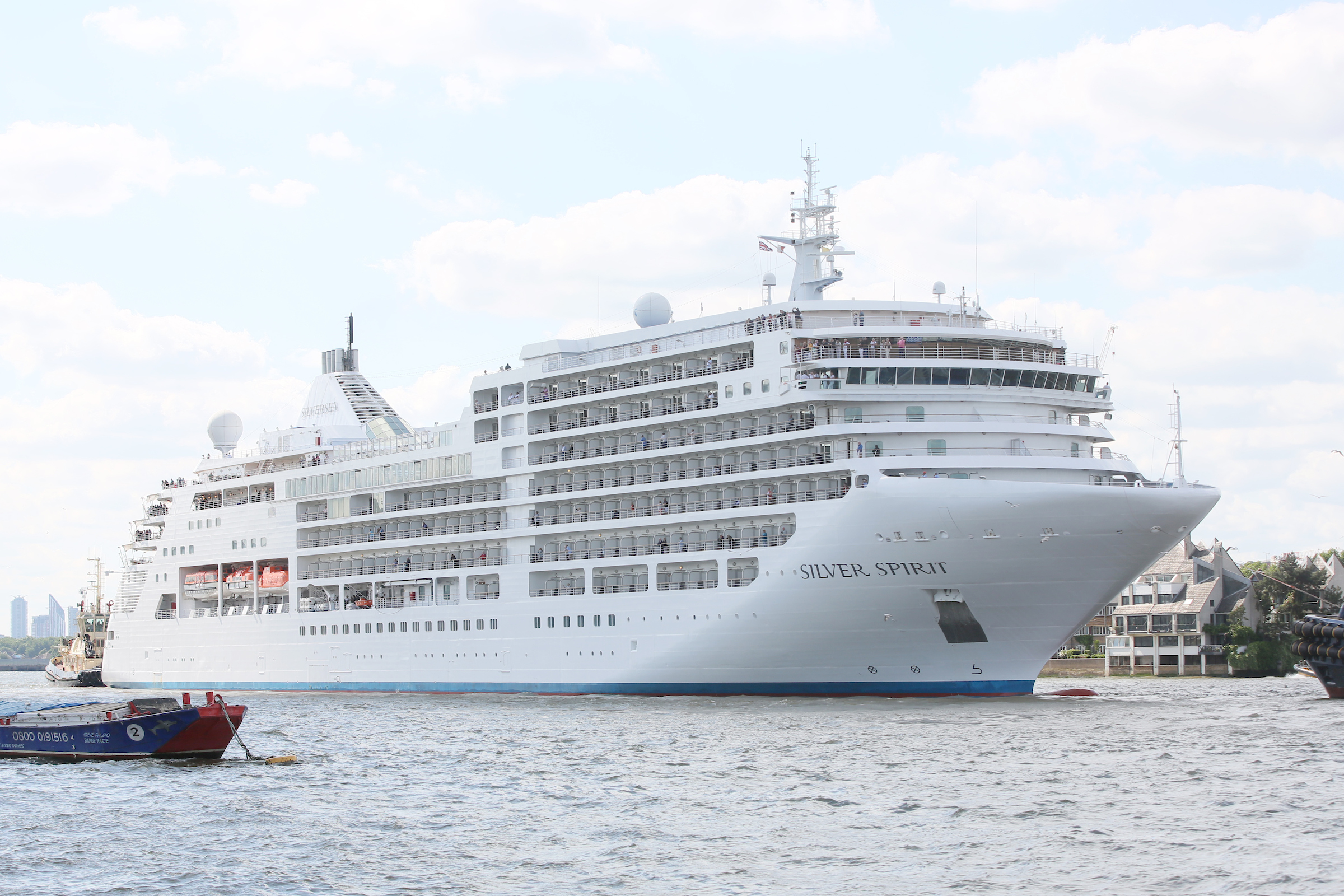
12 nightsFrom Southampton10 ports of call
Southampton (London) to Reykjavik
Silversea · Silver Spirit
Overview
A 12-night voyage aboard Silver Spirit, departing Southampton on 10 Aug 2028 and arriving in Reykjavik, Iceland, calling at 10 destinations along the way.
SouthamptonEdinburgh, UKAberdeen, UKInvergordonKirkwall, ScotlandSeydhisfjordurHusavikAkureyriIsafjordurReykjavik, Iceland
Cabin prices
Live prices per person based on two sharing. Select a grade to see its fare options.
Loading live cabin prices…
Itinerary
12 nights · 13 ports of call- 1
Day 1 ·SouthamptonEmbark
10 Aug 2028Arrive 07:00Depart 17:00Standing on a triangular peninsula formed at the place where the rivers Itchen and Test flow into an eight-mile inlet from the Solent, Southampton has figured in numerous stirring events and for centuries has been of strategic maritime importance. It was from here that the Pilgrim Fathers departed for America in the tiny Mayflower in 1620 and many great ocean liners, such as the Queen Mary and the Titanic have followed since. The image of the thousand-year-old city was greatly blemished by the bombing during World War II and postwar planning caused changes almost beyond recognition. - 2
Day 2 ·At Sea
11 Aug 2028 - 3
Day 3 ·Leith (Edinburgh)
12 Aug 2028Arrive 07:30History and beauty unite in this proud capital of Scotland, dubbed "The Athens of the North”. A dramatic balance exists between the high dark buildings of Edinburgh's medieval old town and the classical architecture of its Georgian New Town. The city has an impressive natural setting, overlooked by the dominating mass of "Arthur's Seat," a mountain in miniature.
Edinburgh is the administrative and cultural capital of Scotland. Though evidence suggests habitation as early as the Iron Age, the present city dates from the 11th-century reign of King Malcolm II and Queen Margaret. The Middle Ages were times of continual fluctuation as the citizenry fought against invasion and poverty. As a result, Edinburgh’s early development was greatly impeded. - 4
Day 4 ·Leith (Edinburgh)
13 Aug 2028Depart 17:00History and beauty unite in this proud capital of Scotland, dubbed "The Athens of the North”. A dramatic balance exists between the high dark buildings of Edinburgh's medieval old town and the classical architecture of its Georgian New Town. The city has an impressive natural setting, overlooked by the dominating mass of "Arthur's Seat," a mountain in miniature.
Edinburgh is the administrative and cultural capital of Scotland. Though evidence suggests habitation as early as the Iron Age, the present city dates from the 11th-century reign of King Malcolm II and Queen Margaret. The Middle Ages were times of continual fluctuation as the citizenry fought against invasion and poverty. As a result, Edinburgh’s early development was greatly impeded. - 5
Day 5 ·Aberdeen , United Kingdom
14 Aug 2028Arrive 05:40Depart 17:00The Granite City sparkles like silver in the Scottish sunshine, and there is over 8,000 years’ worth of history to dig into in this pretty city of cobbled streets and hunched cottages. Located far to the north of the British Isles, Aberdeen is third only to Edinburgh and Glasgow in terms of size. Shaped by its maritime location, granite foundations and offshore oil industry, today’s Aberdeen is a prosperous powerhouse, alive with arts and culture.
Surrounded by the Cairngorms Mountains’ sepia-hues – and the North Sea’s windswept coastline - Aberdeen was forged by the granite quarried from its earth. Local stone is everywhere from the Houses of Parliament to Waterloo Bridge – but arguably the finest examples of the material’s beauty are in the city itself. The barnacled spikes of Marischal College - the world's second largest granite building – and the grand turreted masonry of the Town House leave a lasting impression. Johnston Gardens add some colour to the city’s canvas, and you'll often spot wedding dresses floating among the blooming rhododendrons and ornate bridges. Aberdeen Maritime Museum takes visitors on a voyage through the region’s seafaring heritage, and North Sea oil exploration. Stop for a coffee and watch fishing vessels and trawlers toing and froing from the harbour, surreally mingling with city centre buildings in the unusually central harbour. Old Aberdeen is a fairy-tale walk of cobbled streets and eccentric stone houses where no stone is the same, while the Footdee fishing village, or 'fittie' as the locals pronounce it, consists of historic leaning cottages and ramshackle huts for the city's fishing community. - 6
Day 6 ·Invergordon, Scotland
15 Aug 2028Arrive 08:00Depart 18:00The Highlands in the northern part of Scotland are known for their magnificent scenery, boasting a landscape of dramatic mountains and forested hills. This region also is of historic importance and full of legends including the fabled Loch Ness monster.
For centuries, Scotland was England's principal enemy. Then in 1603, James VI of Scotland became James I of England, thus establishing the first political union between the two countries.
Despite these ties, Scottish nationalism persisted. The resistance came to an end in 1746 when Bonnie Prince Charlie, in a sad but heroic attempt to reclaim the throne, was defeated in the Battle of Culloden. It changed the social structure of the Highlands forever. Powerful clans were disarmed; for many years wearing kilts was prohibited because the kilt was seen as a symbol of Scottish pride. Scotland ultimately was ruled from London.
Invergordon is the port for Inverness, the capital of the Scottish Highlands and junction of many routes. Over the centuries, Inverness was often the focal point of clashes between Highland chiefs, and the Crown. Today the town is a popular tourist attraction as well as a gathering place for the clans of the surrounding area.
Enjoy the picture-perfect scenery and perhaps an opportunity to chat with a Highlander eager to introduce you to his fabled land and its rich heritage.
- 7
Day 7 ·Kirkwall, Orkney Islands, Scotland
16 Aug 2028Arrive 08:00Depart 18:00Scattered just off the northern tip of Scotland, Kirkwall is the capital of the Orkney Islands - a scenic archipelago of fascinating, dual heritage. The Viking influence is deep, while a prehistoric past and World War history adds to the endless stories that these dramatic islands have to tell. Sparse and beautiful, let the sweeping seascapes of frothing waves, and dance of the northern lights, enchant you as you explore. Windswept beaches are inhabited by whooping swans, while grassy cliffs hide puffins amid their wavy embrace. View less
Sea caves and crumbling castles - and the dramatic meeting of the North Sea and the Atlantic Ocean add to the romantic beauty of these lands, which may be physically close to the UK, but feel an entire world away. The sandstone St. Magnus Cathedral is the centrepiece of Orkney's main town - a place of winding lanes and atmospheric walks - and Britain's northernmost cathedral is a masterpiece that took 300 years to complete. Started in 1137, the beautiful cathedral is adorned with mesmerising stain-glass windows and has been evocatively named as the Light of the North. Look down over the ruined Bishop’s and Earl’s Palaces nearby from the tip of the cathedral's tower. Or, test out the islands' history-rich distilleries, which produce smokey single malts - said to be the best in the world. You can also venture out to Europe's best-preserved Stone Age Village, at the extraordinary World Heritage Site of Skara Brae, which offers an unparalleled vision into prehistoric life. - 8
Day 8 ·At Sea
17 Aug 2028 - 9
Day 9 ·Seydisfjordur, Iceland
18 Aug 2028Arrive 08:00Depart 17:00Seydisfjordur,, a beautiful 19th-century Norwegian village on the east coast of Iceland, is regarded by many as one of Iceland's most picturesque towns, not only due to its impressive environment, but also because nowhere in Iceland has a community of old wooden buildings been preserved so well as here. Poet Matthías Johannessen called Seydisfjordur a 'pearl enclosed in a shell'. - 10
Day 10 ·Husavik
19 Aug 2028Arrive 08:00Depart 18:00There's simply nowhere better than Husavilk - the European capital of whale watching - for getting up close and personal with the majestic giants of the ocean. Feel the awe as whales breach the waves around you, before gulping in air and plunging away with almighty tale flicks. Pretty Husavik is framed by the majestic Húsavíkurfjall mountain, which swells up behind, creating a stunning backdrop for the town's tiny wooden warehouses, cherry red houses and undulating fishing ships. View less
The little wooden church has been a beacon of light, guiding tired fishermen back to the shores of Iceland's oldest settlement, since 1907. Let the wind rip through your hair and the sea speckle your face, as you ride waves out among the region's almighty marine creatures, who throw their weight around so spectacularly. Sail among gentle giants in Shaky Bay, spotting humpbacks, minke whales and the world's biggest – blue whales. You may also see teams of smaller white-beaked dolphins skipping across the waves, displaying the full range of acrobatic skills. The town's whale museum is an interesting journey through Iceland's relationship with the sea giants, while its restaurants serve up local specialities – taste juicy reindeer burger and plokkfiskur, a buttery mash of local fish. Hikes and horseback rides into the surrounding countryside can take you up around Lake Botnsvatn, to views down from the slopes of the Húsavíkurfjall - where purple spired lupin flowers spill down amongst the emerald slopes. From the summit, look out over views of the bay, reaching out to the crumpled snowy peaks beyond. Or feel the full force of this land of natural power, at Dettifloss Waterfall, one of Europe's most powerful, thrashing flumes. - 11
Day 11 ·Akureyri, Iceland
20 Aug 2028Arrive 06:00Depart 18:00Iceland’s Capital of the North is the gateway to a thrilling land of roaring waterfalls, soaring volcanoes and glorious wildlife. It may lie a mere 60 miles from the Arctic Circle, but Akureyi blossoms with a bright, cosmopolitan feel, and explodes into life during the summer months, when its outdoor cafes and open-air bathing spots fill up with visitors ready to immerse themselves in Iceland’s cinematic scenery. Feel the thundering impact of Iceland’s celebrated natural wonders shaking your bones at Godafoss Waterfalls, known as the ‘Waterfalls of the Gods’.
Here, the Skjálfandafljót river unleashes a colossal torrent of water over charcoal-black rocks below. Or, find some peace at the Botanical Gardens, which opened in 1957 and offer space for contemplation - amid plants that bloom with unexpected vibrancy, even at this northerly latitude. The Lutheran, Akureyrarkirkja Church rises like a grand church organ and is the town’s most striking landmark. The 112-step climb is worth the effort to see light flooding in through its narrow stain glass windows, spreading colourful patchworks across the interior. Magic and mythology are important elements of Icelandic folklore, and you’ll even bump into giant sculptures of grizzled, child-snatching trolls on the town’s high street. Or, meet more earthly - but no less magical - creatures in the waters around Akureyi, where immense blue whales cruise by and dolphins playfully leap. A trip to the northerly Grimsey island will take you on an inspiring adventure traversing the Arctic Circle to a remote island where flame-beaked puffins nod on cliff-side perches and razorbills nest. Brush up on your puffin-watching skills with our blog. - 12
Day 12 ·Isafjordur, Iceland
21 Aug 2028Arrive 07:30Depart 17:00The town of Ísafjördur is the municipal centre of the West Fjords peninsula. The West Fjords are Iceland's least populated region, with 9,600 inhabitants in the area of nearly 6,000 square miles (9,520 sq km). Ísafjörður, with a present population of approximately 3,500, was formerly one of Iceland's main trading posts and as such, was granted municipal status in 1886. Some of Iceland's oldest and best-preserved buildings, dating from the 18th century, are located in Ísafjördur.
The town is still predominantly a fishing centre. A vigorous and varied cultural and artistic scene flourishes as well. Mountains surround Ísafjördur on the three sides and the sea on the other. The ancient settlement site of Eyri downtown is enclosed by the narrow Skutulsfjordur fjord, which shelters the harbour in all weathers. - 13
Day 13 ·Reykjavik, IcelandDisembark
22 Aug 2028Arrive 08:00Depart 16:00The fire, frost and water symbolized by the red, white and blue of Iceland's flag are manifested by the ice and snow of its glaciers, the hot mud pools, geysers and glowing lava flows in the country's volcanic regions.
The island's settlement dates back to 874 when a Norwegian named Ingolf Arnarson arrived at present-day Reykjavik. In 930, the settlers formed a legislature, the Alting, which was the beginning of the Commonwealth of Iceland. From the 10th to the 14th centuries, Iceland developed a literary form, the Icelandic Saga, which spread throughout the Nordic culture and into the English and German languages. It was used to spin stories of the gods, record historic events and glorify heroes.
As Iceland's capital and main center of the country's population, the city of Reykjavik is a fascinating blend of the traditional and modernism. Just as Iceland is a unique country – rugged and remote, yet technically advanced and enjoying Nordic standards of affluence – Reykjavik is a highly unusual capital city. It dominates the life of Iceland in almost every way. More than half of the country's total population of 270,000 is living in and around the capital, and the economy of the entire nation depends on Reykjavik. Nearly 60 percent of Iceland's imports are received and distributed, and 40 percent of the country's exports are loaded for shipment via the port of Reykjavik. It is also the headquarters of what is probably the world's most advanced seafood industry, which counts for Iceland's number one export.
Your ship: Silver Spirit
Explore Silver Spirit's cabins, dining and onboard facilities.