
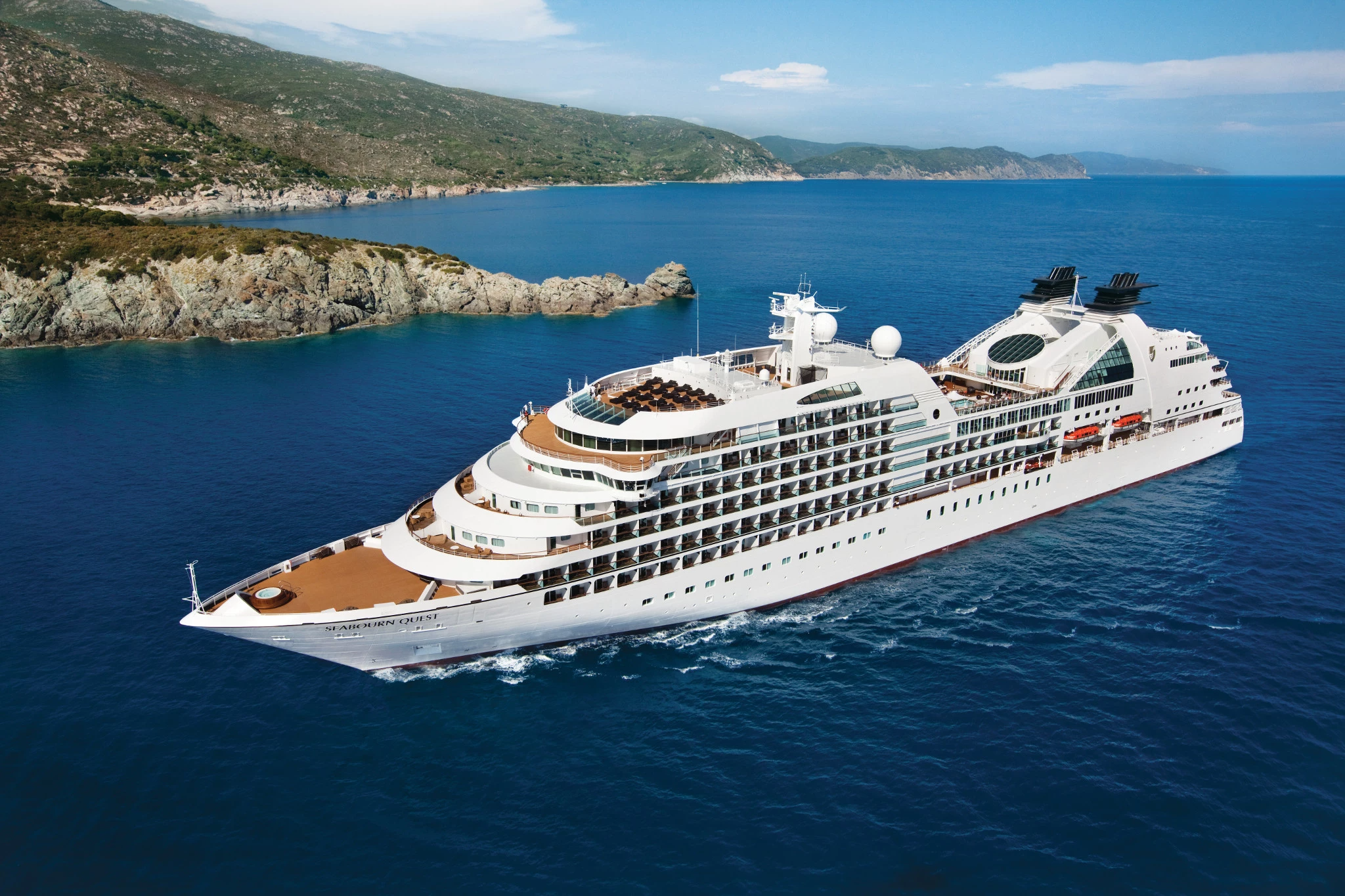
29 nightsFrom Miami, Florida9 ports of call
29-Day Panama Canal & Easter Island Explorer
Seabourn · Seabourn Quest
Overview
A 29-night voyage aboard Seabourn Quest, departing Miami, Florida on 7 Jan 2028 and arriving in Valparaiso, calling at 9 destinations along the way.
Miami, FloridaFuerte Amador, Panama CityGuayaquilSalaverry (Trujillo)Callao, PeruPisco, PeruEaster IslandRobinson Crueso IslandValparaiso
Cabin prices
Live prices per person based on two sharing. Select a grade to see its fare options.
Loading live cabin prices…
Itinerary
29 nights · 31 ports of call- 1
Day 1 ·Miami, FloridaEmbark
7 Jan 2028Depart 16:00Miami is the busiest cruise port in the world, hosting a myriad of ships year-round from all over the globe. Although it is technically not on the Caribbean Sea, no other American city exudes more of the diverse tropical appeal of the Caribbean. The city is home to a large and vibrant immigrant population that blends snowbird refugees from more northern climes with emigres from all Latin America and the Caribbean, as well as sizable groups from Europe, the Middle East and Asia. From the hot-blooded Art Deco haunts of South Beach to the natural wonders of the UNESCO-inscribed Everglades and the laid-back charms of the Keys, South Florida offers a bounty of appealing attractions that make an extended stay in the region nearly mandatory for those either embarking or disembarking here. - 2
Day 2 ·At Sea
8 Jan 2028 - 3
Day 3 ·At Sea
9 Jan 2028 - 4
Day 4 ·At Sea
10 Jan 2028 - 5
Day 5 ·Panama Canal Cruising
11 Jan 2028Arrive 06:00Depart 20:00 - 6
Day 6 ·Fuerte Amador (Panama City), Panama
11 Jan 2028Arrive 21:00Formerly a fortified armory, this newly developed port is the portal to colonial Panama City and an in-depth look at Miraflores Locks. Also from here, you can visit an Embera Indian village. - 6
Day 6 ·Fuerte Amador (Panama City), Panama
12 Jan 2028Depart 16:00Formerly a fortified armory, this newly developed port is the portal to colonial Panama City and an in-depth look at Miraflores Locks. Also from here, you can visit an Embera Indian village. - 7
Day 7 ·At Sea
13 Jan 2028 - 8
Day 8 ·At Sea
14 Jan 2028 - 9
Day 9 ·Guayaquil (Quito), Ecuador
15 Jan 2028Arrive 05:00Depart 18:00Perched on the banks of the Guayas River, Guayaquil is the country's principal seaport and economic center. Cargo ships, ferry boats and dugout canoes compete for space on the busy waterfront where sailing ships once departed for Europe with stores of gold and silver. - 10
Day 10 ·At Sea
16 Jan 2028 - 11
Day 11 ·Salaverry (Trujillo), Peru
17 Jan 2028Arrive 05:00Depart 17:00Salaverry is the port city for Trujillo, the second largest city in Peru. Like Lima, Trujillo was founded by the Spanish conquistador Pizarro. Here you will find colonial mansions with fronts containing distinctive wrought-iron grillwork and pastel color paint. This area is also known for its numerous ancient archeological sites including the ancient Chimu capital of Chan Chan. - 13
Day 13 ·Callao (Lima), Peru
18 Jan 2028Arrive 13:00A 45-minute drive from the port city of Callao brings you to exciting Lima, the City of Kings. From its founding in 1535 until today, it remains one of the most important cities in all South America. The handsome old buildings from the earliest colonial days surrounding the Plaza de Armas contrast with the soaring modern towers rising in the newer sections of the city. - 13
Day 13 ·Callao (Lima), Peru
19 Jan 2028A 45-minute drive from the port city of Callao brings you to exciting Lima, the City of Kings. From its founding in 1535 until today, it remains one of the most important cities in all South America. The handsome old buildings from the earliest colonial days surrounding the Plaza de Armas contrast with the soaring modern towers rising in the newer sections of the city. - 14
Day 14 ·Callao (Lima), Peru
20 Jan 2028Depart 21:00A 45-minute drive from the port city of Callao brings you to exciting Lima, the City of Kings. From its founding in 1535 until today, it remains one of the most important cities in all South America. The handsome old buildings from the earliest colonial days surrounding the Plaza de Armas contrast with the soaring modern towers rising in the newer sections of the city. - 15
Day 15 ·General San Martin (Pisco), Peru
21 Jan 2028Arrive 08:00Depart 18:00Pisco dates from 1640, and its Plaza de Armas is a Spanish colonial treasure. Another treasure is the Ballestas Islands, an offshore cluster of rocky outcroppings teeming with seabirds, penguins, sea lions, dolphins and other wildlife. Many visitors take the opportunity to take a scenic flight over the huge, mysterious Nazca Lines pictographs etched into the nearby desert surface 2,000 years ago. And still more belly up to a bar to sample a Pisco Sour cocktail made with the Pisco brandy distilled from locally grown grapes. - 16
Day 16 ·At Sea
22 Jan 2028 - 17
Day 17 ·At Sea
23 Jan 2028 - 18
Day 18 ·At Sea
24 Jan 2028 - 19
Day 19 ·At Sea
25 Jan 2028 - 20
Day 20 ·At Sea
26 Jan 2028 - 21
Day 21 ·Easter Island, Chile
27 Jan 2028Arrive 08:00The southeastern-most point in the Polynesian Triangle, tiny Easter Island in the South Pacific is one of the most remote places on earth. Even more oddly, it belongs to Chile, which lies 3,700 miles away over the eastern horizon. In fact, a large slice of the island is Chile’s Rapa Nui National Park, preserving the sculptural heritage of the indigenous Rapa Nui people, whose ancestors carved the huge human effigies called moai that give the island its renown and earned it UNESCO World Heritage Site status. These stylized sculptures stand on the slopes of the island, gazing implacably out to sea, often on stone platforms called ahu. They were apparently carved between the 13th and 16th centuries, for reasons that are debated. But the enigmatic effigies, the dramatic volcanic landscape, the Rapa Nui people themselves and the sheer isolation of the island combine to draw visitors from every corner of the globe to this speck in the world’s largest ocean. - 22
Day 22 ·Easter Island, Chile
28 Jan 2028Depart 18:00The southeastern-most point in the Polynesian Triangle, tiny Easter Island in the South Pacific is one of the most remote places on earth. Even more oddly, it belongs to Chile, which lies 3,700 miles away over the eastern horizon. In fact, a large slice of the island is Chile’s Rapa Nui National Park, preserving the sculptural heritage of the indigenous Rapa Nui people, whose ancestors carved the huge human effigies called moai that give the island its renown and earned it UNESCO World Heritage Site status. These stylized sculptures stand on the slopes of the island, gazing implacably out to sea, often on stone platforms called ahu. They were apparently carved between the 13th and 16th centuries, for reasons that are debated. But the enigmatic effigies, the dramatic volcanic landscape, the Rapa Nui people themselves and the sheer isolation of the island combine to draw visitors from every corner of the globe to this speck in the world’s largest ocean. - 23
Day 23 ·At Sea
29 Jan 2028 - 24
Day 24 ·At Sea
30 Jan 2028 - 25
Day 25 ·At Sea
31 Jan 2028 - 26
Day 26 ·At Sea
1 Feb 2028 - 27
Day 27 ·Robinson Crusoe Island
2 Feb 2028Arrive 09:00Depart 19:00 - 28
Day 28 ·Santa Clara Island, Chile
3 Feb 2028Arrive 08:00Depart 18:00 - 29
Day 29 ·At Sea
4 Feb 2028 - 30
Day 30 ·Valparaiso (Santiago), ChileDisembark
5 Feb 2028Arrive 07:00Picturesque Valparaiso was one of the first Chilean cities founded by the Spanish. The city is an historic port and university town, famous for its labyrinth hills, which are covered in quaint, colorful old houses and accessible only by a steep climb or by the city's unique system of funicular railways. Through the efforts of the Chilean government emphasizing the city's culture, heritage preservation, and economic development via tourism, Valparaiso was bestowed designation as a World Heritage Site by UNESCO in 2003.
Your ship: Seabourn Quest
Explore Seabourn Quest's cabins, dining and onboard facilities.