
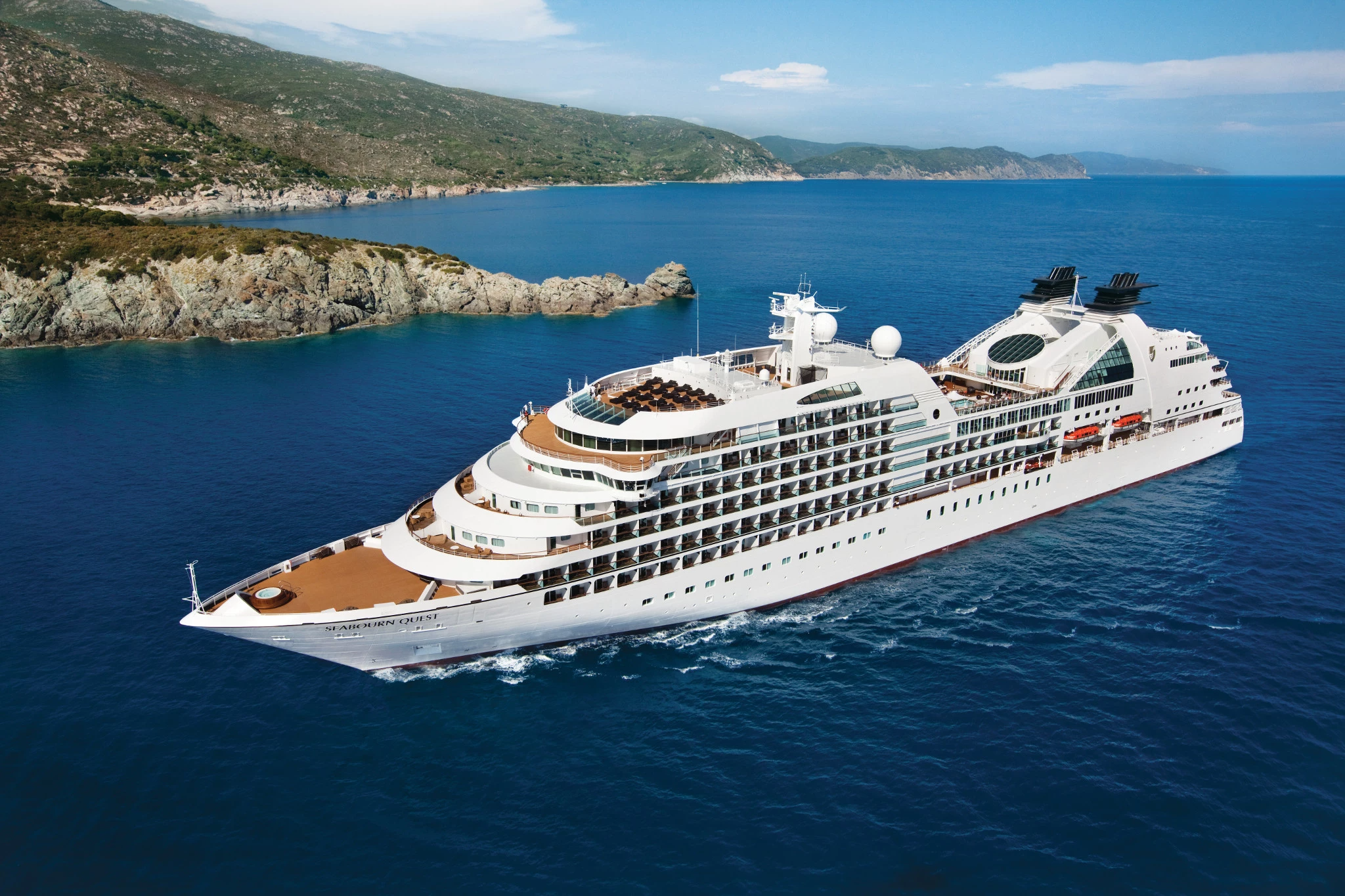
28 nightsFrom Valparaiso11 ports of call
28-Day Chilean Fjords, Antarctica & Falklands
Seabourn · Seabourn Quest
Overview
A 28-night voyage aboard Seabourn Quest, departing Valparaiso on 5 Feb 2028 and arriving in Buenos Aires, calling at 11 destinations along the way.
ValparaisoPuerto MonttCastro, Chiloe IslandPuerto Chacabuco, ChilePio XI GlacierPunta Arenas, ChileGaribaldi Fjord & Glacier, ChileUshuaia, ArgentinaPort StanleyMontevideoBuenos Aires
Cabin prices
Live prices per person based on two sharing. Select a grade to see its fare options.
Loading live cabin prices…
Itinerary
28 nights · 35 ports of call- 1
Day 1 ·Valparaiso (Santiago), ChileEmbark
5 Feb 2028Depart 15:00Picturesque Valparaiso was one of the first Chilean cities founded by the Spanish. The city is an historic port and university town, famous for its labyrinth hills, which are covered in quaint, colorful old houses and accessible only by a steep climb or by the city's unique system of funicular railways. Through the efforts of the Chilean government emphasizing the city's culture, heritage preservation, and economic development via tourism, Valparaiso was bestowed designation as a World Heritage Site by UNESCO in 2003. - 2
Day 2 ·At Sea
6 Feb 2028 - 3
Day 3 ·Puerto Montt, Chile
7 Feb 2028Arrive 10:00Depart 20:00The lake country of southern Chile seems to be altogether another world from the deserts of the north. The Lake District is graced with spectacular scenery, including the magnificent snowcapped volcanic cone, Mt. Osorno. Puerto Montt serves as the principal port for this region and as a gateway for cruises southward into Chile's fjords. - 4
Day 4 ·Castro, Chiloe Island, Chile
8 Feb 2028Arrive 07:00Depart 16:00The towns are largely built of abundant local woods, and many houses are elaborately shingled in intricate designs. Even the cathedral is a beautiful, vaulted structure crafted of local hardwoods. The forest and the sea are the source of livelihood and much more in this rustic outpost. - 4
Day 4 ·Scenic Cruising Gulf of Corcovado
8 Feb 2028The Gulf of Corcovado is a large body of water between Chiloe Island and the coast of Chile. It is surrounded by the Corcovado National Park on the east and Chiloe Island’s Valdivian forest on the west. On the eastern horizon rise the snowcapped volcanic cones of Corcovado and Yanteles. The shoreline is largely unspoiled and forests of southern beech and the magnificent alerce (similar to North American sequoia) trees predominate. The waters are dotted with islands, leading to the bay and harbor of Chiloe’s primary town, Castro. The Gulf is actually a submerged fore-basin carved by a massive glacier. The waters are home to some endangered species, including blue whales, as well as humpback, minke and sei whales. Salmon farms have blossomed in recent years.
Cruise this important, weather-protected shipping channel between the long, mountainous Pitt Island and the equally mountainous mainland of British Columbia’s northern coast. - 5
Day 5 ·Puerto Chacabuco, Chile
9 Feb 2028Arrive 10:00Depart 19:00The wild and beautiful Aysén District of Chile lies south of Chiloe and Puerto Montt. Here you find cliffs that drop into immense river valleys, numerous waterfalls and ravines that open into vast valleys, while the Andes form a continuous barrier. Puerto Chacabuco is a popular entry port to the Aysén region. It lies at the eastern end of a very narrow fjord and has replaced Puerto Aysén as the main shipping port and ferry terminal to this region. Puerto Chacabuco is also a departure point for sailings to Laguna San Rafael. Local vessels make the scenic trip through the channels and islands of Western Patagonia. - 6
Day 6 ·At Sea
10 Feb 2028 - 7
Day 7 ·Scenic Cruising Wide Channel
11 Feb 2028The Wide Channel is an inside passage along the coast of southern Chile. It separates the eastern lobe of the huge Wellington Island from the Chilean mainland, starting between Saumarez Island and Icy Channel in the north and opening into the Concepcion Channel in the south adjacent to the Bernardo O’Higgins National Park on the mainland Wilcock Peninsula. Surrounded by precipitous mountains, its shoreline on the mainland side is interrupted by two large fjords, the Europa and Penguin fjords. Join your expedition team members on deck or in an observation lounge for expert insights into the area. - 7
Day 7 ·Scenic Cruising Eyre Fjord
11 Feb 2028Eyre Fjord penetrates the mainland of southern Chile from the Icy Channel about 20 miles to the broad face of the massive Pio XI glacier, also known as the Brüggen Glacier. It is the longest glacier in the Southern Hemisphere outside Antarctica, flowing some 40 miles from the Southern Patagonian Ice Field to the fjord. It is also one of the very few advancing glaciers on earth. The glacier face is located near a large eastern arm of Eyre Fjord called Exmouth Fjord. - 7
Day 7 ·Pio XI Glacier
11 Feb 2028Arrive 08:00Depart 18:00 - 8
Day 8 ·Scenic Cruising Peel Fjord
12 Feb 2028Cutting eastward from the Sarmiento Channel in Southern Chile, this fjord divides into three separate fjords, called Amalia, Asia and Calvo Fjords. Amalia leads to Amalia Glacier, the El Brujo Glacier is in Asia Fjord, and Calvo boasts several small glaciers of its own. The mainland to the east is all part of the huge Torres del Paine National Park. The area is a fascinating geological panorama, and your expedition team members will be available to interpret the sights, as well as identify wildlife spotted while cruising the scenic waterways. - 8
Day 8 ·Brujo Glacier
12 Feb 2028Arrive 07:00Depart 09:00 - 8
Day 8 ·Scenic Cruising Sarmiento Channel
12 Feb 2028Canal Sarmiento, or the Sarmiento Channel, is a protected inside passage that runs generally north-and-south along Chile’s Pacific Coast between the mainland and Esperanza, Vancouver and Piazzi Islands. It is in the Magallanes y Antárctica Chilena region. Although the native Kawésgar people routinely navigated the channel for 6,000 years up until the 20th century, it was named for the first European to do so, the Spanish explorer Pedro Sarmiento de Gamboa, who sailed it in 1579-80. The channel begins at the Guia Narrows on the north end, and runs general south-to-southeast for approximately 64 miles, passing Esperanza Island on the west with mountain peaks of 300 to over 1000 meters, before turning eastward into the Farquhar Pass. It then turns southward again, merging with the Collingwood Strait for approximately eight miles, at which time the Cordillera Sarmiento rises on the eastern side, crowned with snow-capped peaks, several tidewater glaciers, and a number of shipwrecks on the shore. Finally, the channel turns westward through the Victoria Pass the join the Smyth Channel. - 9
Day 9 ·Strait of Magellan
13 Feb 2028The Strait of Magellan is a 350-mile/570 km channel separating the mainland of South America from the large Isla Grande de Tierra del Fuego and connecting the Atlantic and Pacific Oceans. It was first navigated by the explorer Ferdinand Magellan during his circumnavigation voyage in 1520. He named it the Strait of All Saints, because his transit started on November 1, All Saints Day. It was also Magellan who name the southern island Tierra del Fuego, after seeing the smokes from fires in the camps of the native Yahgan people, whom he named the Patagones, meaning “big feet,” and their land Patagonia. The strait is between two and 20 miles wide, and earned the nickname Dragon’s Tail among sailors, for its tortuous path. Along with the Beagle Channel, it was one of two protected channels for sailing between the oceans prior to the construction of the Panama Canal The third alternative was the notoriously turbulent open ocean Drake Passage beyond Cape Horn. There is one sizeable port city in the strait, Punta Arenas, Chile, which has an interesting harbor breakwater consisting of two ship hulks, the Cavenga and an old iron four-mast sailing ship, the County of Peebles. There are several Chilean national parks and monuments in the strait, including Los Pinguinos National Monument and a sanctuary for protecting humpback whales. Southern right whales are also known to frequent the strait’s waters. There are 41 light signals in the strait, including the San Isidro Lighthouse that has been restored and is now a museum, and the Evangelistas Lighthouse at the western entrance. The strait was very difficult for sailing ships, due to unpredictable winds and tidal currents. Depending on tide conditions, even modern ships often opt for one of the alternative routes, because the tidal speeds are greatly exaggerated by the Venturi effect through narrows. - 9
Day 9 ·Punta Arenas, Chile
13 Feb 2028Arrive 10:00Depart 23:00Red roofs and smoking chimneys decorate the gently sloping hillsides of Punta Arenas (Sandy Point), the bustling center of one of the world's largest sheep farming areas. This pleasant community welcomes you with attractive parks and delightful Victorian architecture. - 10
Day 10 ·At Sea
14 Feb 2028 - 11
Day 11 ·Garibaldi Glacier, Chile
15 Feb 2028Arrive 07:00Depart 17:00 - 12
Day 12 ·Ushuaia, Argentina
16 Feb 2028Arrive 08:00Depart 19:00The southernmost city in the world, Ushuaia is the capital of Argentine Tierra del Fuego and an important naval base boasting a strategic as well as a picturesque location on the shores of Ushuaia Bay and the Beagle Channel. This rustic coastal town is set among waterfalls, glaciers, snow-clad mountains and beech forests, and the nutrient-rich local waters abound with marine life. Though the houses here are painted warm, pastel colors, the weather is chilly year-round and winter sports such as downhill and cross-country skiing and skating are popular. Ushuaia's principal industries are raising sheep, logging, fishing and trapping. It became a boomtown with 30,000 residents in the late 1980's when the government sought to increase Argentina's presence near Antarctica by giving tax breaks to citizens who settled here. - 13
Day 13 ·At Sea
17 Feb 2028 - 14
Day 14 ·At Sea
18 Feb 2028 - 15
Day 15 ·The Seabourn Antarctic Experience
19 Feb 2028Arrive 07:00Depart 17:00 - 16
Day 16 ·The Seabourn Antarctic Experience
20 Feb 2028Arrive 07:00Depart 17:00 - 17
Day 17 ·The Seabourn Antarctic Experience
21 Feb 2028Arrive 07:00Depart 17:00 - 18
Day 18 ·The Seabourn Antarctic Experience
22 Feb 2028Arrive 07:00Depart 17:00 - 19
Day 19 ·The Seabourn Antarctic Experience
23 Feb 2028Arrive 07:00Depart 17:00 - 20
Day 20 ·At Sea
24 Feb 2028 - 21
Day 21 ·At Sea
25 Feb 2028 - 22
Day 22 ·The Seabourn Falkland Island Experience
26 Feb 2028Arrive 07:00Depart 17:00 - 23
Day 23 ·The Seabourn Falkland Island Experience
27 Feb 2028Arrive 07:00Depart 17:00 - 24
Day 24 ·Stanley/Falkland Is/Islas Malvinas
28 Feb 2028Arrive 07:00Depart 17:00An archipelago of over 700 islands spread over 4,700 square miles lies about 300 miles east of the coast of Argentina. Its political affiliation is with the United Kingdom, and it is named the Falkland Islands, although this is disputed by Argentina, which calls the island group Islas Malvinas. The islands were the focus of a short, violent military confrontation between the two nations in 1982 which resulted in many lives lost. Most visitors come to the islands attracted by the severe beauty of the landscape and the unusual wildlife to be seen there, especially colonies of penguins. Port Stanley, the capital, is a plucky outpost supporting the hardy islanders who farm and fish and, lately, newcomers set on exploiting the recently discovered oil reserves offshore. - 25
Day 25 ·At Sea
29 Feb 2028 - 26
Day 26 ·At Sea
1 Mar 2028 - 27
Day 27 ·At Sea
2 Mar 2028 - 28
Day 28 ·Montevideo, Uruguay
3 Mar 2028Arrive 07:00Depart 16:00Tucked in between Brazil and Argentina, the republic of Uruguay has nevertheless maintained its own identity and traditions. As South America's second smallest country, it has been called a city surrounded by a big ranch. Montevideo has also been referred to as "The Switzerland of South America," for its same secretive bank system guaranteed by law. Uruguay is principally middle class and boasts the most highly educated citizens on the continent. - 29
Day 29 ·Buenos Aires, ArgentinaDisembark
4 Mar 2028Arrive 07:00Founded in 1536, Buenos Aires was administered by a Spanish viceroy for nearly three centuries before winning its independence in 1816. A sleepy port town for most of that time, it wasn't until the turn of the 20th century that the city finally emerged as an important shipping center. Today, Argentina's democratically elected government has made it South America's safest (and most expensive) country. This cosmopolitan city is characterized by broad boulevards with huge shade trees, beautiful residential districts, plazas containing monuments and fountains, interspersed with 20th-century high-rise buildings. It is a truly great walking city.
Your ship: Seabourn Quest
Explore Seabourn Quest's cabins, dining and onboard facilities.