
22 nightsFrom Valparaiso5 ports of call
22-Day Juan Fernandez Islands, Chilea
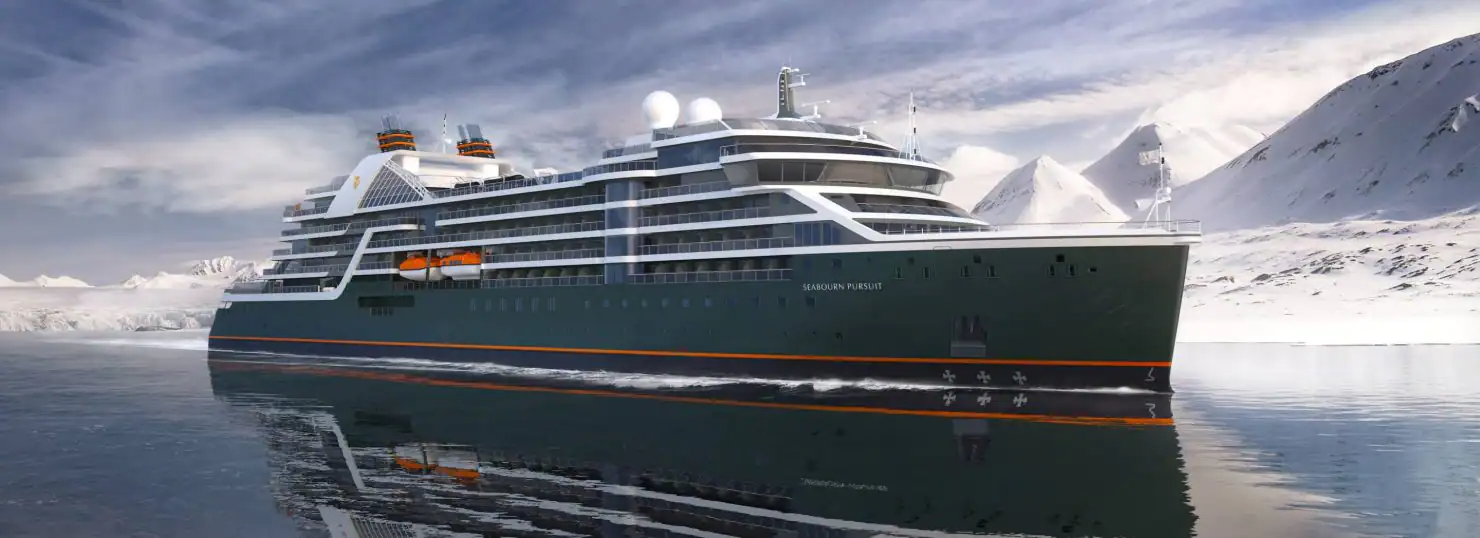
Seabourn · Seabourn Pursuit
Overview
A 22-night voyage aboard Seabourn Pursuit, departing Valparaiso on 18 Oct 2028 and arriving in Ushuaia, Argentina, calling at 5 destinations along the way.
ValparaisoPuerto MonttPio XI GlacierPunta Arenas, ChileUshuaia, Argentina
Cabin prices
Live prices per person based on two sharing. Select a grade to see its fare options.
Loading live cabin prices…
Itinerary
22 nights · 33 ports of call- 1
Valparaiso (Santiago), ChileEmbark
17 Oct 2028Picturesque Valparaiso was one of the first Chilean cities founded by the Spanish. The city is an historic port and university town, famous for its labyrinth hills, which are covered in quaint, colorful old houses and accessible only by a steep climb or by the city's unique system of funicular railways. Through the efforts of the Chilean government emphasizing the city's culture, heritage preservation, and economic development via tourism, Valparaiso was bestowed designation as a World Heritage Site by UNESCO in 2003. - 2
Valparaiso (Santiago), Chile
17 Oct 2028Depart 17:00Picturesque Valparaiso was one of the first Chilean cities founded by the Spanish. The city is an historic port and university town, famous for its labyrinth hills, which are covered in quaint, colorful old houses and accessible only by a steep climb or by the city's unique system of funicular railways. Through the efforts of the Chilean government emphasizing the city's culture, heritage preservation, and economic development via tourism, Valparaiso was bestowed designation as a World Heritage Site by UNESCO in 2003. - 2
Day 2 ·At Sea
19 Oct 2028 - 3
Day 3 ·The Seabourn Juan Fernandez Experience
20 Oct 2028Arrive 07:00Depart 17:00 - 4
Day 4 ·The Seabourn Juan Fernandez Experience
21 Oct 2028Arrive 07:00Depart 17:00 - 5
Day 5 ·The Seabourn Juan Fernandez Experience
22 Oct 2028Arrive 07:00Depart 12:00 - 6
Day 6 ·At Sea
23 Oct 2028 - 7
Day 7 ·Scenic Cruising Reloncavi Sound
24 Oct 2028Puerto Montt, in Chile’s Northern Patagonia Los Lagos region is set on the shores of a large bay identified as Reloncavi Sound. To the east looms Mt. Yate, a snowcapped, glaciated stratovolcano, and beyond that the cordillera of the Andes. The sound is punctuated by islands, the three largest being Tengio, Maillén and Huar. Two much larger islands, Puluqiui and Queulín, sprawl across the mouth of the sound, separating it from the Gulf of Ancud. The point where the Reloncavi Estuary empties into the sound is effectively where the Chilean Central Valley meets the Pacific Ocean. Salmon farms dimple the coves of the sound, and pods of orcas are sometimes seen. Near the sound on shore, Chile’s Alerce Andino National Park protects a vestigial forest of ancient alerce trees, similar to the huge sequoias found in North America. - 7
Day 7 ·Puerto Montt, Chile
24 Oct 2028Arrive 08:00Depart 18:00The lake country of southern Chile seems to be altogether another world from the deserts of the north. The Lake District is graced with spectacular scenery, including the magnificent snowcapped volcanic cone, Mt. Osorno. Puerto Montt serves as the principal port for this region and as a gateway for cruises southward into Chile's fjords. - 8
Day 8 ·Scenic Cruising Moraleda Channel
25 Oct 2028The Moraleda Channel is a protected waterway running along the coast of Chile from the Gulf of Corcovado in the north to the Laguna San Rafael in the south. It separates the myriad mountainous islands of the Chonos Archipelago from the Chilean mainland. Like the Inside Passage on the Pacific coast of North America, the Moraleda Channel is a geological feature. Its course follows the geologic Liguiñe-Ofqui Fault on the eastern side of the islands, which are actually the peaks of the submerged Chilean Coastal Range. - 8
Day 8 ·Scenic Cruising Darwin Channel
25 Oct 2028The Darwin Channel cuts through the elongated, mountainous islands of the Chonos Archipelago in Southern Chile, connecting the Pacific Ocean on the west with the Moraleda Channel running along the Chilean mainland. These forested islands, mostly uninhabited, are actually the peaks of the submerged Chilean Coastal Range. Darwin Channel is a westward continuation of the Aysén Fjord, connecting to the Pacific at Isquiliac Island, and opening at its eastern end into Darwin Bay. Being free of navigational hazards, it forms a preferred, scenic pathway for ships navigating in the area. - 9
Day 9 ·Scenic Cruising Baker Channel
26 Oct 2028The Baker Channel is a large, multi-armed fjord that cuts from Tarn Bay in the Gulf of Penas some 75 miles into the Chilean mainland. It lies roughly halfway between the Northern and Southern Patagonian Ice Fields, and its southern arm culminates at the face of the Jorge Montt Glacier, which flows from the Southern ice field and frequently calves icebergs into the channel. The channel forms the northern boundary of Chile’s vast Bernardo O’Higgins National Park. - 9
Day 9 ·Transit The English Narrows
26 Oct 2028On the long Messier Channel between the huge Wellington island and the Chilean mainland, the English Narrows is a natural, eight-mile obstacle consisting of a scattering of islands constricting the passage to a width of as little as 200 yards. It presents no hazard to a skilled navigator under most conditions, but at spring tides the current runs as much as six knots, and wind conditions may also make navigation risky. The narrows transit is a good time to be on deck, to keep an eye out for birds such as diving petrels or steamer ducks, and possibly the small, rare dolphins that are sometimes seen in remote areas like this. - 9
Day 9 ·Caleta Tortel, Chile
26 Oct 2028Arrive 10:00Depart 18:00 - 10
Day 10 ·Scenic Cruising Eyre Fjord
27 Oct 2028Eyre Fjord penetrates the mainland of southern Chile from the Icy Channel about 20 miles to the broad face of the massive Pio XI glacier, also known as the Brüggen Glacier. It is the longest glacier in the Southern Hemisphere outside Antarctica, flowing some 40 miles from the Southern Patagonian Ice Field to the fjord. It is also one of the very few advancing glaciers on earth. The glacier face is located near a large eastern arm of Eyre Fjord called Exmouth Fjord. - 10
Day 10 ·Scenic Cruising Wide Channel
27 Oct 2028The Wide Channel is an inside passage along the coast of southern Chile. It separates the eastern lobe of the huge Wellington Island from the Chilean mainland, starting between Saumarez Island and Icy Channel in the north and opening into the Concepcion Channel in the south adjacent to the Bernardo O’Higgins National Park on the mainland Wilcock Peninsula. Surrounded by precipitous mountains, its shoreline on the mainland side is interrupted by two large fjords, the Europa and Penguin fjords. Join your expedition team members on deck or in an observation lounge for expert insights into the area. - 10
Day 10 ·Pio XI Glacier
27 Oct 2028Arrive 08:00Depart 13:00 - 11
Day 11 ·Scenic Cruising Peel Fjord
28 Oct 2028Cutting eastward from the Sarmiento Channel in Southern Chile, this fjord divides into three separate fjords, called Amalia, Asia and Calvo Fjords. Amalia leads to Amalia Glacier, the El Brujo Glacier is in Asia Fjord, and Calvo boasts several small glaciers of its own. The mainland to the east is all part of the huge Torres del Paine National Park. The area is a fascinating geological panorama, and your expedition team members will be available to interpret the sights, as well as identify wildlife spotted while cruising the scenic waterways. - 11
Day 11 ·Scenic Cruising Smyth Channel
28 Oct 2028The Smyth Channel is another of the spectacular waterways threading the maze of islands off the coast of extreme southern Chile. At its northern end, it briefly parallels the Sarmiento Channel, then veers southward opening into the Strait of Magellan. Dotted with myriad small islands and corrugated with countless narrow fjords and bays, it makes a mesmerizing panorama as your ship plies between the islands on one side and the immense Peninsula Muñoz-Gamero on the other. Members of your expedition team will be on deck and in lounges to offer insights into the wild, unspoiled terrain you are passing. - 11
Day 11 ·Brujo Glacier
28 Oct 2028Arrive 07:00Depart 11:00 - 12
Day 12 ·Strait of Magellan
29 Oct 2028The Strait of Magellan is a 350-mile/570 km channel separating the mainland of South America from the large Isla Grande de Tierra del Fuego and connecting the Atlantic and Pacific Oceans. It was first navigated by the explorer Ferdinand Magellan during his circumnavigation voyage in 1520. He named it the Strait of All Saints, because his transit started on November 1, All Saints Day. It was also Magellan who name the southern island Tierra del Fuego, after seeing the smokes from fires in the camps of the native Yahgan people, whom he named the Patagones, meaning “big feet,” and their land Patagonia. The strait is between two and 20 miles wide, and earned the nickname Dragon’s Tail among sailors, for its tortuous path. Along with the Beagle Channel, it was one of two protected channels for sailing between the oceans prior to the construction of the Panama Canal The third alternative was the notoriously turbulent open ocean Drake Passage beyond Cape Horn. There is one sizeable port city in the strait, Punta Arenas, Chile, which has an interesting harbor breakwater consisting of two ship hulks, the Cavenga and an old iron four-mast sailing ship, the County of Peebles. There are several Chilean national parks and monuments in the strait, including Los Pinguinos National Monument and a sanctuary for protecting humpback whales. Southern right whales are also known to frequent the strait’s waters. There are 41 light signals in the strait, including the San Isidro Lighthouse that has been restored and is now a museum, and the Evangelistas Lighthouse at the western entrance. The strait was very difficult for sailing ships, due to unpredictable winds and tidal currents. Depending on tide conditions, even modern ships often opt for one of the alternative routes, because the tidal speeds are greatly exaggerated by the Venturi effect through narrows. - 13
Day 13 ·Punta Arenas, Chile
29 Oct 2028Arrive 12:00Red roofs and smoking chimneys decorate the gently sloping hillsides of Punta Arenas (Sandy Point), the bustling center of one of the world's largest sheep farming areas. This pleasant community welcomes you with attractive parks and delightful Victorian architecture. - 13
Day 13 ·Punta Arenas, Chile
30 Oct 2028Depart 18:00Red roofs and smoking chimneys decorate the gently sloping hillsides of Punta Arenas (Sandy Point), the bustling center of one of the world's largest sheep farming areas. This pleasant community welcomes you with attractive parks and delightful Victorian architecture. - 14
Day 14 ·At Sea
31 Oct 2028 - 15
Day 15 ·At Sea
1 Nov 2028 - 16
Day 16 ·The Seabourn Antarctic Experience
2 Nov 2028Arrive 07:00Depart 17:00 - 17
Day 17 ·The Seabourn Antarctic Experience
3 Nov 2028Arrive 07:00Depart 17:00 - 18
Day 18 ·The Seabourn Antarctic Experience
4 Nov 2028Arrive 07:00Depart 17:00 - 19
Day 19 ·The Seabourn Antarctic Experience
5 Nov 2028Arrive 07:00Depart 17:00 - 20
Day 20 ·The Seabourn Antarctic Experience
6 Nov 2028Arrive 07:00Depart 17:00 - 21
Day 21 ·At Sea
7 Nov 2028 - 23
Day 23 ·Ushuaia, Argentina
8 Nov 2028Arrive 19:00The southernmost city in the world, Ushuaia is the capital of Argentine Tierra del Fuego and an important naval base boasting a strategic as well as a picturesque location on the shores of Ushuaia Bay and the Beagle Channel. This rustic coastal town is set among waterfalls, glaciers, snow-clad mountains and beech forests, and the nutrient-rich local waters abound with marine life. Though the houses here are painted warm, pastel colors, the weather is chilly year-round and winter sports such as downhill and cross-country skiing and skating are popular. Ushuaia's principal industries are raising sheep, logging, fishing and trapping. It became a boomtown with 30,000 residents in the late 1980's when the government sought to increase Argentina's presence near Antarctica by giving tax breaks to citizens who settled here. - 23
Day 23 ·Ushuaia, ArgentinaDisembark
9 Nov 2028Arrive 06:00The southernmost city in the world, Ushuaia is the capital of Argentine Tierra del Fuego and an important naval base boasting a strategic as well as a picturesque location on the shores of Ushuaia Bay and the Beagle Channel. This rustic coastal town is set among waterfalls, glaciers, snow-clad mountains and beech forests, and the nutrient-rich local waters abound with marine life. Though the houses here are painted warm, pastel colors, the weather is chilly year-round and winter sports such as downhill and cross-country skiing and skating are popular. Ushuaia's principal industries are raising sheep, logging, fishing and trapping. It became a boomtown with 30,000 residents in the late 1980's when the government sought to increase Argentina's presence near Antarctica by giving tax breaks to citizens who settled here.
Your ship: Seabourn Pursuit
Explore Seabourn Pursuit's cabins, dining and onboard facilities.