
21 nightsFrom Buenos Aires7 ports of call
21-Day Ultimate Antarctica, Falklands
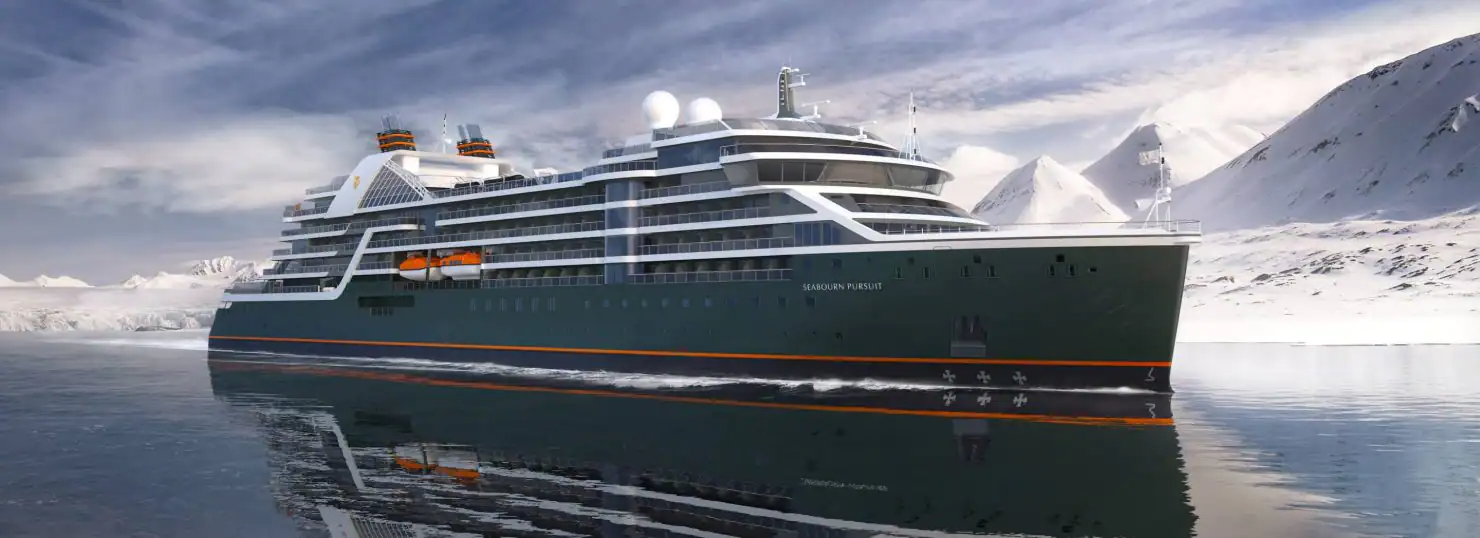
Seabourn · Seabourn Pursuit
Overview
A 21-night voyage aboard Seabourn Pursuit, departing Buenos Aires on 29 Jan 2029 and returning to the same port, calling at 7 destinations along the way.
Buenos AiresUshuaia, ArgentinaSouth Georgia Islands, AntarcticaPort StanleyFalkland IslandsUshuaia, ArgentinaBuenos Aires
Cabin prices
Live prices per person based on two sharing. Select a grade to see its fare options.
Loading live cabin prices…
Itinerary
21 nights · 25 ports of call- 1
Day 1 ·Buenos Aires, ArgentinaEmbark
29 Jan 2029Founded in 1536, Buenos Aires was administered by a Spanish viceroy for nearly three centuries before winning its independence in 1816. A sleepy port town for most of that time, it wasn't until the turn of the 20th century that the city finally emerged as an important shipping center. Today, Argentina's democratically elected government has made it South America's safest (and most expensive) country. This cosmopolitan city is characterized by broad boulevards with huge shade trees, beautiful residential districts, plazas containing monuments and fountains, interspersed with 20th-century high-rise buildings. It is a truly great walking city. - 2
Day 2 ·Buenos Aires, Argentina
30 Jan 2029Founded in 1536, Buenos Aires was administered by a Spanish viceroy for nearly three centuries before winning its independence in 1816. A sleepy port town for most of that time, it wasn't until the turn of the 20th century that the city finally emerged as an important shipping center. Today, Argentina's democratically elected government has made it South America's safest (and most expensive) country. This cosmopolitan city is characterized by broad boulevards with huge shade trees, beautiful residential districts, plazas containing monuments and fountains, interspersed with 20th-century high-rise buildings. It is a truly great walking city. - 2
Day 2 ·Buenos Aires, Argentina
30 Jan 2029Founded in 1536, Buenos Aires was administered by a Spanish viceroy for nearly three centuries before winning its independence in 1816. A sleepy port town for most of that time, it wasn't until the turn of the 20th century that the city finally emerged as an important shipping center. Today, Argentina's democratically elected government has made it South America's safest (and most expensive) country. This cosmopolitan city is characterized by broad boulevards with huge shade trees, beautiful residential districts, plazas containing monuments and fountains, interspersed with 20th-century high-rise buildings. It is a truly great walking city. - 2
Day 2 ·Ushuaia, Argentina
30 Jan 2029Depart 17:00The southernmost city in the world, Ushuaia is the capital of Argentine Tierra del Fuego and an important naval base boasting a strategic as well as a picturesque location on the shores of Ushuaia Bay and the Beagle Channel. This rustic coastal town is set among waterfalls, glaciers, snow-clad mountains and beech forests, and the nutrient-rich local waters abound with marine life. Though the houses here are painted warm, pastel colors, the weather is chilly year-round and winter sports such as downhill and cross-country skiing and skating are popular. Ushuaia's principal industries are raising sheep, logging, fishing and trapping. It became a boomtown with 30,000 residents in the late 1980's when the government sought to increase Argentina's presence near Antarctica by giving tax breaks to citizens who settled here. - 3
Day 3 ·At Sea
31 Jan 2029 - 4
Day 4 ·At Sea
1 Feb 2029 - 5
Day 5 ·Antarctic Experience
2 Feb 2029 - 6
Day 6 ·Antarctic Experience
3 Feb 2029 - 7
Day 7 ·Antarctic Experience
4 Feb 2029 - 8
Day 8 ·Antarctic Experience
5 Feb 2029 - 9
Day 9 ·Antarctic Experience
6 Feb 2029 - 10
Day 10 ·Antarctic Experience
7 Feb 2029Arrive 07:00Depart 17:00 - 11
Day 11 ·At Sea
8 Feb 2029 - 12
Day 12 ·At Sea
9 Feb 2029 - 13
Day 13 ·South Georgia Experience
10 Feb 2029South Georgia may include the following experiences. The exact itinerary is subject to permissions, weather, ice conditions and time available. The daily program will be determined by the Expedition Team and is subject to site availability.
Cooper Bay, South Georgia
A wealth of wildlife and awe-inspiring scenery reward those who visit Cooper Bay, a hidden gem awaiting discovery at the southeastern-most extremity of South Georgia. Four species of penguins nest and breed at Cooper Bay, including the island’s largest chinstrap penguin colony, together with colonies of macaroni and gentoo penguins and a small number of king penguins.
While macaroni penguins are the most abundant species on South Georgia, with numbers estimated at ten million, they are usually extremely hard to find. Elsewhere, they nest on inaccessibly high cliffs and steep rocky slopes, making Cooper Bay one of the few easily accessible locations. Giant petrels and both light-mantled and sooty albatrosses find safe nesting sites among the waist-high tussock grass that covers the steep slopes above the bay. Masses of fur seals swarm the beaches and are often seen playing in the kelp beds offshore.
Cooper Bay was named after Robert Cooper, First Lieutenant of James Cook’s ship HMS Resolution that visited here in 1775.
Drygalski Fjord, South Georgia
Drygalski Fjord is one of the most scenic areas of South Georgia, and also one of the windiest. Its narrow, two-and-a-half mile (4 km) waterway is bordered by steep-sided rock walls crowned by spectacular snow-covered peaks rising to over a 3,200’ (1,000 m). At the head of the fjord looms the mass of the Risting Glacier. The sharply pointed ice pinnacles and deep blue crevasses of its massive face occasionally send huge blocks of ice thundering into the water.
Despite its impressive and seemingly inhospitable appearance, Drygalski Fjord supports a surprising amount of wildlife. This is the main breeding area in South Georgia for snow petrels. Blue-eyed shags, Wilson’s storm petrels, and Antarctic terns are common visitors, and the fjord is also the northernmost recorded breeding site for Weddell seals.
The fjord was named to honor Professor Eric Von Drygalski, leader of the First German Antarctic Expedition of 1901-03.
Fortuna Bay, South Georgia
Scenic Fortuna Bay offers both prolific wildlife viewing and a magnificent panorama from its beach of jagged summit peaks and the impressive expanse of the Konig Glacier. Named after the first whale-catcher to operate here in the early 1900s, Fortuna Bay was used by early explorers and sealers long before the establishment of whaling stations on South Georgia.
It boasts a large population of elephant and fur seals along its mile-and-a-half (2km) long pebble beach. Seal pups congregate here in huge numbers. The curious pups run to and fro, playing frisky games and exploring the world around them, resembling a chaotic animal kindergarten. The bay also supports a colony of several thousand photogenic king penguins, the largest on South Georgia.
The best-known human history of Fortuna Bay comes from the tribulations of Sir Ernest Shackleton. It was here that he and his companions descended to the bay in 1916, after a treacherous crossing of the island’s ice cap, to reach their rescuers at the Stromness Whaling Station.
Gold Harbour, South Georgia
Gold Harbour, its small, crescent cove framed by the glacier-covered peaks of the Salvesen Range, is regarded as one of the most beautiful areas in all of South Georgia. The prominent icefall of the Betrab Glacier hangs dramatically from the cliffs above, from time to time releasing a large ice block to fall thundering into the sea.
The highlight of a visit to Gold Harbour is the large colony of king penguins that covers the length of the beach. Raucous penguin calls fill the air with never-ending whistles and chatters as fluffy penguin chicks roam the beach in search of their parents. A small gentoo penguin colony has tucked itself in amongst the grass nearby. Massive elephant seals, weighing thousands of pounds, lounge at the water’s edge, while leopard seals lurk off the beach in hopes of a careless penguin. Above, light-mantled albatrosses glide along the cliff faces as giant petrels hover over the colony.
Grytviken, South Georgia
Tucked in at the head of King Edward Cove and encircled by steep rugged mountains is the capital of South Georgia, Grytviken. It was established by the Norwegian captain Carl Larsen in 1904 as the island’s first land-based whaling station, and its name literally means “Pot Bay” for the number of seal- oil try-pots left here by early sealers.
Over 300 people lived in Grytviken during its busiest years. Nowadays it resembles a ghost town strewn with the remnants of rusty oil tanks, oil processing plants and the skeletons of derelict whaling vessels. The house of the station manager has been restored to become the South Georgia Museum. The Lutheran church and the white crosses of the cemetery are restored to their former state and stand in stark contrast to the verdant green peaks above. A monument marks the grave of the heroic British explorer Sir Ernest Shackleton, affectionately known by his men as ‘the boss.’ Grytviken also has its own post office, selling unique South Georgia stamps, while across the cove is the British Scientific Station at King Edward Point.
Salisbury Plain, South Georgia
Salisbury Plain is a stunningly beautiful place to visit. It was deposited by retreating glaciers along the shore of the Bay of Isles, and resembles an open stage rimmed by a towering amphitheater of snow-capped mountains. Its name first appeared on British Admiralty charts in 1930 and likely refers to the similarly named feature back in England.
Salisbury Plain is home to the second largest king penguin colony on the island. It is immense in size and overwhelming in numbers, with over 250,000 birds nesting, breeding, and molting on its shores. Penguins are everywhere, dotting the beach and covering the adjacent hillsides. A cacophony of trumpeting and chirping adult penguins and whistling chicks fills the air against a rhythmic backdrop of the surf crashing on the beach.
One of South Georgia’s largest elephant seal populations also comes to haul out along this 1.8 mile (3 km) long pebble beach. Fur seals are here in great abundance, hustling between penguin congregations and clusters of massive elephant seals in a scene of controlled biological chaos!
South Georgia
Remote and forbidding South Georgia, the most rugged of all sub-Antarctic islands, digests the fury of the stormy Southern Seas. The island’s dramatic glacier-covered mountains rise sharply and are crowned by Mount Paget at 6,900’ (2935m). Some 50 percent of South Georgia is permanently covered by glaciers, nourished by the proximity of the Antarctic Circumpolar Current.
The cold, surrounding seas in this area the most nutrient-rich on earth, and make South Georgia a mecca for wildlife. Amidst the vastness of the Southern Ocean, it is a place of pilgrimage for penguins: a place to feed, to breed, and to rear young. Over 250,000 king penguins return to South Georgia annually, transforming its bays and beaches into a mosaic of motion and sound. Several other species of penguins, along with skuas, petrels, albatrosses, pipits and other birds nest along its shores. A few million fur seals hustle about like playful puppies, and hundreds of thousands of elephant seals gather in haul-outs so unimaginably immense they must be seen to be believed.
St Andrews Bay, South Georgia
Few places on earth are as immensely grand as St Andrews Bay. This is a place of such sheer vast scale that it must be truly experienced to be believed. Its wave-battered, windswept beaches border a broad plain left behind by retreating glaciers, their white snouts clearly visible at the base of the mountains.
The desolation left behind by the glaciers didn’t stay vacant for long. The void was filled by literally hundreds of thousands of king penguins, gathering in one of the largest colonies on earth. Take the time to climb onto the crest of the moraine view to the unforgettable sight of a sea of penguins standing shoulder to shoulder. One of the largest Elephant seals haul-outs on the island is also here. In the early summer months, the beach seems carpeted by animals, an ever-changing labyrinth of massive gray forms and shapes. They growl and grunt while the wails and whimpers of fur seals fill the air from afar.
Stromness, South Georgia
The name Stromness is tied in history books to one of the greatest human endeavors of adversity and hope ever recorded. It was here that Sir Ernest Shackleton and his companions arrived in 1916 after an arduous 36-hour crossing of the island, traversing uncharted ice caps and treacherous mountain terrain, and finally reached this remote outpost of civilization.
Stromness Bay on the northern coast of South Georgia once housed a prominent whaling station. Established in 1907 as a site for a factory ship, it was enlarged in 1912 when the processing moved on shore. Buildings were constructed, and the population of the station dramatically increased. In 1961, it was abandoned to the mercy of the elements, and today the station’s ghostly appearance has given way to the forces of nature. Fur seals have reclaimed the bay and the occupy the ruins. Often, hundreds of fur seal pups only a few weeks old congregate on the beach and around the station, playing, fighting, hustling and running among the remnants of the abandoned equipment. - 14
Day 14 ·South Georgia Experience
11 Feb 2029South Georgia may include the following experiences. The exact itinerary is subject to permissions, weather, ice conditions and time available. The daily program will be determined by the Expedition Team and is subject to site availability.
Cooper Bay, South Georgia
A wealth of wildlife and awe-inspiring scenery reward those who visit Cooper Bay, a hidden gem awaiting discovery at the southeastern-most extremity of South Georgia. Four species of penguins nest and breed at Cooper Bay, including the island’s largest chinstrap penguin colony, together with colonies of macaroni and gentoo penguins and a small number of king penguins.
While macaroni penguins are the most abundant species on South Georgia, with numbers estimated at ten million, they are usually extremely hard to find. Elsewhere, they nest on inaccessibly high cliffs and steep rocky slopes, making Cooper Bay one of the few easily accessible locations. Giant petrels and both light-mantled and sooty albatrosses find safe nesting sites among the waist-high tussock grass that covers the steep slopes above the bay. Masses of fur seals swarm the beaches and are often seen playing in the kelp beds offshore.
Cooper Bay was named after Robert Cooper, First Lieutenant of James Cook’s ship HMS Resolution that visited here in 1775.
Drygalski Fjord, South Georgia
Drygalski Fjord is one of the most scenic areas of South Georgia, and also one of the windiest. Its narrow, two-and-a-half mile (4 km) waterway is bordered by steep-sided rock walls crowned by spectacular snow-covered peaks rising to over a 3,200’ (1,000 m). At the head of the fjord looms the mass of the Risting Glacier. The sharply pointed ice pinnacles and deep blue crevasses of its massive face occasionally send huge blocks of ice thundering into the water.
Despite its impressive and seemingly inhospitable appearance, Drygalski Fjord supports a surprising amount of wildlife. This is the main breeding area in South Georgia for snow petrels. Blue-eyed shags, Wilson’s storm petrels, and Antarctic terns are common visitors, and the fjord is also the northernmost recorded breeding site for Weddell seals.
The fjord was named to honor Professor Eric Von Drygalski, leader of the First German Antarctic Expedition of 1901-03.
Fortuna Bay, South Georgia
Scenic Fortuna Bay offers both prolific wildlife viewing and a magnificent panorama from its beach of jagged summit peaks and the impressive expanse of the Konig Glacier. Named after the first whale-catcher to operate here in the early 1900s, Fortuna Bay was used by early explorers and sealers long before the establishment of whaling stations on South Georgia.
It boasts a large population of elephant and fur seals along its mile-and-a-half (2km) long pebble beach. Seal pups congregate here in huge numbers. The curious pups run to and fro, playing frisky games and exploring the world around them, resembling a chaotic animal kindergarten. The bay also supports a colony of several thousand photogenic king penguins, the largest on South Georgia.
The best-known human history of Fortuna Bay comes from the tribulations of Sir Ernest Shackleton. It was here that he and his companions descended to the bay in 1916, after a treacherous crossing of the island’s ice cap, to reach their rescuers at the Stromness Whaling Station.
Gold Harbour, South Georgia
Gold Harbour, its small, crescent cove framed by the glacier-covered peaks of the Salvesen Range, is regarded as one of the most beautiful areas in all of South Georgia. The prominent icefall of the Betrab Glacier hangs dramatically from the cliffs above, from time to time releasing a large ice block to fall thundering into the sea.
The highlight of a visit to Gold Harbour is the large colony of king penguins that covers the length of the beach. Raucous penguin calls fill the air with never-ending whistles and chatters as fluffy penguin chicks roam the beach in search of their parents. A small gentoo penguin colony has tucked itself in amongst the grass nearby. Massive elephant seals, weighing thousands of pounds, lounge at the water’s edge, while leopard seals lurk off the beach in hopes of a careless penguin. Above, light-mantled albatrosses glide along the cliff faces as giant petrels hover over the colony.
Grytviken, South Georgia
Tucked in at the head of King Edward Cove and encircled by steep rugged mountains is the capital of South Georgia, Grytviken. It was established by the Norwegian captain Carl Larsen in 1904 as the island’s first land-based whaling station, and its name literally means “Pot Bay” for the number of seal- oil try-pots left here by early sealers.
Over 300 people lived in Grytviken during its busiest years. Nowadays it resembles a ghost town strewn with the remnants of rusty oil tanks, oil processing plants and the skeletons of derelict whaling vessels. The house of the station manager has been restored to become the South Georgia Museum. The Lutheran church and the white crosses of the cemetery are restored to their former state and stand in stark contrast to the verdant green peaks above. A monument marks the grave of the heroic British explorer Sir Ernest Shackleton, affectionately known by his men as ‘the boss.’ Grytviken also has its own post office, selling unique South Georgia stamps, while across the cove is the British Scientific Station at King Edward Point.
Salisbury Plain, South Georgia
Salisbury Plain is a stunningly beautiful place to visit. It was deposited by retreating glaciers along the shore of the Bay of Isles, and resembles an open stage rimmed by a towering amphitheater of snow-capped mountains. Its name first appeared on British Admiralty charts in 1930 and likely refers to the similarly named feature back in England.
Salisbury Plain is home to the second largest king penguin colony on the island. It is immense in size and overwhelming in numbers, with over 250,000 birds nesting, breeding, and molting on its shores. Penguins are everywhere, dotting the beach and covering the adjacent hillsides. A cacophony of trumpeting and chirping adult penguins and whistling chicks fills the air against a rhythmic backdrop of the surf crashing on the beach.
One of South Georgia’s largest elephant seal populations also comes to haul out along this 1.8 mile (3 km) long pebble beach. Fur seals are here in great abundance, hustling between penguin congregations and clusters of massive elephant seals in a scene of controlled biological chaos!
South Georgia
Remote and forbidding South Georgia, the most rugged of all sub-Antarctic islands, digests the fury of the stormy Southern Seas. The island’s dramatic glacier-covered mountains rise sharply and are crowned by Mount Paget at 6,900’ (2935m). Some 50 percent of South Georgia is permanently covered by glaciers, nourished by the proximity of the Antarctic Circumpolar Current.
The cold, surrounding seas in this area the most nutrient-rich on earth, and make South Georgia a mecca for wildlife. Amidst the vastness of the Southern Ocean, it is a place of pilgrimage for penguins: a place to feed, to breed, and to rear young. Over 250,000 king penguins return to South Georgia annually, transforming its bays and beaches into a mosaic of motion and sound. Several other species of penguins, along with skuas, petrels, albatrosses, pipits and other birds nest along its shores. A few million fur seals hustle about like playful puppies, and hundreds of thousands of elephant seals gather in haul-outs so unimaginably immense they must be seen to be believed.
St Andrews Bay, South Georgia
Few places on earth are as immensely grand as St Andrews Bay. This is a place of such sheer vast scale that it must be truly experienced to be believed. Its wave-battered, windswept beaches border a broad plain left behind by retreating glaciers, their white snouts clearly visible at the base of the mountains.
The desolation left behind by the glaciers didn’t stay vacant for long. The void was filled by literally hundreds of thousands of king penguins, gathering in one of the largest colonies on earth. Take the time to climb onto the crest of the moraine view to the unforgettable sight of a sea of penguins standing shoulder to shoulder. One of the largest Elephant seals haul-outs on the island is also here. In the early summer months, the beach seems carpeted by animals, an ever-changing labyrinth of massive gray forms and shapes. They growl and grunt while the wails and whimpers of fur seals fill the air from afar.
Stromness, South Georgia
The name Stromness is tied in history books to one of the greatest human endeavors of adversity and hope ever recorded. It was here that Sir Ernest Shackleton and his companions arrived in 1916 after an arduous 36-hour crossing of the island, traversing uncharted ice caps and treacherous mountain terrain, and finally reached this remote outpost of civilization.
Stromness Bay on the northern coast of South Georgia once housed a prominent whaling station. Established in 1907 as a site for a factory ship, it was enlarged in 1912 when the processing moved on shore. Buildings were constructed, and the population of the station dramatically increased. In 1961, it was abandoned to the mercy of the elements, and today the station’s ghostly appearance has given way to the forces of nature. Fur seals have reclaimed the bay and the occupy the ruins. Often, hundreds of fur seal pups only a few weeks old congregate on the beach and around the station, playing, fighting, hustling and running among the remnants of the abandoned equipment. - 15
Day 15 ·South Georgia Experience
12 Feb 2029South Georgia may include the following experiences. The exact itinerary is subject to permissions, weather, ice conditions and time available. The daily program will be determined by the Expedition Team and is subject to site availability.
Cooper Bay, South Georgia
A wealth of wildlife and awe-inspiring scenery reward those who visit Cooper Bay, a hidden gem awaiting discovery at the southeastern-most extremity of South Georgia. Four species of penguins nest and breed at Cooper Bay, including the island’s largest chinstrap penguin colony, together with colonies of macaroni and gentoo penguins and a small number of king penguins.
While macaroni penguins are the most abundant species on South Georgia, with numbers estimated at ten million, they are usually extremely hard to find. Elsewhere, they nest on inaccessibly high cliffs and steep rocky slopes, making Cooper Bay one of the few easily accessible locations. Giant petrels and both light-mantled and sooty albatrosses find safe nesting sites among the waist-high tussock grass that covers the steep slopes above the bay. Masses of fur seals swarm the beaches and are often seen playing in the kelp beds offshore.
Cooper Bay was named after Robert Cooper, First Lieutenant of James Cook’s ship HMS Resolution that visited here in 1775.
Drygalski Fjord, South Georgia
Drygalski Fjord is one of the most scenic areas of South Georgia, and also one of the windiest. Its narrow, two-and-a-half mile (4 km) waterway is bordered by steep-sided rock walls crowned by spectacular snow-covered peaks rising to over a 3,200’ (1,000 m). At the head of the fjord looms the mass of the Risting Glacier. The sharply pointed ice pinnacles and deep blue crevasses of its massive face occasionally send huge blocks of ice thundering into the water.
Despite its impressive and seemingly inhospitable appearance, Drygalski Fjord supports a surprising amount of wildlife. This is the main breeding area in South Georgia for snow petrels. Blue-eyed shags, Wilson’s storm petrels, and Antarctic terns are common visitors, and the fjord is also the northernmost recorded breeding site for Weddell seals.
The fjord was named to honor Professor Eric Von Drygalski, leader of the First German Antarctic Expedition of 1901-03.
Fortuna Bay, South Georgia
Scenic Fortuna Bay offers both prolific wildlife viewing and a magnificent panorama from its beach of jagged summit peaks and the impressive expanse of the Konig Glacier. Named after the first whale-catcher to operate here in the early 1900s, Fortuna Bay was used by early explorers and sealers long before the establishment of whaling stations on South Georgia.
It boasts a large population of elephant and fur seals along its mile-and-a-half (2km) long pebble beach. Seal pups congregate here in huge numbers. The curious pups run to and fro, playing frisky games and exploring the world around them, resembling a chaotic animal kindergarten. The bay also supports a colony of several thousand photogenic king penguins, the largest on South Georgia.
The best-known human history of Fortuna Bay comes from the tribulations of Sir Ernest Shackleton. It was here that he and his companions descended to the bay in 1916, after a treacherous crossing of the island’s ice cap, to reach their rescuers at the Stromness Whaling Station.
Gold Harbour, South Georgia
Gold Harbour, its small, crescent cove framed by the glacier-covered peaks of the Salvesen Range, is regarded as one of the most beautiful areas in all of South Georgia. The prominent icefall of the Betrab Glacier hangs dramatically from the cliffs above, from time to time releasing a large ice block to fall thundering into the sea.
The highlight of a visit to Gold Harbour is the large colony of king penguins that covers the length of the beach. Raucous penguin calls fill the air with never-ending whistles and chatters as fluffy penguin chicks roam the beach in search of their parents. A small gentoo penguin colony has tucked itself in amongst the grass nearby. Massive elephant seals, weighing thousands of pounds, lounge at the water’s edge, while leopard seals lurk off the beach in hopes of a careless penguin. Above, light-mantled albatrosses glide along the cliff faces as giant petrels hover over the colony.
Grytviken, South Georgia
Tucked in at the head of King Edward Cove and encircled by steep rugged mountains is the capital of South Georgia, Grytviken. It was established by the Norwegian captain Carl Larsen in 1904 as the island’s first land-based whaling station, and its name literally means “Pot Bay” for the number of seal- oil try-pots left here by early sealers.
Over 300 people lived in Grytviken during its busiest years. Nowadays it resembles a ghost town strewn with the remnants of rusty oil tanks, oil processing plants and the skeletons of derelict whaling vessels. The house of the station manager has been restored to become the South Georgia Museum. The Lutheran church and the white crosses of the cemetery are restored to their former state and stand in stark contrast to the verdant green peaks above. A monument marks the grave of the heroic British explorer Sir Ernest Shackleton, affectionately known by his men as ‘the boss.’ Grytviken also has its own post office, selling unique South Georgia stamps, while across the cove is the British Scientific Station at King Edward Point.
Salisbury Plain, South Georgia
Salisbury Plain is a stunningly beautiful place to visit. It was deposited by retreating glaciers along the shore of the Bay of Isles, and resembles an open stage rimmed by a towering amphitheater of snow-capped mountains. Its name first appeared on British Admiralty charts in 1930 and likely refers to the similarly named feature back in England.
Salisbury Plain is home to the second largest king penguin colony on the island. It is immense in size and overwhelming in numbers, with over 250,000 birds nesting, breeding, and molting on its shores. Penguins are everywhere, dotting the beach and covering the adjacent hillsides. A cacophony of trumpeting and chirping adult penguins and whistling chicks fills the air against a rhythmic backdrop of the surf crashing on the beach.
One of South Georgia’s largest elephant seal populations also comes to haul out along this 1.8 mile (3 km) long pebble beach. Fur seals are here in great abundance, hustling between penguin congregations and clusters of massive elephant seals in a scene of controlled biological chaos!
South Georgia
Remote and forbidding South Georgia, the most rugged of all sub-Antarctic islands, digests the fury of the stormy Southern Seas. The island’s dramatic glacier-covered mountains rise sharply and are crowned by Mount Paget at 6,900’ (2935m). Some 50 percent of South Georgia is permanently covered by glaciers, nourished by the proximity of the Antarctic Circumpolar Current.
The cold, surrounding seas in this area the most nutrient-rich on earth, and make South Georgia a mecca for wildlife. Amidst the vastness of the Southern Ocean, it is a place of pilgrimage for penguins: a place to feed, to breed, and to rear young. Over 250,000 king penguins return to South Georgia annually, transforming its bays and beaches into a mosaic of motion and sound. Several other species of penguins, along with skuas, petrels, albatrosses, pipits and other birds nest along its shores. A few million fur seals hustle about like playful puppies, and hundreds of thousands of elephant seals gather in haul-outs so unimaginably immense they must be seen to be believed.
St Andrews Bay, South Georgia
Few places on earth are as immensely grand as St Andrews Bay. This is a place of such sheer vast scale that it must be truly experienced to be believed. Its wave-battered, windswept beaches border a broad plain left behind by retreating glaciers, their white snouts clearly visible at the base of the mountains.
The desolation left behind by the glaciers didn’t stay vacant for long. The void was filled by literally hundreds of thousands of king penguins, gathering in one of the largest colonies on earth. Take the time to climb onto the crest of the moraine view to the unforgettable sight of a sea of penguins standing shoulder to shoulder. One of the largest Elephant seals haul-outs on the island is also here. In the early summer months, the beach seems carpeted by animals, an ever-changing labyrinth of massive gray forms and shapes. They growl and grunt while the wails and whimpers of fur seals fill the air from afar.
Stromness, South Georgia
The name Stromness is tied in history books to one of the greatest human endeavors of adversity and hope ever recorded. It was here that Sir Ernest Shackleton and his companions arrived in 1916 after an arduous 36-hour crossing of the island, traversing uncharted ice caps and treacherous mountain terrain, and finally reached this remote outpost of civilization.
Stromness Bay on the northern coast of South Georgia once housed a prominent whaling station. Established in 1907 as a site for a factory ship, it was enlarged in 1912 when the processing moved on shore. Buildings were constructed, and the population of the station dramatically increased. In 1961, it was abandoned to the mercy of the elements, and today the station’s ghostly appearance has given way to the forces of nature. Fur seals have reclaimed the bay and the occupy the ruins. Often, hundreds of fur seal pups only a few weeks old congregate on the beach and around the station, playing, fighting, hustling and running among the remnants of the abandoned equipment. - 16
Day 16 ·At Sea
13 Feb 2029 - 17
Day 17 ·At Sea
14 Feb 2029 - 18
Day 18 ·Stanley/Falkland Is/Islas Malvinas
15 Feb 2029Arrive 07:00Depart 17:00An archipelago of over 700 islands spread over 4,700 square miles lies about 300 miles east of the coast of Argentina. Its political affiliation is with the United Kingdom, and it is named the Falkland Islands, although this is disputed by Argentina, which calls the island group Islas Malvinas. The islands were the focus of a short, violent military confrontation between the two nations in 1982 which resulted in many lives lost. Most visitors come to the islands attracted by the severe beauty of the landscape and the unusual wildlife to be seen there, especially colonies of penguins. Port Stanley, the capital, is a plucky outpost supporting the hardy islanders who farm and fish and, lately, newcomers set on exploiting the recently discovered oil reserves offshore. - 19
Day 19 ·Falkland Islands
16 Feb 2029Arrive 07:00Depart 17:00There is nowhere else in the world like the Falkland Islands. The archipelago is a remote, wind-swept place of stunning landscapes, dazzling white sand beaches, magnificent wildlife, and a rather gregarious mix of people. Over 200 islands surround the two main islands of West and East Falkland. These isolated and treeless shores are home to an overwhelming abundance of birdlife: albatross, penguins, caracaras, geese, and many others. Perhaps it was the very remoteness of the islands; the allure of its barren landscapes, pure in their austerity and colorful in their details, and the immensely large open skies that attracted settlers to its shores long ago.
It has accumulated a wealth of maritime and military history. More than three hundred shipwrecks litter its shores, while the stark white crosses of both British and Argentine soldiers stand as a silent reminder to the war of 1982. Numerous claims for the islands have been put forward in the course of their history. Nowadays the Falkland Islands are a self-governing British Overseas Territory. - 20
Day 20 ·Falkland Islands
17 Feb 2029Arrive 07:00Depart 17:00There is nowhere else in the world like the Falkland Islands. The archipelago is a remote, wind-swept place of stunning landscapes, dazzling white sand beaches, magnificent wildlife, and a rather gregarious mix of people. Over 200 islands surround the two main islands of West and East Falkland. These isolated and treeless shores are home to an overwhelming abundance of birdlife: albatross, penguins, caracaras, geese, and many others. Perhaps it was the very remoteness of the islands; the allure of its barren landscapes, pure in their austerity and colorful in their details, and the immensely large open skies that attracted settlers to its shores long ago.
It has accumulated a wealth of maritime and military history. More than three hundred shipwrecks litter its shores, while the stark white crosses of both British and Argentine soldiers stand as a silent reminder to the war of 1982. Numerous claims for the islands have been put forward in the course of their history. Nowadays the Falkland Islands are a self-governing British Overseas Territory. - 21
Day 21 ·At Sea
18 Feb 2029 - 22
Day 22 ·Ushuaia, Argentina
19 Feb 2029Arrive 07:00The southernmost city in the world, Ushuaia is the capital of Argentine Tierra del Fuego and an important naval base boasting a strategic as well as a picturesque location on the shores of Ushuaia Bay and the Beagle Channel. This rustic coastal town is set among waterfalls, glaciers, snow-clad mountains and beech forests, and the nutrient-rich local waters abound with marine life. Though the houses here are painted warm, pastel colors, the weather is chilly year-round and winter sports such as downhill and cross-country skiing and skating are popular. Ushuaia's principal industries are raising sheep, logging, fishing and trapping. It became a boomtown with 30,000 residents in the late 1980's when the government sought to increase Argentina's presence near Antarctica by giving tax breaks to citizens who settled here. - 22
Day 22 ·Buenos Aires, ArgentinaDisembark
19 Feb 2029Founded in 1536, Buenos Aires was administered by a Spanish viceroy for nearly three centuries before winning its independence in 1816. A sleepy port town for most of that time, it wasn't until the turn of the 20th century that the city finally emerged as an important shipping center. Today, Argentina's democratically elected government has made it South America's safest (and most expensive) country. This cosmopolitan city is characterized by broad boulevards with huge shade trees, beautiful residential districts, plazas containing monuments and fountains, interspersed with 20th-century high-rise buildings. It is a truly great walking city.
Your ship: Seabourn Pursuit
Explore Seabourn Pursuit's cabins, dining and onboard facilities.