
28 nightsFrom Tokyo19 ports of call
28-Day Japan's Hidden Autumn Harbors & Korea
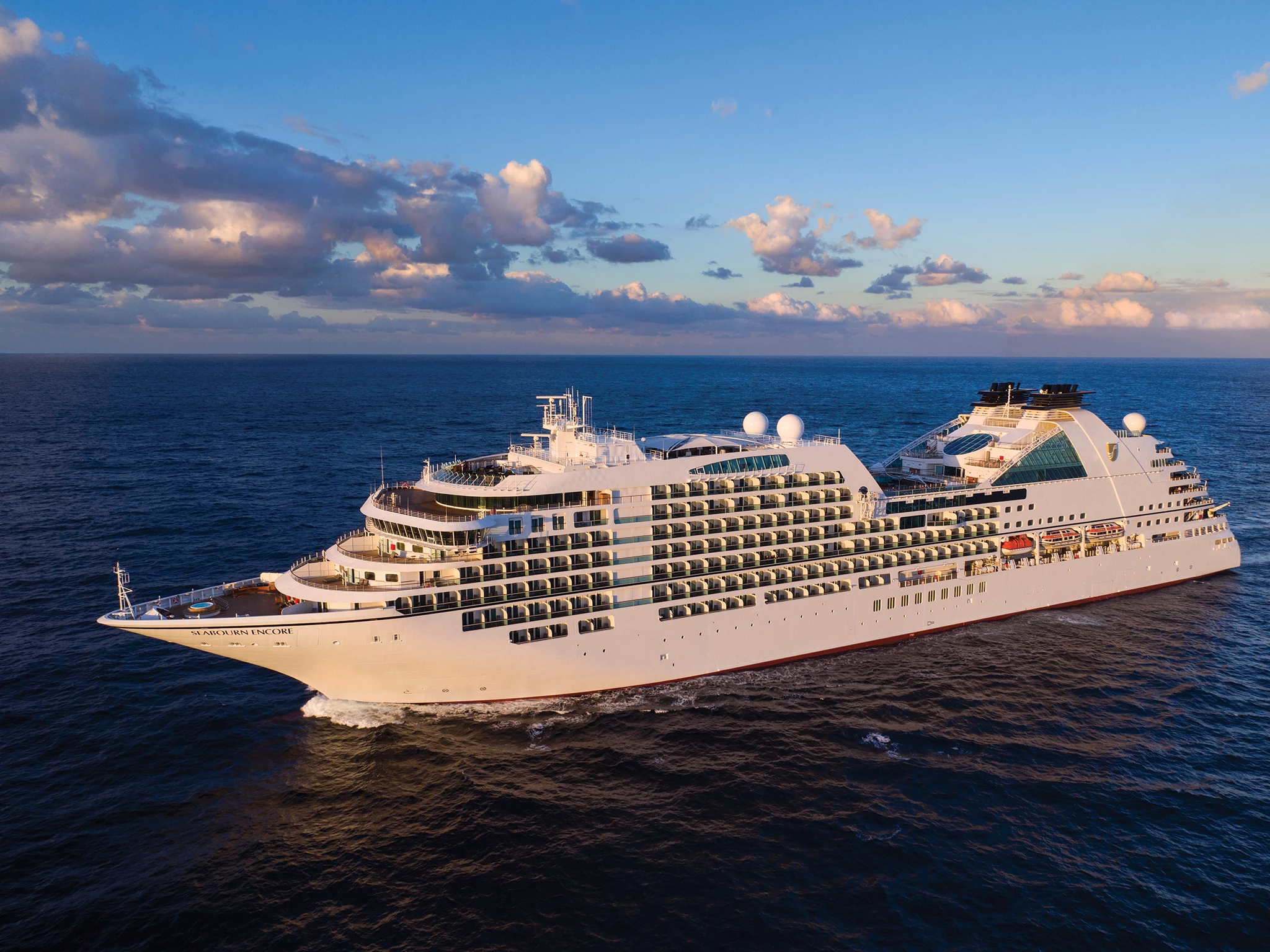
Seabourn · Seabourn Encore
Overview
A 28-night voyage aboard Seabourn Encore, departing Tokyo on 29 Sept 2028 and returning to the same port, calling at 19 destinations along the way.
TokyoMiyako,Iwate, JapanMuroran, JapanHakodateOtaru, JapanSokcho, South KoreaBusan, South KoreaChejuTokyoOsakaBusan, South KoreaSakaiminatoTsuruga, JapanToyamaSakata, JapanAomoriHakodateMiyako,Iwate, JapanTokyo
Cabin prices
Live prices per person based on two sharing. Select a grade to see its fare options.
Loading live cabin prices…
Itinerary
28 nights · 29 ports of call- 1
Day 1 ·Tokyo, JapanEmbark
29 Sept 2028Depart 19:00 - 2
Day 2 ·At Sea
30 Sept 2028 - 3
Day 3 ·Miyako, Japan
1 Oct 2028Arrive 07:00Depart 17:00 - 4
Day 4 ·Muroran, Japan
2 Oct 2028Arrive 08:00Depart 20:00 - 5
Day 5 ·Hakodate, Japan
3 Oct 2028Arrive 07:30Depart 18:30This important port on Japan’s northern Hokkaido Island was the first to be opened to European and American trade. The result of this is a trove of Western-style buildings in the suburb of Motomachi that gives the impression of a movie set. The bell of the distinctive Haristo Greek Orthodox church is designated one of Japan’s official treasured “100 soundscapes.” Hokkaido is famous for its hot springs, much beloved by the Japanese. Yunokawa Hot Spring enjoys a commanding view of the sea, and its botanical garden is home to the Japanese macaques called “snow monkeys” because of their habit of soaking in the hot springs during the northern winter. Goryokaku is a 150-year old star fortress that holds the Magistrate’s Office, an excellent example of traditional Japanese architecture. Get a panoramic view from the observation platform atop the Goryokaku Tower. - 7
Day 7 ·Otaru
4 Oct 2028Arrive 12:00This port on Japan’s northern island of Hokkaido thrived on coal exports and the herring fishery through the end of the 19th and the early 20th centuries, evidenced by the Western influenced “herring mansions” that line its central canal. The 1897 Nishin Goten is an early example, while the Aoyama Villa from 1924 is a later version. The 1912 Bank of Japan Museum is also influenced by Western taste, but nods to tradition with keystones representing owls, an ancient Ainu deity. Further afield, explore the Yoichi Nikka Whisky Distillery, the spas at the Jyozankei Hot Springs, or the Hokkaido coast as seen from the Cape Kanui Lighthouse. Any visit to Sapporo should include the mile-long Odoro Park. - 7
Day 7 ·Otaru
5 Oct 2028Depart 22:00This port on Japan’s northern island of Hokkaido thrived on coal exports and the herring fishery through the end of the 19th and the early 20th centuries, evidenced by the Western influenced “herring mansions” that line its central canal. The 1897 Nishin Goten is an early example, while the Aoyama Villa from 1924 is a later version. The 1912 Bank of Japan Museum is also influenced by Western taste, but nods to tradition with keystones representing owls, an ancient Ainu deity. Further afield, explore the Yoichi Nikka Whisky Distillery, the spas at the Jyozankei Hot Springs, or the Hokkaido coast as seen from the Cape Kanui Lighthouse. Any visit to Sapporo should include the mile-long Odoro Park. - 8
Day 8 ·At Sea
6 Oct 2028 - 9
Day 9 ·At Sea
7 Oct 2028 - 10
Day 10 ·Sokcho, South Korea
8 Oct 2028Arrive 07:00Depart 16:00 - 11
Day 11 ·Busan (Pusan), South Korea
9 Oct 2028Arrive 09:00Depart 19:00Busan is the second largest city in South Korea, and the country's seaside connection to Japan and the West. Lovely urban scenery, the Pusan International Film Festival, and near-by hot springs has made Busan a popular leisure destination. Busan has the sophistication of a major city, as well as famous beaches that lure visitors from all over the world. The city is a microcosm of South Korea, a nation whose economic success often obscures, to Westerners, one of Asia's most sophisticated and venerable cultures. - 12
Day 12 ·Jeju (Cheju) City, South Korea
10 Oct 2028Arrive 09:00Depart 19:00Jeju (Cheju) Island is a volcanic island, dominated by Halla-san (Halla Mountain), a volcano 6,398 feet high and the tallest mountain in South Korea. The island was created entirely from volcanic eruptions approximately two million years ago. Because of the relative isolation of the island, the people of Jeju have developed a culture and language that are distinct from those of mainland Korea. The most distinct cultural artifact is the ubiquitous dol hareubang ("stone grandfather") carved from a block of lava. Jeju translates to "Island of the Gods" and lives up to its name with beautiful beaches, waterfalls and volcanic rock formations. - 13
Day 13 ·At Sea
11 Oct 2028 - 14
Day 14 ·At Sea
12 Oct 2028 - 15
Day 15 ·Tokyo, Japan
13 Oct 2028Arrive 08:00Depart 19:00 - 16
Day 16 ·At Sea
14 Oct 2028 - 17
Day 17 ·Osaka
15 Oct 2028Arrive 07:00Depart 20:00 - 18
Day 18 ·Scenic Cruising Kanmon Straits
16 Oct 2028 - 19
Day 19 ·Busan (Pusan), South Korea
17 Oct 2028Arrive 07:00Depart 16:00Busan is the second largest city in South Korea, and the country's seaside connection to Japan and the West. Lovely urban scenery, the Pusan International Film Festival, and near-by hot springs has made Busan a popular leisure destination. Busan has the sophistication of a major city, as well as famous beaches that lure visitors from all over the world. The city is a microcosm of South Korea, a nation whose economic success often obscures, to Westerners, one of Asia's most sophisticated and venerable cultures. - 20
Day 20 ·Sakaiminato, Japan
18 Oct 2028Arrive 09:00Depart 18:00Renowned for its bounty of fresh seafood, Sakaiminato is a fishing town backed by mountains in the Honshu region. Izumo Grand Shrine is one of Japan’s most important Shinto temples, and the six-story, black Matsue Castle is one of the oldest surviving Tokugawa Samurai castles. View the snow-capped Mount Daisen, the vermilion, elaborately carved Hinomisaki temples or soak in the Kaike Onsen hot springs by the sea. The Adachi Museum holds a collection of modern Japanese art, while the Tottori Flower Road is a 124-acre flower garden. On the streets, a number of statues commemorate the Yokai figures created by the locally-born manga artist Mizuki Shigeru. - 21
Day 21 ·Tsuruga, Japan
19 Oct 2028Arrive 07:00Depart 16:00Tsuruga is a port city in central Japan. By the waterfront, the early-20th-century Red Brick Warehouse has a large-scale diorama of the historic city. Nearby, Kehi Jingū Shrine has a grand red torii gate. Kehi no Matsubara is a white-sand beach backed by pine trees. To the east, Nakaikemi-shicchi Wetland is known for birdlife and dragonflies. North of the city, ferries run to Mizushima, a tiny uninhabited island. - 22
Day 22 ·Toyama, Japan
20 Oct 2028Arrive 08:00Depart 18:00Toyama is a coastal city on Japan’s main island, Honshu. In the center, Toyama Castle Park has a restored castle dating to the 1500s, plus small museums of history and art. The nearby Toyama Glass Art Museum displays striking contemporary works. Rakusui-tei is an art museum in a traditional home with a formal garden. On the Fugan Canal, Kansui Park has views of the distant Tateyama mountains. - 23
Day 23 ·Sakata, Japan
21 Oct 2028Arrive 08:00Depart 18:00Sakata is a city on the northwest coast of Japan’s Honshu Island. In the center, Sankyo Soko is a group of warehouses built in 1893. One now contains the Historical Museum of Shonai Rice. The Honma Museum of Art includes antiques displayed in a 19th-century villa. The Ken Domon Museum of Photography is dedicated to the revered social realist photographer. North of the city, trails lead to up Mount Chōkai volcano. - 24
Day 24 ·Aomori, Japan
22 Oct 2028Arrive 09:00Depart 22:00Located on the northernmost harbor of Japan’s main island of Honshu, Aomori is the traditional departure point for Hokkaido Island. It is famous for its summer Nebuta Matsuri festival, and has a museum that recaptures the color and pageantry for those who visit in other seasons. Explore the earliest prehistoric cultures of Japan at the Sannai Maruyama archaeological site, or visit the Aomori Museum of Art for a look at more contemporary works. Nearby Hirosaki boasts a 17th Century castle. Visit either the Auga or the Furukawa public fish market, where you can create your own version of a donburi rice bowl with pristinely fresh local seafood. - 25
Day 25 ·Hakodate, Japan
23 Oct 2028Arrive 08:00This important port on Japan’s northern Hokkaido Island was the first to be opened to European and American trade. The result of this is a trove of Western-style buildings in the suburb of Motomachi that gives the impression of a movie set. The bell of the distinctive Haristo Greek Orthodox church is designated one of Japan’s official treasured “100 soundscapes.” Hokkaido is famous for its hot springs, much beloved by the Japanese. Yunokawa Hot Spring enjoys a commanding view of the sea, and its botanical garden is home to the Japanese macaques called “snow monkeys” because of their habit of soaking in the hot springs during the northern winter. Goryokaku is a 150-year old star fortress that holds the Magistrate’s Office, an excellent example of traditional Japanese architecture. Get a panoramic view from the observation platform atop the Goryokaku Tower. - 26
Day 26 ·Hakodate, Japan
24 Oct 2028Depart 20:00This important port on Japan’s northern Hokkaido Island was the first to be opened to European and American trade. The result of this is a trove of Western-style buildings in the suburb of Motomachi that gives the impression of a movie set. The bell of the distinctive Haristo Greek Orthodox church is designated one of Japan’s official treasured “100 soundscapes.” Hokkaido is famous for its hot springs, much beloved by the Japanese. Yunokawa Hot Spring enjoys a commanding view of the sea, and its botanical garden is home to the Japanese macaques called “snow monkeys” because of their habit of soaking in the hot springs during the northern winter. Goryokaku is a 150-year old star fortress that holds the Magistrate’s Office, an excellent example of traditional Japanese architecture. Get a panoramic view from the observation platform atop the Goryokaku Tower. - 27
Day 27 ·Miyako, Japan
25 Oct 2028Arrive 09:00Depart 20:00 - 28
Day 28 ·At Sea
26 Oct 2028 - 29
Day 29 ·Tokyo, JapanDisembark
27 Oct 2028Arrive 08:00
Your ship: Seabourn Encore
Explore Seabourn Encore's cabins, dining and onboard facilities.