
30 nightsFrom Cape Town15 ports of call
30-Day Africa's West Coast: Cape Town to Cabo Verde
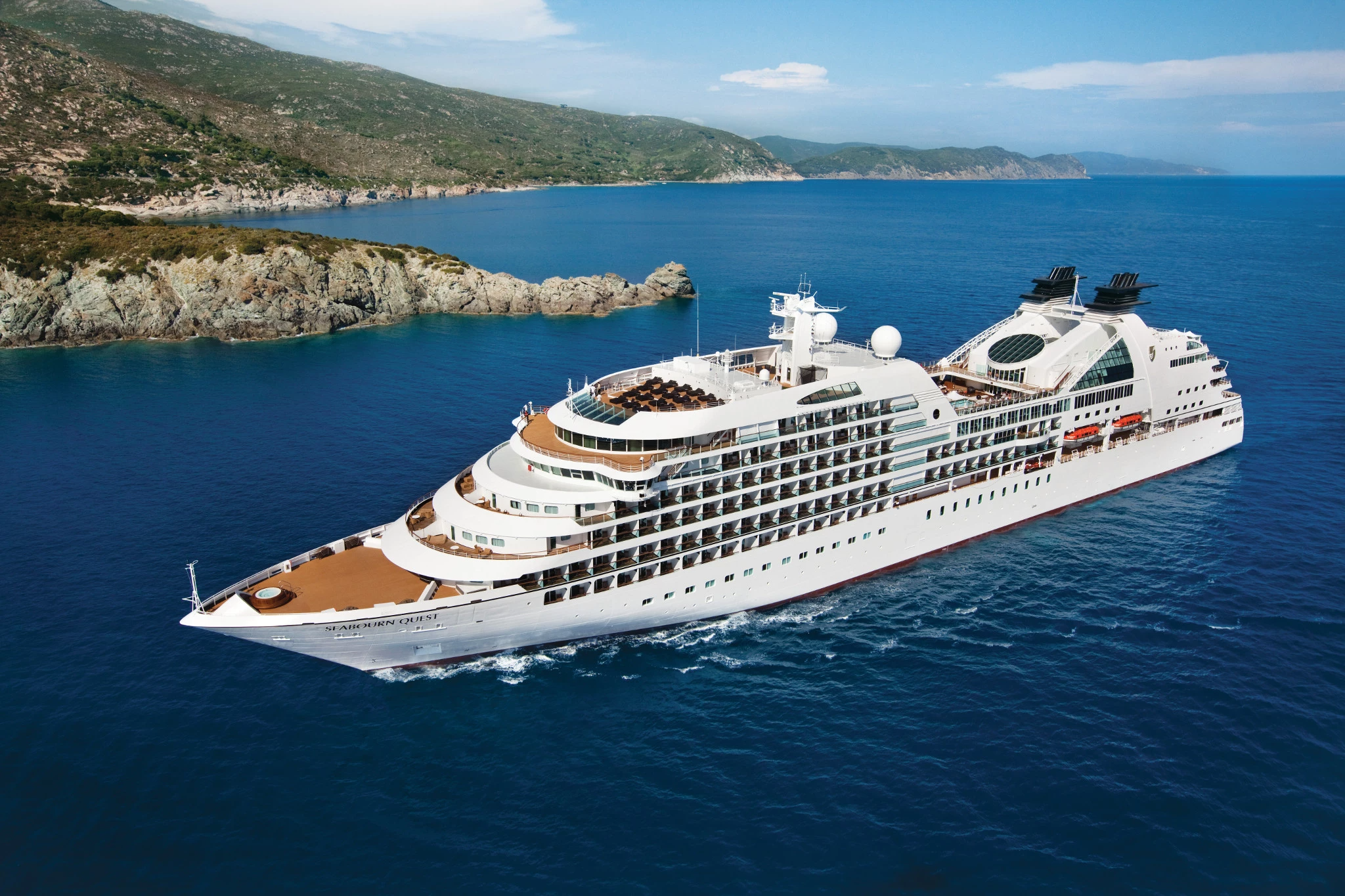
Seabourn · Seabourn Quest
Overview
A 30-night voyage aboard Seabourn Quest, departing Cape Town on 29 Mar 2028 and arriving in Lisbon, calling at 15 destinations along the way.
Cape TownLuderitzWalvis BayLuandaSao TomeCotonouTakoradiDakarMindelo, Cape VerdeLas Palmas,Gran CanariaArrecife, Lanzarote, Canary IslandsCasablancaTangier, MoroccoCadizLisbon
Cabin prices
Live prices per person based on two sharing. Select a grade to see its fare options.
Loading live cabin prices…
Itinerary
30 nights · 31 ports of call- 1
Day 1 ·Cape Town, South AfricaEmbark
29 Mar 2028Depart 22:00Nestled at the foot of Table Mountain and flanked by Devil's Peak and Lion's Head, Cape Town is known by South Africans simply as 'the Cape,' an acknowledgment of its uniqueness and its status as the Mother City. The first area to be settled by Europeans in the 17th century, it is today a major seaport and the legislative capital of South Africa. The feeling here is not African but cosmopolitan, and a sense of history remains. - 2
Day 2 ·At Sea
30 Mar 2028 - 3
Day 3 ·Luderitz, Namibia
31 Mar 2028Arrive 08:00Depart 17:00In 1883, a German businessman, Adolf Luderitz, purchased a parcel of land enclosing a small bay for purposes of speculation. The so-called Skeleton Coast had limited potential in many ways, being largely made up of the shifting sands of the Namib Desert. Then, in 1906, a local railway worker noticed an oddly sparkly stone beside the tracks. It proved to be a diamond, and it became clear that there were many like it lying literally on the surface of the sands. By 1909 a diamond rush was in full sway, and a thriving, German-styled town called Kolmanskop sprouted out of the desert to house the gem-seekers. When the easy pickings ended, the townspeople simply walked away, and the desert climate preserved the town as it was slowly engulfed by the shifting sands. Today it makes an evocative and haunting place to visit. The bay still hosts a bounty of wildlife as well, including seals, whales and flamingos. Other endeavors have started, too, such as the culture of delicious oysters in the clean, cold ocean waters. - 5
Day 5 ·Walvis Bay, Namibia
1 Apr 2028Arrive 12:00Its name in Afrikaans means "Whale Bay," but those days are long gone. Today its dramatic setting is inseparable from any impression of this deep-water port on Namibia's desolate, but beautiful "Skeleton Coast." Here the undulating dunes of the Namib Desert meet the sea, and its lagoon is spangled with white pelicans, pink flamingos and other seabirds. Up the coast road is Dune Seven, the highest along Namibia's coast, and a great place to take off your shoes and feel some sand between your toes after your Atlantic crossing. - 5
Day 5 ·Walvis Bay, Namibia
2 Apr 2028Depart 17:00Its name in Afrikaans means "Whale Bay," but those days are long gone. Today its dramatic setting is inseparable from any impression of this deep-water port on Namibia's desolate, but beautiful "Skeleton Coast." Here the undulating dunes of the Namib Desert meet the sea, and its lagoon is spangled with white pelicans, pink flamingos and other seabirds. Up the coast road is Dune Seven, the highest along Namibia's coast, and a great place to take off your shoes and feel some sand between your toes after your Atlantic crossing. - 6
Day 6 ·At Sea
3 Apr 2028 - 7
Day 7 ·At Sea
4 Apr 2028 - 8
Day 8 ·Luanda, Angola
5 Apr 2028Arrive 08:00Depart 18:00Luanda looks to be booming. Development and construction is fueled by extractive industries such as petroleum and diamonds. However over half the city’s residents live in poverty. It has for several years dominated the chart of the most expensive cities in the world for expatriates, outstripping such notorious places as Hong Kong and London. Like the rest of Portugal’s African colonies, Angola won its independence under force of arms in the mid-1970s. But the country immediately descended into a disastrous civil war that lasted decades, severely stunting development. Sites of interest include the 16th century Fortess of Sao Miguel, which looms over the harbor. Any visitor will assuredly be directed to the towering monument at the mausoleum of Agostinho Neto, the hero of the revolution. The National Museum of Anthropology is a good place to learn about the folkloric traditions, including a collection of exemplary masks. - 9
Day 9 ·At Sea
6 Apr 2028 - 10
Day 10 ·At Sea
7 Apr 2028 - 11
Day 11 ·Sao Tome, Sao Tome & Principe
8 Apr 2028Arrive 07:00Depart 18:00 - 12
Day 12 ·At Sea
9 Apr 2028 - 13
Day 13 ·Cotonou
10 Apr 2028Arrive 07:00Depart 18:00Cotonou is a large port city on the south coast of Benin, in West Africa. At the eastern end of central Boulevard St. Michel is the huge Dantokpa Market, which features religious items and spices alongside everyday objects. To the southwest, the 19th-century Cotonou Cathedral has a striking red-and-white striped facade. Nearby, in the Haie Vive district, the Fondation Zinsou museum shows contemporary African art. - 14
Day 14 ·Tema (Accra), Ghana
11 Apr 2028Arrive 08:00Depart 18:00 - 15
Day 15 ·Takoradi, Ghana
12 Apr 2028Arrive 08:00Depart 17:00Takoradi is a very important and busy West African seaport on Ghana’s Cape Coast, a main transport depot for container ships and oil tankers. Two of the main tourist sites near Takoradi are the village of Nzulemo and the old Portuguese slave depots called “castles.” The village of Nzulezo, on Lake Tadane, is a stilt community inscribed as a UNESCO World Heritage Site for its unique architectural and cultural characteristics. At Akatekyi, crocodiles play part in the activities of a fetish priest. Elmina Castle is about an hour away, and one of the best preserved slave barracoons on the coast. - 16
Day 16 ·At Sea
13 Apr 2028 - 17
Day 17 ·At Sea
14 Apr 2028 - 18
Day 18 ·At Sea
15 Apr 2028 - 19
Day 19 ·Dakar, Senegal
16 Apr 2028Arrive 08:00Depart 18:00One of the most vibrant and cosmopolitan African cities, the Senegalese capital bears many visual reminders of its past as a French colonial outpost. Despite the Parisian-style boulevards and buildings, however, there is a distinctly African feel to the city. Bankers and executives can be seen going about their businesses dressed in the flamboyant traditional Grand Boubou costume, and women wear the feminine version with an equally striking headpiece. The common language is French, although many citizens may also speak as many as five or six ethnic languages, since the whole coast of West Africa has been steeped in a heritage of mutual trade for centuries. Among the many sights and sounds greeting visitors, none is more evocative and sobering than a visit to Goree Island and its House of Slaves. This fortress, just offshore of the city waterfront, displays many reminders of the brutal trade in human beings, including an unimposing doorway, set just above the waterline in the seaside wall, identified simply as the “Door of No Return.” - 20
Day 20 ·At Sea
17 Apr 2028 - 21
Day 21 ·Mindelo, Cape Verde
18 Apr 2028Arrive 08:00Depart 18:00The most important city on the Cape Verde island of São Vicente, Mindelo originally thrived as a coal depot for steamships plying the Atlantic. With the advent of diesel engines, its importance waned, although it is still an important port for the maritime trade. The island is volcanic, dry and mostly low. The town has replica of Lisbon’s Belem Tower, located near the fish market, in an interesting part of the city. The late Cape Verdean singer Cesaria Evora started her career singing in the taverns of Mindelo, and later brought the uniquely lilting Cape Verdean form of fado music to the world through her bestselling records and concert tours. - 22
Day 22 ·At Sea
19 Apr 2028 - 23
Day 23 ·At Sea
20 Apr 2028 - 24
Day 24 ·Las Palmas, Spain
21 Apr 2028Arrive 08:00Depart 18:00Las Palmas is a large Spanish city, which just happens to be on the island of Gran Canaria. That fact adds the exotic, slightly African and international flavor to the place. It played an important part in the early exploration and exploitation of Africa and the New World, some of which is recounted in the Casa de Colon Museum. Columbus may have slept there, but it was never his house. It was actually the mansion of early governors. Other museums of note are the Museo Canaria with a number of Cro Magnon skulls, and the fascinating Elder Museum of Science and Technology. For shopping, strolling and general local interest, head to La Vegueta, the oldest quarter and a UNESCO World Heritage Site, and the adjacent Triana high street shopping district. Most visitors are here for the beaches, and the municipal Playa de Las Canteras is a long, clean and safe option if that is your intention. The Canaria in the name of the islands refers to the indigenous Presa Canaria breed of dogs, which are large, strong and made quite an impression on the earliest Spanish visitors. - 25
Day 25 ·Arrecife, Canary Islands
22 Apr 2028Arrive 08:00Depart 18:00Lanzarote is the northernmost of the Canary Islands, often known as "volcano island." Its capital is Arrecife, a quiet town of about 30,000 inhabitants. Present day Lanzarote consists of two quite distinct massifs: Famara in the north, and Los Ajaches in the south, where centuries of erosion have sculpted abrupt cliffs and deep ravines, contrasting sharply with the smoothly rounded hills of the island's central region. - 26
Day 26 ·At Sea
23 Apr 2028 - 27
Day 27 ·Casablanca, Morocco
24 Apr 2028Arrive 06:00Depart 20:00Casablanca, located on the Atlantic coast, is with 4 million inhabitants Morocco's largest city, and at the same time the largest port in Africa. Built on the site of ancient Phoenician Anfa, it remained a small fishing village for many centuries until the French arrived in 1912. Since then Casablanca has become a vast modern city, ever on the increase since Morocco's independence from France in 1956. A successful blend of oriental-style, white cubic dwellings with modern Moroccan quarters gives the city an interesting flair. Lovely beaches and attractive hotels make for a popular year-round holiday resort. To help understand Moroccan culture a visit to the Medina, the quaint old Moorish quarter, is a must for all visitors. - 28
Day 28 ·Tangier, Morocco
25 Apr 2028Arrive 09:00Depart 19:00Situated just across the narrow Strait of Gibraltar from Europe, Tangier has long comprised a hybrid culture that is nearly as European as it is African. Standing atop Cap Spartel, one can gaze down on the place where the Atlantic meets the Mediterranean. The “Hollywood” district where the foreign embassies have traditionally been located reflects the European influence. But ascending the hill above the waterfront, one enters the narrow, winding alleys of the Kasbah, the city’s oldest, most Moroccan section. Down the coast, nearby Tetouan retains a nearly untouched walled medina, with sections originally occupied by Andalusian, Berber and Jewish populations. It is small enough that visitors can explore it without risking becoming lost, making it a perfect choice as a UNESCO World Heritage Site. - 29
Day 29 ·Cadiz (Seville), Spain
26 Apr 2028Arrive 07:00Depart 23:00To taste the true flavor of this ancient port city, one should stroll its seaside promenade, pausing to rest beneath the huge banyan trees. The narrow, winding streets of the old town fan out from the port, leading you to sunny, palm-lined plazas. Visit the Catedral Nueva (New Cathedral), begun in the early 1800s but not completed for 116 years. Its dramatic, golden dome rises over a striking interior. For those who enjoy people-watching as much as sightseeing, the seafood restaurants along the eastern edge of the port provide the ideal setting. - 30
Day 30 ·At Sea
27 Apr 2028 - 31
Day 31 ·Lisbon, PortugalDisembark
28 Apr 2028Arrive 07:00The great period of "the Discoveries" accounted for phenomenal wealth brought back from India, Africa and Brazil by the great Portuguese navigators. Gold, jewels, ivory, porcelain and spices helped finance grand new buildings and impressive monuments in Lisbon, the country's capital city. As you sail up the Tagus River, be on deck to admire Lisbon's panorama and see some of the great monuments lining the river. Lisbon is one of Europe's smallest capital cities but considered by many visitors to be one of the most likeable. Spread over a string of seven hills, the city offers a variety of faces, including a refreshing no-frills simplicity reflected in the people as they go unhurriedly through their day enjoying a hearty and delicious cuisine accompanied by the country's excellent wines.
Your ship: Seabourn Quest
Explore Seabourn Quest's cabins, dining and onboard facilities.