
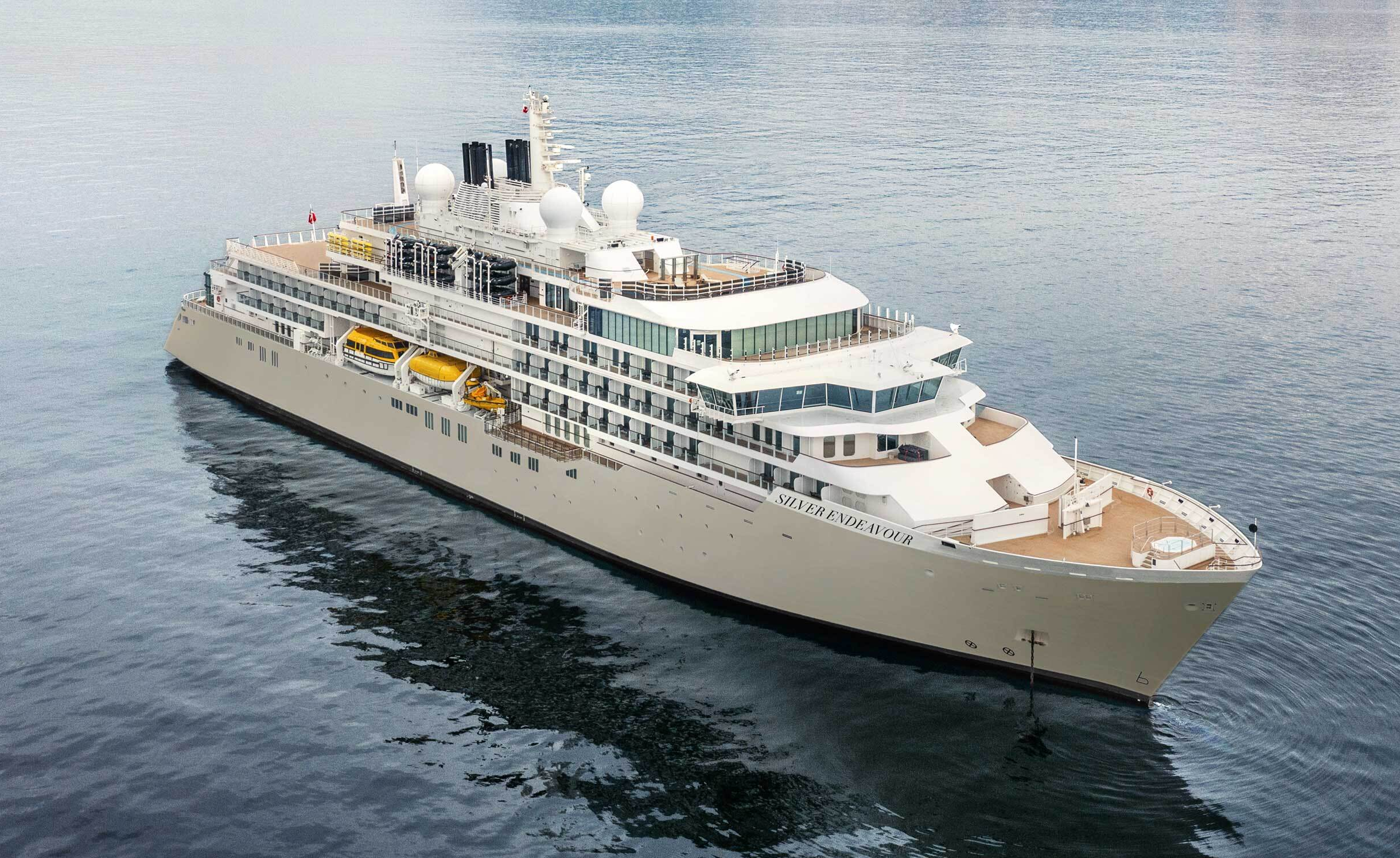
18 nightsFrom Dublin12 ports of call
Dublin to Longyearbyen
Silversea · Silver Endeavour
Overview
A 18-night voyage aboard Silver Endeavour, departing Dublin on 19 May 2027 and arriving in Longyearbyen, calling at 12 destinations along the way.
DublinBelfastCannaLerwick, ScotlandIsle of NossBronnoysundSvartisen GlacierSvolvaerTromso, NorwaySkarsvagSvalbardLongyearbyen
Cabin prices
Live prices per person based on two sharing. Select a grade to see its fare options.
Loading live cabin prices…
Itinerary
18 nights · 20 ports of call- 1
Day 1 ·Dublin , IrelandEmbark
19 May 2027Depart 20:00 - 2
Day 2 ·Belfast
20 May 2027Arrive 07:30Depart 18:00Reborn as a cool, modern city, Belfast has successfully left its troubles behind, emerging as a hotbed of culture and architecture, where the comfort of a cosy pub is never far away. Take a voyage of discovery in its maritime quarter, home to a celebrated museum dedicated to the most famous ship ever built, which was constructed right here in the city’s shipyards. A walk across the Lagan Weir Footbridge brings you to Belfast’s fascinating Titanic District – an area of the city devoted to its rich ship-building heritage.
The state-of-the-art Titanic Museum brings the story of the doomed vessel to life, and is the largest museum dedicated to the infamously ‘unsinkable’ ship. Wind up a nautical-themed ramble along the Maritime Mile with a visit to SS Nomadic, the smaller cousin of the Titanic, and a ship which serves as a fascinating time capsule back to the pomp and grandeur of the Titanic, while also telling its own stories of service in both World Wars. There’s just enough time to give the 10-metre long Salmon of Knowledge sculpture a quick peck for luck, before continuing to explore. A stark barbed wire and graffitied sheet metal barrier marks an abrupt scar through the city’s residential areas. The Peace Line was constructed during the height of the Troubles, when Belfast was plagued by sectarian divisions between Protestants and Catholics. Nowadays, you can jump in a black taxi tour to see the colourful murals and living history of the walls, which stand as a stark reminder of the fragility of peace. After exploring the city’s historic divisions, a reminder of Belfast’s uniting creativity can be found at the Metropolitan Arts Centre – a seven-storey tall building, which invites light to gloriously cascade inside. The Cathedral Quarter is a cobbled blend of flower-adorned pubs, restaurants and theatres, and venues where music spills out onto the streets at night, and many a pint is cheerily shared. - 3
Day 3 ·Isle of Canna, Scotland
21 May 2027Arrive 07:30Depart 16:00 - 5
Day 5 ·Lerwick, Shetland Islands, Scotland
22 May 2027Arrive 12:30Depart 22:00Adrift between the Scottish and Norwegian coasts, the craggy Shetland Islands form the most northerly point of the British Isles. Sprawling across 100 islands, connected by sandy bridges and crisscrossing ferries, explore the highlights of this scenic archipelago outpost. With incredible Neolithic history, spanning 5,000 years of human heritage, these islands, which sit just shy of the Arctic Circle, are an isolated and immense treasure trove of history and thrilling scenery. Look out over dramatic coastline from atmospheric Iron Age towers. View less
Sweeping, windswept beaches and wisps of sand connect islands and rugged cliffs - stand back as the sounds of the waves smashing against the shore and calling gulls fills the air. The islands are also home to some of the most adorable four-legged creatures you’ll ever meet, the diminutive and wavy-fringed, Shetland Ponies who roam the hills and reach a maximum size of 42 inches. Don't be fooled, though, they are amongst the strongest and toughest of all breeds. Their existence here points to Viking history, as local horses bred with ponies brought ashore by Norse settlers, creating the lovable crossbreed that is an icon of these islands today. The towering Broch of Mousa is perhaps Europe’s best-preserved Iron Age building - and one of the Shetland's finest brochs - a series of round, stone towers, believed to have been constructed around 100 BC. Seals and birdlife ensure that the isolated islands are always well-populated with life - and you can embark on hikes to discover their coastal homes. Lerwick is the islands’ capital, and there's a charming welcome on offer, as you arrive before the waterfront of stone buildings, which cascade down to the shore. - 5
Day 5 ·Noss, Scotland, United Kingdom
23 May 2027Arrive 06:30Depart 12:30 - 6
Day 6 ·Fosnavåg
24 May 2027Arrive 07:00Depart 13:00 - 7
Day 7 ·Bronnoysund
25 May 2027Arrive 08:30Depart 18:00Brønnøysund is a town and the administrative centre of Brønnøy Municipality in Nordland county, Norway. It is also a former municipality within Nordland county. The village of Brønnøysund originally was declared a ladested in 1923 which made it an independent municipality - 8
Day 8 ·Svartisen Glacier
26 May 2027Arrive 07:00Depart 20:00 - 9
Day 9 ·Svolvaer, Norway
27 May 2027Arrive 06:30Depart 15:00Svolvaer is located in Lofoten on the south coast of Austvagoy, facing the open sea to the south, and with mountains immediately to the north. The most famous mountain, Svolværgeita, was first climbed in 1910. Svolvaer is partly located on smaller islands, such as Svinøya, connected to the main island by way of the Svinoy Bridge. Sheltered by the mountains to the north and west, the Svolvær area has less fog and experiences somewhat higher daytime temperatures in summer than the western part of Lofoten, but the same mountains also create more orographic precipitation on rainy days. Svolvær offers the atmosphere of a harbour, a small town and art simultaneously. This is a bustling trading and communications centre with ferry, sea and air connections. - 10
Day 10 ·Tromsø
28 May 2027Arrive 08:00Depart 18:00Feel your heart flutter, as you catch your first glimpse of that famous emerald haze dancing across the stars, during your visit to this wonderful Arctic gateway. Located in the far north of Norway, a visit to Tromso beckons you to the extremes of this magical country, to explore a fairytale land of jagged mountains, glistening glaciers and husky-pulled sledges. Despite its remote location, you'll discover a perhaps surprisingly cosmopolitan city, with a healthy student population injecting plenty of energy. View less
Sat 250 miles above the Arctic Circle - at 69° north - you can bathe in the midnight sun's glow during summer, before winter brings the thick blackness and starry skies of endless polar nights. The darkness doesn't stop the fun - with a polar night half-marathon taking place in January - but the return of the sun is always a reason for a celebration here. To get the best view over the city, take the cable car to Storsteinen's amazing viewpoint. Magnificent views down over the city, fjord and Tromso's arching bridge will unravel before you. Learn more about northerly traditions, polar expeditions and arctic hunting at the Polar Museum. The Science Centre, meanwhile, explains how humans have harnessed and survived these epic landscapes over the years, and explores Tromso's breathtaking natural spectacle - the northern lights. The city is famed for its extraordinary viewing opportunities, which are often said to be the best in the world. The Alpine Botanic Garden is the most northern such garden on the planet, showcasing some of Norway's hardiest plantlife, which survives and thrives at this nose-bleeding altitude. - 12
Day 12 ·Skarsvag
29 May 2027Arrive 13:00Depart 18:00For those who like to travel far (very far) off the beaten track, then you have found your Nordic nirvana in Skarsvag. Large, sparsely populated (there are just 60 human year round residents), and a joy to all those who revel in stark, unbridled beauty, Skarsvag also enjoys the auspicious title of being the world’s most northerly fishing village. But rolling hills, prolific birdlife and arctic fjords aside, Skarsvag is above all famous for its proximity to the North Cape. View less
Found on the island of Magerøya, the most northernmost point of Europe above the arctic circle is a bucket list basic. Stand beneath the massive metal globe and gaze out onto the Barents Sea, where the only land between you and the North Pole is the Svalbard archipelago. This is truly the land of the midnight sun – in fact, you are so far north that the sun doesn’t even dip beneath the horizon between May and mid-July. The island’s famous bird cliffs are quite spectacular, and home to thousands of puffins, gannets and cormorants. Those willing to hike to cape Knivskjellodden, the northernmost point on Magerøya, will be rewarded with stunning cliff face views of the North Cape Plateau. Before leaving, head into the impressive North Cape Hall for exhibitions on the North Cape’s history. Travellers have been visiting since 1664, when Italian priest Francesco Negri arrived, so there are some tales to tell! More intriguingly, a tunnel has been hewn into the rock, leading down to the cliff face, complete with a chapel. - 12
Day 12 ·Cruising Along North Cape
29 May 2027Arrive 19:00Depart 20:00Situated at the very north tip of Norway and inside the Arctic Circle, there is something very special about being (almost) at the top of the world. Called the northernmost point of Europe, the North Cape (Nordkapp in Norwegian) lies about 1,306.3 mi from the North Pole, with no dry land between except for the Svalbald archipelago.
Home to where the Atlantic and Arctic oceans meet, this is the true land of the midnight sun – constant spectacular scenic views and 24-hour sunlight lends itself to a sense of giddy informality aboard. Just imagine sipping a chilled glass of champagne at the very top of the world in full daylight at midnight – sensational. Be sure to be on the lookout for hundreds of thousands of puffins, gannets, cormorants, seals, dolphins and whales that make this stretch of chilly water their home. Not forgetting the colourful, compact fishing villages, so at odds with the otherwise this stark, barren landscape. - 13
Day 13 ·Cruise & Explore Bear Island
30 May 2027Arrive 13:00Depart 17:30Bear Island is considered Svalbard’s southernmost island, roughly half way between Spitsbergen and Norway’s North Cape. Although the last polar bears were seen in 2004, the name goes back to Dutch explorer Willem Barentsz and his visit in 1596. The island has been used to hunt walrus, for whaling, and even coal mining has taken place. The strategic location on the border of the Norwegian Sea and the Barents Sea has led to a meteorological station being set up by Norway near Gravodden on Bear Island’s north coast.
Some two thirds of the island is a relatively flat plain with shallow freshwater lakes and Ramsar Wetland, while the entire island and the surrounding waters are a Nature Reserve. Bear Island has also been designated an Import Bird Area as it is a staging area for Pink-footed and Barnacle Geese and the steep cliffs south of Sørhamna are home to thousands of breeding seabirds. This is a specially protected area where Zodiacs are allowed to cruise along the cliffs around Kapp Kolthoff. In smaller amounts Atlantic Puffins, Northern Gannets, Glaucous Gulls and Great Skuas are found in between the large Black-legged Kittiwake, Little Auk, Common Guillemot and Brünnich’s Guillemot colonies. The constant battering of the sea has not only created impressive sea caves and tunnels, but unfortunately the Russian vessel Petrozavodsk shipwrecked near Revdalen at the base of the limestone cliffs and the waves are causing a continuous disintegration of the remains of the ship. - 14
Day 14 ·Svalbard
31 May 2027Arrive 12:30Depart 12:30Svalbard’s northern region is less influenced by the Norwegian Current coming through the Greenland Sea than the southern region and shows more ice. The northern part of the island of Spitsbergen shows quite a number of impressive fjords, bays and glaciers. The Nordaust Svalbard Nature Reserve includes Spitsbergen’s east coast, the Hinlopen Strait, Nordaustlandet and some islands further east like Kvitoya and Storoya. View less
Several walrus haul-outs, spectacular glaciers, bird cliffs and bird islands, as well as surprising flora in Arctic deserts and the possibility to see polar bears and to visit historically important sites make this an area prone for exploration. Ice conditions will dictate which sites can be seen. - 14
Day 14 ·Svalbard
1 Jun 2027Svalbard’s northern region is less influenced by the Norwegian Current coming through the Greenland Sea than the southern region and shows more ice. The northern part of the island of Spitsbergen shows quite a number of impressive fjords, bays and glaciers. The Nordaust Svalbard Nature Reserve includes Spitsbergen’s east coast, the Hinlopen Strait, Nordaustlandet and some islands further east like Kvitoya and Storoya. View less
Several walrus haul-outs, spectacular glaciers, bird cliffs and bird islands, as well as surprising flora in Arctic deserts and the possibility to see polar bears and to visit historically important sites make this an area prone for exploration. Ice conditions will dictate which sites can be seen. - 15
Day 15 ·Svalbard
2 Jun 2027Svalbard’s northern region is less influenced by the Norwegian Current coming through the Greenland Sea than the southern region and shows more ice. The northern part of the island of Spitsbergen shows quite a number of impressive fjords, bays and glaciers. The Nordaust Svalbard Nature Reserve includes Spitsbergen’s east coast, the Hinlopen Strait, Nordaustlandet and some islands further east like Kvitoya and Storoya. View less
Several walrus haul-outs, spectacular glaciers, bird cliffs and bird islands, as well as surprising flora in Arctic deserts and the possibility to see polar bears and to visit historically important sites make this an area prone for exploration. Ice conditions will dictate which sites can be seen. - 16
Day 16 ·Svalbard
3 Jun 2027Svalbard’s northern region is less influenced by the Norwegian Current coming through the Greenland Sea than the southern region and shows more ice. The northern part of the island of Spitsbergen shows quite a number of impressive fjords, bays and glaciers. The Nordaust Svalbard Nature Reserve includes Spitsbergen’s east coast, the Hinlopen Strait, Nordaustlandet and some islands further east like Kvitoya and Storoya. View less
Several walrus haul-outs, spectacular glaciers, bird cliffs and bird islands, as well as surprising flora in Arctic deserts and the possibility to see polar bears and to visit historically important sites make this an area prone for exploration. Ice conditions will dictate which sites can be seen. - 17
Day 17 ·Svalbard
4 Jun 2027Svalbard’s northern region is less influenced by the Norwegian Current coming through the Greenland Sea than the southern region and shows more ice. The northern part of the island of Spitsbergen shows quite a number of impressive fjords, bays and glaciers. The Nordaust Svalbard Nature Reserve includes Spitsbergen’s east coast, the Hinlopen Strait, Nordaustlandet and some islands further east like Kvitoya and Storoya. View less
Several walrus haul-outs, spectacular glaciers, bird cliffs and bird islands, as well as surprising flora in Arctic deserts and the possibility to see polar bears and to visit historically important sites make this an area prone for exploration. Ice conditions will dictate which sites can be seen. - 18
Day 18 ·Svalbard
5 Jun 2027Svalbard’s northern region is less influenced by the Norwegian Current coming through the Greenland Sea than the southern region and shows more ice. The northern part of the island of Spitsbergen shows quite a number of impressive fjords, bays and glaciers. The Nordaust Svalbard Nature Reserve includes Spitsbergen’s east coast, the Hinlopen Strait, Nordaustlandet and some islands further east like Kvitoya and Storoya. View less
Several walrus haul-outs, spectacular glaciers, bird cliffs and bird islands, as well as surprising flora in Arctic deserts and the possibility to see polar bears and to visit historically important sites make this an area prone for exploration. Ice conditions will dictate which sites can be seen. - 19
Day 19 ·LongyearbyenDisembark
6 Jun 2027Arrive 07:00
Your ship: Silver Endeavour
Explore Silver Endeavour's cabins, dining and onboard facilities.