
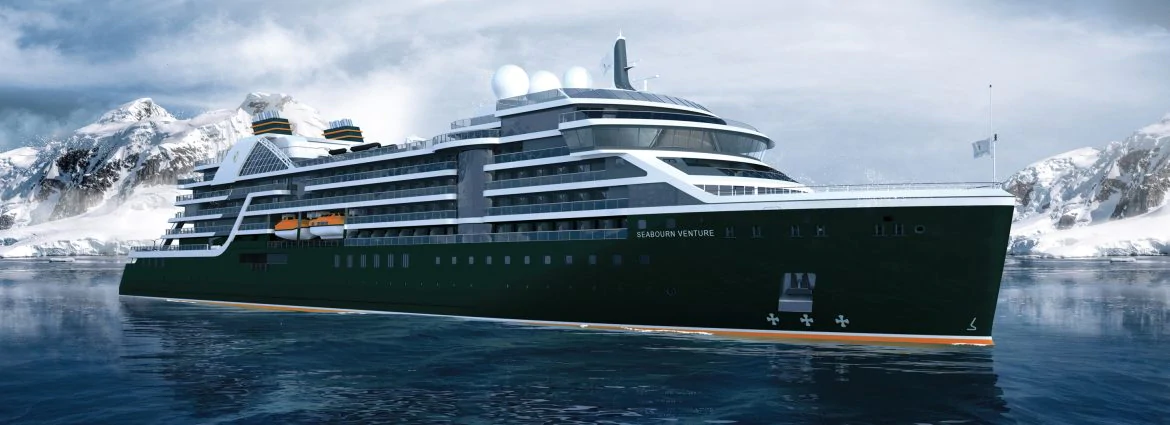
33 nightsFrom Reykjavik, Iceland19 ports of call
Greenland, Scoresbysund & Northwest Passage
Seabourn · Seabourn Venture
Overview
A 33-night voyage aboard Seabourn Venture, departing Reykjavik, Iceland on 17 Jul 2027 and returning to the same port, calling at 19 destinations along the way.
Reykjavik, IcelandGrundafjordurIttoqqortoormiitUmivikPrins Christian SundKangikitsokQaqortoq, GreenlandHvalseyQassiarsuq (Brattalihd)Nuuk GodthaabEvighedsfjordenSisimiut, GreenlandKangerlussuaqIlulissat, GreenlandPond InletNunavut CanadaNuuk GodthaabKangerlussuaqReykjavik, Iceland
Cabin prices
Live prices per person based on two sharing. Select a grade to see its fare options.
Loading live cabin prices…
Itinerary
33 nights · 38 ports of call- 1
Reykjavik, IcelandEmbark
16 Jul 2027Warmed by the Gulf Stream as well as by highly active thermal hot springs and volcanoes, Iceland is somewhat misnamed. While it is a stark and barren country with three huge areas of glaciers, one theory is that early Norsemen sought to mislead other potential settlers by giving a pleasant name to fierce, inhospitable Greenland, and a forbidding name to the imminently habitable Iceland. Irish monks and hermits established themselves here in the 8th century, but left a century later when the pagan Norsemen arrived. Europe's first Parliament of General Assembly, the Althing, was established in the year 930 and still functions as the legislative body, although it was suspended by the Danes at the end of the 18th century and not reconvened until 1843. Reykjavik was the site picked by the island's first permanent resident, Ingolfur Arnarson in 874, and is home to more than half of the island's total population. The world's northernmost capital, Reykjavik is proud of its virtual lack of air pollution. Both electrical power and home heating are derived from the geothermal activity on the island. The city's large swimming pools are always warm, and in the countryside exotic fruits such as grapes and bananas are cultivated in greenhouses made cozy with the help of underground hot springs. - 2
Reykjavik, Iceland
16 Jul 2027Warmed by the Gulf Stream as well as by highly active thermal hot springs and volcanoes, Iceland is somewhat misnamed. While it is a stark and barren country with three huge areas of glaciers, one theory is that early Norsemen sought to mislead other potential settlers by giving a pleasant name to fierce, inhospitable Greenland, and a forbidding name to the imminently habitable Iceland. Irish monks and hermits established themselves here in the 8th century, but left a century later when the pagan Norsemen arrived. Europe's first Parliament of General Assembly, the Althing, was established in the year 930 and still functions as the legislative body, although it was suspended by the Danes at the end of the 18th century and not reconvened until 1843. Reykjavik was the site picked by the island's first permanent resident, Ingolfur Arnarson in 874, and is home to more than half of the island's total population. The world's northernmost capital, Reykjavik is proud of its virtual lack of air pollution. Both electrical power and home heating are derived from the geothermal activity on the island. The city's large swimming pools are always warm, and in the countryside exotic fruits such as grapes and bananas are cultivated in greenhouses made cozy with the help of underground hot springs. - 2
Day 2 ·Grundarfjordur, Iceland
18 Jul 2027Arrive 07:00Depart 17:00The charming small fishing village of Grundarfjörður is located in the middle of the Snæfellsnes Peninsula and thus provides easy access to Stykkishólmur, Snæfellsbær and the Snæfellsnes National Park. Its best-known landmark is undoubtedly the peak of Mt. Kirkjufell. Translated as ‘church mountain,’ Kirkjufell is the most easily recognizable peak, and one of the most photographed mountains in Iceland. During summer months a Viking Village is built in the center of town where Viking re-enactments occur quite regularly. During the Á góðri stund town festival in July, the town’s 900 residents decorate their houses in red, blue, yellow, and green, transforming the town into a spinning kaleidoscope of color.
The town first began trade in 1786, and around 1800, French merchants came to Iceland and settled in Grundarfjörður, where they constructed a church and a hospital. The town has prospered through the fishing industry for a long time. The surrounding sea is rich with birdlife & marine life throughout the year. - 3
Day 3 ·At Sea
19 Jul 2027 - 4
Day 4 ·Exploring Scoresbysund
20 Jul 2027 - 5
Day 5 ·Exploring Scoresbysund
21 Jul 2027Arrive 07:00Depart 17:00 - 6
Day 6 ·Ittoqqortoormiit, Greenland
22 Jul 2027Arrive 07:00Depart 12:00 - 7
Day 7 ·At Sea
23 Jul 2027 - 8
Day 8 ·Umivik
24 Jul 2027Arrive 07:00Depart 12:00Umivik Bay, also known as Umiivik and Umerik, is a bay in King Frederick VI Coast, southeastern Greenland. It is part of the Sermersooq municipality. Unlike the jagged and forbidding appearance of most fjord systems in East Greenland, the Umivik area has a relatively gentle shape - 9
Day 9 ·Prins Christian Sund, Greenland
25 Jul 2027Arrive 08:00Depart 13:00 - 10
Day 10 ·Kangikitsok, Greenland
25 Jul 2027Arrive 16:00Depart 20:00 - 10
Day 10 ·Qaqortoq, Greenland
26 Jul 2027Arrive 08:00Depart 14:00The largest town in South Greenland with over 3,500 citizens, Qaqortoq was founded in 1775 and still reveals some examples of colonial-period architecture. There is not infrastructure to support shore excursions here, but guests can explore the town and its museum, or possibly arrange a visit to a nearby hot springs. Like other towns in Greenland, there are also possibilities to buy examples of traditional Inuit arts and crafts, including items crafted of bone, soapstone and wild-harvested furs. - 11
Day 11 ·Hvalsey, Greenland
26 Jul 2027Arrive 15:00Depart 20:00Twelve miles by Zodiac up the Hvalseyjarfjord from Qaqortoq, the largest community in South Greenland, lies the most prominent Norse archaeological site in Greenland. The so-called Eastern Settlement lasted from the 10th until the mid-15th century. Your expedition team archaeologist can interpret for you the ruins of the great halls and church at Hvalsey that hint of a prospering medieval farmstead. The site evokes an era when the Norse were trading with the indigenous Thule people of the area for furs and ivory, which were a prized commodities in Europe. A wedding held in the church in 1408 comprises the last written record of the Norse adventure in Greenland. Within a few years, Hvalsey and the rest of other Norse communities of Greenland withered as immigrants returned to the more established communities in Iceland and Norway. The site’s meadows of wildflowers sloping up from the fjord give a sense of the peaceful community that existed here in that long-ago summer. - 11
Day 11 ·Brattahlid (Qassiarsuk), Greenland
27 Jul 2027Arrive 07:00Depart 12:00 - 13
Day 13 ·Nuuk (Godthab), Greenland
28 Jul 2027Arrive 12:00Depart 23:00Greenland’s capital boasts some 16,000 inhabitants. Although the town does not offer us any shore excursions, there are several attractions which guests may wish to visit. One is the roofed town market, where the products of the nearby sea and wilderness are for sale, including the meat of whales, seals, birds and fish. The Katuaq Cultural Center offers changing exhibitions. Especially worth a visit is the National Museum, which besides many historic objects, contains the quite famous 500-year old mummies recovered from Qilakitsoq. The nearby Museum of Art has works by both Inuit and Nordic artists. There is also an artisan’s center where guests may purchase locally produced works, and a collection of traditional houses. - 14
Day 14 ·Evighedsfjorden
29 Jul 2027Arrive 12:00Depart 18:00 - 14
Day 14 ·Sisimiut (Holsteinsborg), Greenland
30 Jul 2027Arrive 07:00Depart 17:00Sisimiut is Greenland’s second-largest town, and large by Greenland standards, housing some 6,000 people. It is located just north of the Arctic Circle, and is a popular base for visitors seeking adventurous pastimes in the surrounding country. Although there are no shore excursions planned for Sisimiut, guests may wish to investigate the local market, where the products of the country are sold, including meat from whales, reindeer, musk oxen and many kinds of fish. Watch for the stocky little Icelandic horses trotting along the highways, and keep an eye out for sea eagles often seen perched on the surrounding mountains. Whales are also often seen in the sea nearby. On the hill above the harbor, there is an artisan’s workshop where they create and sell Inuit crafts, and nearby is the town museum, which has examples of colonial period houses, peat houses and other early buildings. - 15
Day 15 ·Kangerlussuaq
31 Jul 2027Arrive 07:00Depart 20:00In October, 1941 the United States Army Air Force constructed an airbase at the site of Kangerlussuaq. It served as a refuelling stop for single-engine military aircraft being flown to Britain during World War II. Form their last port of call, Goose Bay, Labrador, it was 1,600 kilometers (1,000 miles) to Kangerlussuaq until they could refuel. Kangerlussuaq fjord (‘Big Fjord’), is 170 kilometers (105 miles) long and was often shrouded in fog, providing a serious navigation problem for those aircrews.
Today, with the use of modern technology, navigation is no longer an issue. The landscape was ideal for the site of an airport. A large alluvial plain, deposited by the nearby glacial-outflow river, provided a perfectly flat environment for an airport. Kangerlussuaq is the largest commercial airport in Greenland and supports a population of 500. A little known fact, from 1971 to 1987, 33 missiles from various countries, were fired from Kangerlussuaq for upper atmospheric scientific research. - 16
Day 16 ·At Sea
1 Aug 2027 - 17
Day 17 ·Ilulissat (Jakobshavn), Greenland
2 Aug 2027Arrive 07:00Depart 17:00Located in Disco Bay, Ilulissat is home to Sermeq Kujalleq, the fastest-moving glacier in the world. This tremendous river of ice flows from the Greenland Ice Shield toward the sea, funneling through a narrow opening at nearly 40 meters a day. Designated a UNESCO World Heritage Site, it is the “Mother of Icebergs” that fills its fjord and the bay with great quantities of floating icebergs that parade down the bay and into the Atlantic Ocean. No formal excursions are planned for the town, which is home to about 4,600 people and some 3,500 sled dogs. - 18
Day 18 ·The Seabourn Northwest Greenland Experience
3 Aug 2027Arrive 07:00Depart 17:00 - 19
Day 19 ·At Sea
4 Aug 2027 - 20
Day 20 ·Pond Inlet
5 Aug 2027Arrive 06:00Depart 10:00 - 21
Day 21 ·Erik Harbour, Nunavut, Canada
5 Aug 2027Arrive 14:00Depart 18:00 - 21
Day 21 ·The Seabourn Northwest Passage Experience
6 Aug 2027 - 22
Day 22 ·The Seabourn Northwest Passage Experience
7 Aug 2027 - 23
Day 23 ·The Seabourn Northwest Passage Experience
8 Aug 2027 - 24
Day 24 ·The Seabourn Northwest Passage Experience
9 Aug 2027 - 25
Day 25 ·Cambridge Bay Village
10 Aug 2027Arrive 07:00Depart 12:00 - 26
Day 26 ·The Seabourn Northwest Passage Experience
11 Aug 2027 - 27
Day 27 ·The Seabourn Northwest Passage Experience
12 Aug 2027 - 29
Day 29 ·Philpots Island
13 Aug 2027Arrive 12:00Depart 16:00 - 29
Day 29 ·Dymond Islands, Nunavut, Canada
14 Aug 2027Arrive 09:00Depart 13:00 - 30
Day 30 ·The Seabourn Baffin Island Experience
15 Aug 2027 - 31
Day 31 ·At Sea
16 Aug 2027 - 32
Day 32 ·Nuuk (Godthab), Greenland
17 Aug 2027Arrive 05:00Depart 14:00Greenland’s capital boasts some 16,000 inhabitants. Although the town does not offer us any shore excursions, there are several attractions which guests may wish to visit. One is the roofed town market, where the products of the nearby sea and wilderness are for sale, including the meat of whales, seals, birds and fish. The Katuaq Cultural Center offers changing exhibitions. Especially worth a visit is the National Museum, which besides many historic objects, contains the quite famous 500-year old mummies recovered from Qilakitsoq. The nearby Museum of Art has works by both Inuit and Nordic artists. There is also an artisan’s center where guests may purchase locally produced works, and a collection of traditional houses. - 33
Day 33 ·Kangerlussuaq
18 Aug 2027Arrive 07:00Depart 20:00In October, 1941 the United States Army Air Force constructed an airbase at the site of Kangerlussuaq. It served as a refuelling stop for single-engine military aircraft being flown to Britain during World War II. Form their last port of call, Goose Bay, Labrador, it was 1,600 kilometers (1,000 miles) to Kangerlussuaq until they could refuel. Kangerlussuaq fjord (‘Big Fjord’), is 170 kilometers (105 miles) long and was often shrouded in fog, providing a serious navigation problem for those aircrews.
Today, with the use of modern technology, navigation is no longer an issue. The landscape was ideal for the site of an airport. A large alluvial plain, deposited by the nearby glacial-outflow river, provided a perfectly flat environment for an airport. Kangerlussuaq is the largest commercial airport in Greenland and supports a population of 500. A little known fact, from 1971 to 1987, 33 missiles from various countries, were fired from Kangerlussuaq for upper atmospheric scientific research. - 34
Day 34 ·Reykjavik, IcelandDisembark
19 Aug 2027Warmed by the Gulf Stream as well as by highly active thermal hot springs and volcanoes, Iceland is somewhat misnamed. While it is a stark and barren country with three huge areas of glaciers, one theory is that early Norsemen sought to mislead other potential settlers by giving a pleasant name to fierce, inhospitable Greenland, and a forbidding name to the imminently habitable Iceland. Irish monks and hermits established themselves here in the 8th century, but left a century later when the pagan Norsemen arrived. Europe's first Parliament of General Assembly, the Althing, was established in the year 930 and still functions as the legislative body, although it was suspended by the Danes at the end of the 18th century and not reconvened until 1843. Reykjavik was the site picked by the island's first permanent resident, Ingolfur Arnarson in 874, and is home to more than half of the island's total population. The world's northernmost capital, Reykjavik is proud of its virtual lack of air pollution. Both electrical power and home heating are derived from the geothermal activity on the island. The city's large swimming pools are always warm, and in the countryside exotic fruits such as grapes and bananas are cultivated in greenhouses made cozy with the help of underground hot springs.
Your ship: Seabourn Venture
Explore Seabourn Venture's cabins, dining and onboard facilities.