
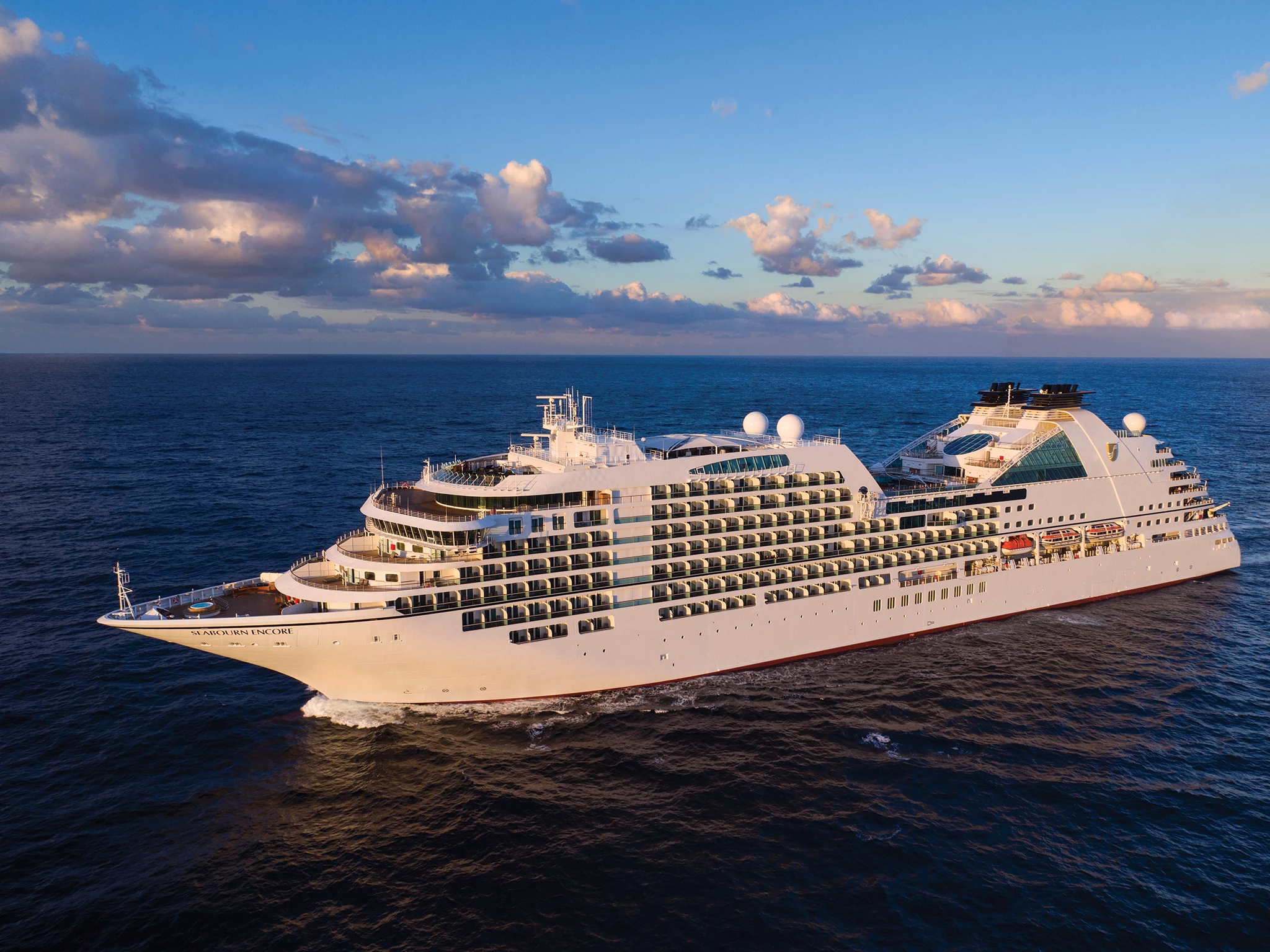
34 nightsFrom Vancouver, Canada22 ports of call
34-Day Alaska, Pacific Crossing & Autumn Reverie
Seabourn · Seabourn Encore
Overview
A 34-night voyage aboard Seabourn Encore, departing Vancouver, Canada on 18 Sept 2027 and arriving in Tokyo, calling at 22 destinations along the way.
Vancouver, CanadaKetchikanKlawock, AlaskaSitkaGlacier BayKodiak, AlaskaDutch Harbor, AlaskaKushiro, JapanMiyako,Iwate, JapanSendai, JapanHitachinaka, JapanTokyoOsakaBusan, South KoreaSakaiminatoTsuruga, JapanToyamaNiigata, JapanAomoriHakodateMiyako,Iwate, JapanTokyo
Cabin prices
Live prices per person based on two sharing. Select a grade to see its fare options.
Loading live cabin prices…
Itinerary
34 nights · 36 ports of call- 1
Day 1 ·Vancouver, B.C., CA Embark
18 Sept 2027Depart 17:00The humble beginnings of the City of Vancouver, in the settlement of Gastown on Burrard Inlet, rose out of the old growth forests and the sawdust of the old Hastings Mill. Its location between the Pacific Ocean and the snow-capped coastal mountains creates one of the most idyllic settings of any city in the world. As a world-class city it has the best of both worlds, intermingling urban sophistication with a sense of wilderness and outdoor adventure. Whether you are exploring Vancouver's diverse downtown core, strolling through the giant trees of Stanley Park or taking in the 20 miles (30 km) of uninterrupted waterfront trails along the seawall, you are bound to fall in love with Canada's third largest metropolitan center, which is consistently ranked as one of most livable cities on earth.
In 1886, the Canadian Pacific Railway reached Vancouver, completing Canada’s 'National Dream' of a connection between east and west, and opening up new trade routes between Asia and Europe. The city was named for British captain and explorer George Vancouver. - 1
Day 1 ·Transit the Seymour Narrows
18 Sept 2027The Seymour Narrows is a 3-mile/5 km stretch of the Discovery Channel north of Vancouver Island, British Columbia that is notorious for the strength of the tidal currents flowing through it. The average width of the narrows is just 750 meters. During extreme tides, the current through the narrows is subject to severe Venturi effect, resulting in an increased velocity that can reach 15 knots. For much of its modern history, there was an additional hazard in the narrows called Ripple Rock, a shallow obstruction that claimed no fewer than 119 ships and 114 lives. In 1958, after months of tunneling and preparation, Ripple Rock was blown up in the largest commercial, non-nuclear explosion ever recorded in North America. Still, the navigation of Seymour Narrows is dependent on tidal and other conditions, and requires skill and technical accomplishment. - 2
Day 2 ·Cruising the Queen Charlotte Sound
19 Sept 2027The Queen Charlotte Sound lies between the Queen Charlotte Strait, which winds between Vancouver Island and the British Columbia mainland in the south, and Hecate Strait, which is northward, adjacent to the Haida Gwaii Islands off the Pacific coast of British Columbia. It is a broad reach in the long shipping route called the Inside Passage threading the myriad islands stretching from Washington’s Puget Sound to Alaska. - 3
Day 3 ·Ketchikan, Alaska, US
20 Sept 2027Arrive 08:00Depart 17:00Ketchikan is a picturesque coastal town with a colorful frontier history, standing at the southern entrance to Alaska's famed Inside Passage. It began as a salmon cannery in 1885, built by company employee Mike Martin at the mouth of Ketchikan Creek. Once dubbed the 'Canned Salmon Capital of the World,’ today government, commercial fishing, and tourism are its main industries. The renowned Creek Street, perched on stilts along the mouth of the creek, would bring lasting infamy to the area for the red-light district that burgeoned there during the Gold Rush.
The town’s site first served as a camp for Tlingit people, and for thousands of years this has been their home. Their rich culture is being preserved to this day. A visit to Ketchikan is not complete without visiting one or all of Native American sites such as Totem Bight State Park, Potlatch Park, Saxman Native Village and the Totem Heritage Center. Together, these locations comprise the world's largest collection of standing Native American totem poles.
VIEW CRUISES - 4
Day 4 ·Klawock, Alaska, USA
21 Sept 2027Arrive 08:00Depart 17:00 - 5
Day 5 ·Sitka, Alaska, US
22 Sept 2027Arrive 08:00Depart 17:00A stroll through the streets and National Historic Park of Sitka is a glimpse into its unique and colorful past. A blend of Tlingit and Russian cultures defines this first capital of Alaska. Although fish canning and gold mining were the initial catalysts for growth in Sitka, the construction of an air base during World War II truly paved the way for Sitka to come into its own. One of Sitka's most intriguing structures is the Cathedral of Saint Michael, built in 1848 to honor a Russian Orthodox bishop.
Sitka’s history begins thousands of years ago with the Tlingit people and their use of the land for sustenance and spirituality. Old Sitka, located just north of the present-day settlement, was founded by Russian-American Company trader Alexander Baranov in 1799. Originally named Novo-Arkhangelsk (New Archangel) under Russian rule, its name was changed to Sitka after Alaska was purchased by the United States in 1867. Sitka is a Tlingit word meaning 'by the sea.’ - 6
Day 6 ·Glacier Bay
23 Sept 2027Arrive 08:00Depart 16:00Designated as an International World Heritage Site in 1992, Glacier Bay is also a National Monument, a National Park and a designated Biosphere Reserve. Over millennia, Glacier Bay has experienced many major advances of its glaciers. When first surveyed in 1794 by a team under the command of British captain George Vancouver on HMS Discovery, its vast glaciers extended well beyond present-day margins of the bay.
Temperate, coniferous rainforest dominates its southern shores. Black and brown bears, wolves, moose, eagles and ravens all go about their daily routines, while harbor seals and whales frolic within the bay waters.
Glacier Bay has two major arms, East and West, and over fifty named glaciers, some of which push forward at three to six feet per day. Combined with Wrangell St. Elias National Park and Canada’s Kluane National Park and Alsek-Tatshenshini Park, Glacier Bay encompasses the largest protected wilderness area on earth. This is a truly a place of awe-inspiring beauty and an icon of wild Alaska.
VIEW CRUISES
Skip Footer Content
About Us - 7
Day 7 ·At Sea
24 Sept 2027 - 8
Day 8 ·Kodiak, Alaska, US
25 Sept 2027Arrive 07:00Depart 16:00The largest of the Aleutian Islands, Kodiak is also Alaska’s largest island the second largest in the United States. Although occupied by native people for some 7,000 years, it languished in relative obscurity until the Second World War, when it housed as many as 25,000 troops. Fort Abercrombie, once the major center of North Pacific operations, today is a State Historic Park and a good place to learn the history. At the other end of the road system is the United States Coast Guard’s largest base, with a fleet of orange and white watercraft and aircraft that serves the Alaskan fishing fleet and other shipping and maritime activities in the Pacific area. Kodiak harbor is seasonally home to a fleet of some 650 fishing vessels, including huge trawlers, long-line and crab boats. Fishing is also a popular draw for visitors, but they also are attracted by opportunities to view and photograph local birds and wildlife, including the island’s massive brown bears, the males of which weigh as much as 1,500 pounds and stand ten feet tall. In the town, the fur warehouse originally built by the Russian American Company in 1808 is now the Baranov Museum, the oldest standing building in Alaska.
VIEW CRUISES - 9
Day 9 ·At Sea
26 Sept 2027 - 10
Day 10 ·Dutch Harbor, Alaska
27 Sept 2027Arrive 10:00Depart 18:00 - 11
Day 11 ·At Sea
28 Sept 2027 - 12
Day 12 ·At Sea
29 Sept 2027 - 13
Day 13 ·At Sea
30 Sept 2027 - 14
Day 14 ·Cross International Dateline
1 Oct 2027 - 16
Day 16 ·At Sea
3 Oct 2027 - 17
Day 17 ·At Sea
4 Oct 2027 - 18
Day 18 ·Kushiro, Japan
5 Oct 2027Arrive 07:00Depart 16:00Blessed by a protective range of mountains and a relatively warm ocean current, Kushiro gets less than a third of the winter snow of its Hokkaido neighbor Sapporo, and twice as much sunshine as the nearby Kuril Islands. Thus it is an important reliably ice-free port during the winter. Like all of Japan, it is riddled with semi-active geothermal features and occasionally rattled by tremors. Scenic Lake Akan is ringed by hot springs. It also has an Ainu Koten museum with a replica village and folklore performances of the indigenous Hokkaido people. The Japanese Crane Reserve is a good place to see breeding populations of these large and graceful birds, so respected by the Japanese. The city encompasses Japan’s largest wetland, and the Kushiro City Marsh Observatory has a boardwalk to see it, as well as the Fureai Horse Park which offers equestrian tours into the forest. - 19
Day 19 ·Miyako, Japan
6 Oct 2027Arrive 10:00Depart 19:00 - 20
Day 20 ·Sendai, Japan
7 Oct 2027Arrive 08:00Depart 18:00 - 21
Day 21 ·Hitachinaka, Japan
8 Oct 2027Arrive 07:00Depart 17:00 - 22
Day 22 ·Tokyo, Japan
9 Oct 2027Arrive 08:00Depart 19:00 - 23
Day 23 ·At Sea
10 Oct 2027 - 24
Day 24 ·Osaka
11 Oct 2027Arrive 07:00Depart 20:00 - 25
Day 25 ·Scenic Cruising Kanmon Straits
12 Oct 2027 - 26
Day 26 ·Busan (Pusan), South Korea
13 Oct 2027Arrive 07:00Depart 16:00Busan is the second largest city in South Korea, and the country's seaside connection to Japan and the West. Lovely urban scenery, the Pusan International Film Festival, and near-by hot springs has made Busan a popular leisure destination. Busan has the sophistication of a major city, as well as famous beaches that lure visitors from all over the world. The city is a microcosm of South Korea, a nation whose economic success often obscures, to Westerners, one of Asia's most sophisticated and venerable cultures. - 27
Day 27 ·Sakaiminato, Japan
14 Oct 2027Arrive 09:00Depart 18:00Renowned for its bounty of fresh seafood, Sakaiminato is a fishing town backed by mountains in the Honshu region. Izumo Grand Shrine is one of Japan’s most important Shinto temples, and the six-story, black Matsue Castle is one of the oldest surviving Tokugawa Samurai castles. View the snow-capped Mount Daisen, the vermilion, elaborately carved Hinomisaki temples or soak in the Kaike Onsen hot springs by the sea. The Adachi Museum holds a collection of modern Japanese art, while the Tottori Flower Road is a 124-acre flower garden. On the streets, a number of statues commemorate the Yokai figures created by the locally-born manga artist Mizuki Shigeru. - 28
Day 28 ·Tsuruga, Japan
15 Oct 2027Arrive 07:00Depart 16:00Tsuruga is a port city in central Japan. By the waterfront, the early-20th-century Red Brick Warehouse has a large-scale diorama of the historic city. Nearby, Kehi Jingū Shrine has a grand red torii gate. Kehi no Matsubara is a white-sand beach backed by pine trees. To the east, Nakaikemi-shicchi Wetland is known for birdlife and dragonflies. North of the city, ferries run to Mizushima, a tiny uninhabited island. - 29
Day 29 ·Toyama, Japan
16 Oct 2027Arrive 08:00Depart 18:00Toyama is a coastal city on Japan’s main island, Honshu. In the center, Toyama Castle Park has a restored castle dating to the 1500s, plus small museums of history and art. The nearby Toyama Glass Art Museum displays striking contemporary works. Rakusui-tei is an art museum in a traditional home with a formal garden. On the Fugan Canal, Kansui Park has views of the distant Tateyama mountains. - 30
Day 30 ·Niigata
17 Oct 2027Arrive 07:00Depart 16:00 - 31
Day 31 ·Aomori, Japan
18 Oct 2027Arrive 11:00Depart 22:00Located on the northernmost harbor of Japan’s main island of Honshu, Aomori is the traditional departure point for Hokkaido Island. It is famous for its summer Nebuta Matsuri festival, and has a museum that recaptures the color and pageantry for those who visit in other seasons. Explore the earliest prehistoric cultures of Japan at the Sannai Maruyama archaeological site, or visit the Aomori Museum of Art for a look at more contemporary works. Nearby Hirosaki boasts a 17th Century castle. Visit either the Auga or the Furukawa public fish market, where you can create your own version of a donburi rice bowl with pristinely fresh local seafood. - 32
Day 32 ·Hakodate, Japan
19 Oct 2027Arrive 08:00This important port on Japan’s northern Hokkaido Island was the first to be opened to European and American trade. The result of this is a trove of Western-style buildings in the suburb of Motomachi that gives the impression of a movie set. The bell of the distinctive Haristo Greek Orthodox church is designated one of Japan’s official treasured “100 soundscapes.” Hokkaido is famous for its hot springs, much beloved by the Japanese. Yunokawa Hot Spring enjoys a commanding view of the sea, and its botanical garden is home to the Japanese macaques called “snow monkeys” because of their habit of soaking in the hot springs during the northern winter. Goryokaku is a 150-year old star fortress that holds the Magistrate’s Office, an excellent example of traditional Japanese architecture. Get a panoramic view from the observation platform atop the Goryokaku Tower. - 33
Day 33 ·Hakodate, Japan
20 Oct 2027Depart 18:00This important port on Japan’s northern Hokkaido Island was the first to be opened to European and American trade. The result of this is a trove of Western-style buildings in the suburb of Motomachi that gives the impression of a movie set. The bell of the distinctive Haristo Greek Orthodox church is designated one of Japan’s official treasured “100 soundscapes.” Hokkaido is famous for its hot springs, much beloved by the Japanese. Yunokawa Hot Spring enjoys a commanding view of the sea, and its botanical garden is home to the Japanese macaques called “snow monkeys” because of their habit of soaking in the hot springs during the northern winter. Goryokaku is a 150-year old star fortress that holds the Magistrate’s Office, an excellent example of traditional Japanese architecture. Get a panoramic view from the observation platform atop the Goryokaku Tower. - 34
Day 34 ·Miyako, Japan
21 Oct 2027Arrive 08:00Depart 18:00 - 35
Day 35 ·At Sea
22 Oct 2027 - 36
Day 36 ·Tokyo, JapanDisembark
23 Oct 2027Arrive 08:00
Your ship: Seabourn Encore
Explore Seabourn Encore's cabins, dining and onboard facilities.