
35 nightsFrom Copenhagen, Denmark25 ports of call
35-Day Baltic Explorer, Iceland & Canada Fall Foliage
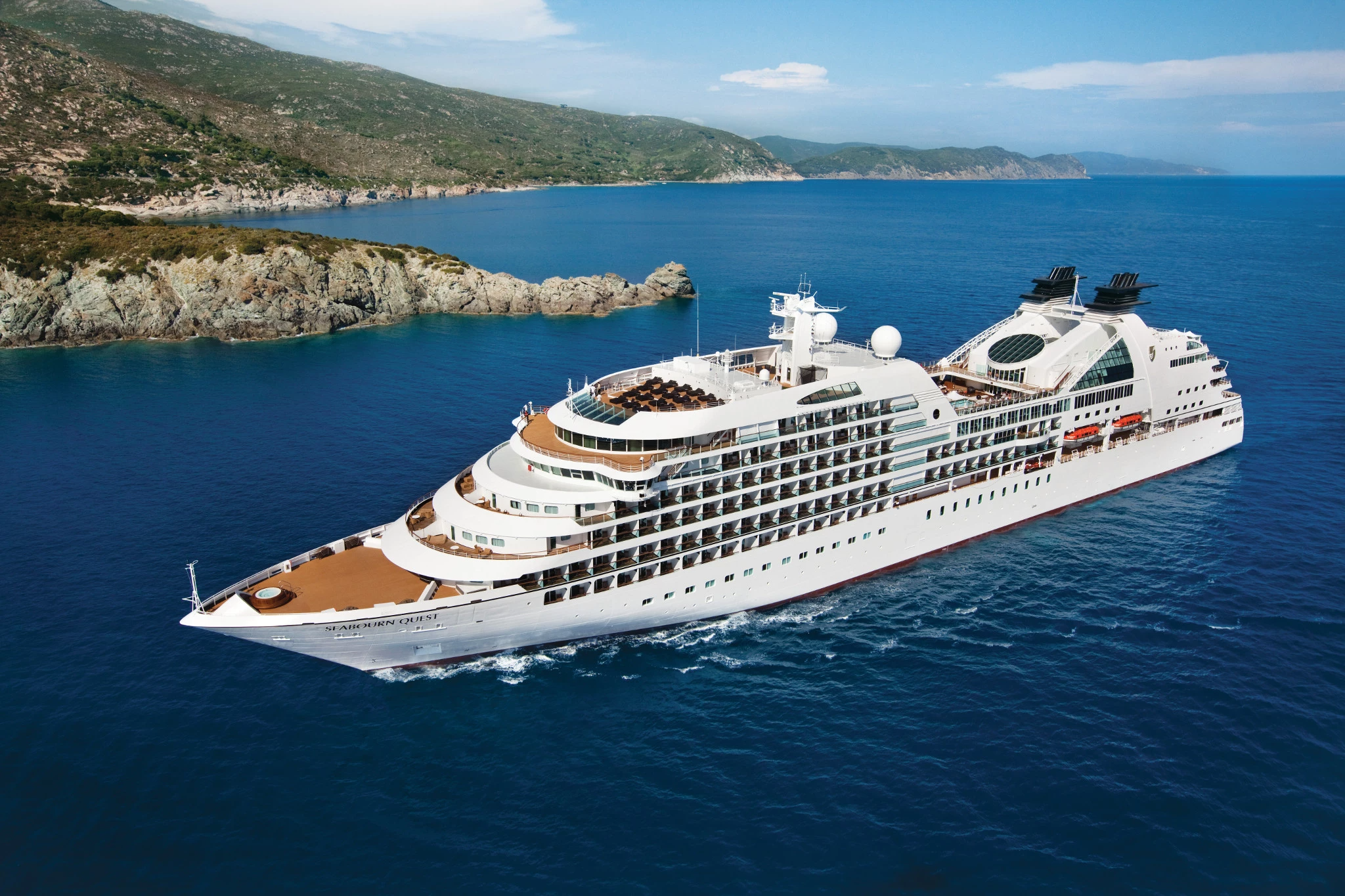
Seabourn · Seabourn Quest
Overview
A 35-night voyage aboard Seabourn Quest, departing Copenhagen, Denmark on 21 Aug 2027 and arriving in Montreal, calling at 25 destinations along the way.
Copenhagen, DenmarkVisby, SwedenStockholmTallinn, EstoniaRigaKlaipeda, LithuaniaGdansk, PolandCopenhagen, DenmarkStavanger, NorwayLerwick, ScotlandThorshavenRunavik (Faroe Isles)HusavikSiglufjordurGrundafjordurReykjavik, IcelandGrundafjordurIsafjordurNanortalikQaqortoq, GreenlandSt. Anthony, NewfoundlandGaspeBaie-Commeau, Quebec, CanadaQuebec City, CanadaMontreal
Cabin prices
Live prices per person based on two sharing. Select a grade to see its fare options.
Loading live cabin prices…
Itinerary
35 nights · 36 ports of call- 1
Day 1 ·Copenhagen, DenmarkEmbark
21 Aug 2027Depart 22:00Denmark's capital is arguably one of the world's best-loved cities, and certainly the liveliest of all the Scandinavian capitals. It is a gracious and comfortable place, with a decidedly friendly, hospitable and fun-loving atmosphere. If there is such a thing as a cozy city, Copenhagen is it. From the lingering memory of the tales of Hans Christian Andersen to the colored lights of Tivoli Gardens, there is a delightful ambience that surrounds the visitor everywhere. Tidy, narrow streets are lined with tempting restaurants and cafes, and the pedestrian-only Stroget abounds with stylish shops. The spirited Copenhageners are imaginative and unconventional and exude a "do-what-you-want" philosophy that embraces and respects almost all aspects of life. Every friendly Dane you meet further illustrates the city's motto "Wonderful, wonderful, Copenhagen." - 2
Day 2 ·Ronne (Bornholm), Denmark
22 Aug 2027Arrive 07:00Depart 16:00A favorite summer getaway for Danes, Bornholm's rolling countryside reveals distinctive round white churches and ruined castles. The picturesque seaport of Roenne lies at the southwest corner of this Baltic island whose coastline mixes pearl white sand in the south with sheer granite cliffs to the north. Here you can see four of Denmark's seven famous round churches dating from the 12th century. - 3
Day 3 ·Visby, Gotland, Sweden
23 Aug 2027Arrive 08:00Depart 17:00This delightful hilly town, boasting medieval houses and ruined fortifications, is Gotland's capital city. Due to its gentle climate an abundance of roses bloom here, even as late as November, marking Visby as 'The City of Roses. In its heyday, Visby was one of the richest trading centers in northern Europe. Remains of the medieval city walls are considered to be among the best-preserved in Europe. Additional points of interest include the cathedral, one of the town's 17 medieval churches still in use today; the Old Apothecary, a late-medieval four-story merchant's house; and the Fornsal Museum with an interesting exhibit of medieval artwork, hordes of silver form Viking times, and impressive picture stones that predate the Viking rune stones. Sweden's main holiday island offers wide sandy beaches, wild cliff formations, and verdant sheepfarming country and glades in which 35 different varieties of wild orchids thrive, attracting botanists from around the world. There are also a hundred more churches dating from Gotland's great commercial era scattered across the island which are still in use today. - 4
Day 4 ·Stockholm, Sweden
24 Aug 2027Arrive 09:00Sweden's capital has been called the most beautiful city in the world. This "city that floats on water" sprawls over 14 islands that are linked by over 50 bridges, which cross winding waterways in all directions. To the east is an archipelago of thousands of islands in different shapes, sizes and contours. Venice, for all its gondolas, does not approach the water traffic of Stockholm. The hundreds of small boats that line the inlets and canals testify to the passion of every family to own and sail a boat. - 5
Day 5 ·Stockholm, Sweden
25 Aug 2027Depart 14:00Sweden's capital has been called the most beautiful city in the world. This "city that floats on water" sprawls over 14 islands that are linked by over 50 bridges, which cross winding waterways in all directions. To the east is an archipelago of thousands of islands in different shapes, sizes and contours. Venice, for all its gondolas, does not approach the water traffic of Stockholm. The hundreds of small boats that line the inlets and canals testify to the passion of every family to own and sail a boat. - 6
Day 6 ·Tallinn, Estonia
26 Aug 2027Arrive 09:00Depart 23:00The capital of Estonia, Tallinn was called Reval until the 20th century. The port's ideal maritime position has always been a temptation to other nations and won it a position in the Hanseatic League. This cross-cultural history gives Tallinn a special ambience that visitors appreciate. The main attraction is the Old Town. Perched on a low hill by the shore, its fortification walls, worn cobbled streets and 13th-century buildings make it one of the purest medieval towns in all of northern Europe. With about a half-million inhabitants, Tallinn comprises almost a third of Estonia's population. Outside of town there is rich dairy land and along the coast stretch expansive sand beaches. - 7
Day 7 ·At Sea
27 Aug 2027 - 8
Day 8 ·Riga, Latvia
28 Aug 2027Arrive 07:00Depart 16:00Riga, situated on a sandy plain about 9 miles from the mouth of the River Dvina, is the capital of Latvia and is one of the most beautiful of the Baltic cities. The advantageous geographical position, with access to both the sea and via the river to the east, shaped both the history and culture of the city. Founded in the 12th century, it was established as a trading settlement and grew quickly into an important port with a remarkable diversity of Gothic, Baroque Renaissance and Classical architectural styles. Today, the capital city is a major tourist attraction while remaining one of the principal ports in the Baltic and a top producer of manufactured goods. - 9
Day 9 ·Klaipeda, Lithuania
29 Aug 2027Arrive 10:00Depart 19:00Klaip eda's history dates back to 1252, when it was founded as a fortress to provide protection against marauders arriving by sea. A member of the Hanseatic League during its heyday, Klaip eda was also ruled at various times by Sweden, Russia, Prussia, Lithuania, Germany, the Soviet Union, and now, once again, Lithuania. With a population of nearly 200,000, Klaip eda is one of Lithuania's largest cities and most important ports. Be sure to visit Mazvydas Sculpture Park or perhaps make the drive to nearby Palanga or Nida along the Baltic coast. Special Note: Please bear in mind that tourism in Lithuania is still in its infancy. Facilities and guides may not be up to Cunard's normally high standards. - 10
Day 10 ·Gdansk, Poland
30 Aug 2027Arrive 08:00Depart 23:00Historically known as the tinderbox whose spark ignited the WWII, it was also in Gdansk where the flame that signalized the collapse of communism was illuminated. Today, the affectionately restored facades of the town houses lining the streets in the Old Town remind visitors of the heyday of the Hanseatic League and preserve its distinctive charm. Nestled on the banks of the Bay of Gdansk, amid the seaside resort of Sopot and the seaport of Gdynia, the Gdansk area is often referred to as "Tri-City." The close affiliation to its neighboring cities and its advantageous location make Gdansk the perfect gateway to discover beautiful Poland. - 11
Day 11 ·At Sea
31 Aug 2027 - 12
Day 12 ·Copenhagen, Denmark
1 Sept 2027Arrive 07:00Depart 22:00Denmark's capital is arguably one of the world's best-loved cities, and certainly the liveliest of all the Scandinavian capitals. It is a gracious and comfortable place, with a decidedly friendly, hospitable and fun-loving atmosphere. If there is such a thing as a cozy city, Copenhagen is it. From the lingering memory of the tales of Hans Christian Andersen to the colored lights of Tivoli Gardens, there is a delightful ambience that surrounds the visitor everywhere. Tidy, narrow streets are lined with tempting restaurants and cafes, and the pedestrian-only Stroget abounds with stylish shops. The spirited Copenhageners are imaginative and unconventional and exude a "do-what-you-want" philosophy that embraces and respects almost all aspects of life. Every friendly Dane you meet further illustrates the city's motto "Wonderful, wonderful, Copenhagen." - 13
Day 13 ·At Sea
2 Sept 2027 - 14
Day 14 ·Stavanger, Norway
3 Sept 2027Arrive 07:00Depart 16:00A Romanesque cathedral and old medieval lanes blend beautifully with Stavanger's modern city and spectacular countryside. In 872, when Harald Fairhair won the Battle of Hafrsfjord near Stavanger, he united Norway for the first time. Huge harvests of brisling, herring and sardines have made the key of a sardine can the city symbol. Today, the town is the center of Norway's oil industry, and has become one of the country's most cosmopolitan cities. - 15
Day 15 ·Lerwick, Shetland Islands, Scotland
4 Sept 2027Arrive 08:00Depart 17:00Perhaps best known to most of the world for their shaggy ponies, the Shetland Islands offer magnificent seascapes, good trout fishing and prime bird watching. Local handicraft specialties such as polished stones, traditional silver craft, seal skin furs and distinctive hand knitted sweaters are displayed temptingly in local shops. Of the 100-or-so islands in the group, twelve are developed with permanent residents, and the largest is named Mainland. In this remote area of the North Sea, the lilting speech of the islanders may prove a bit difficult to understand at first, but their warm-hearted hospitality is easily grasped. - 17
Day 17 ·Torshavn, Faroe Island
5 Sept 2027Arrive 12:00Depart 22:00A distant outpost of Denmark, the Faroe Islands suddenly appear out of the misty North Atlantic, nearly 200 miles from the nearest landfall. Of the twenty-two islands in the group, seventeen are inhabited, with a population of 17,000 residing in the capital city of Torshavn. Irish monks discovered the islands in the 8th century and became the first settlers, only to be driven out by Viking explorers a century later. The traditions and legends of their Viking forefathers are kept alive in a language so close to old Norse that Faroe Islanders can still read the ancient texts inscribed centuries ago. The name Faroe comes from faereyjar, the Old Norse word meaning "Sheep Islands." With thousands of sheep dotting the hillsides, the name remains apt today. While sheep are important to the economy, the real wealth of the islands comes from the fishing industry. A fleet of over 300 trawlers and line-fishing boats bring in an average annual haul of 245,000 tons of cod and herring. Ultra-modern processing and freezing plants do the job of getting the product to market in the most efficient manner. - 17
Day 17 ·Runavik, Faroe Islands
6 Sept 2027Arrive 08:00Depart 17:00Originally a fishing port, Kongshavn harbor on the southern end of Eysturoy, the Faroes’ second-largest isle, is now a major staging port for the North Sea oil platforms as well. Runavik’s buildings are scattered across an alluvial fan below looming, green-clad peaks beside the Skalafjordur fjord. The mountainous island is criss-crossed with hiking trails, some of which date from Viking times. The main attraction for visitors is the grandeur of nature, along with the birds and animals that inhabit the island. Lake Toftavatn is one place to see them, on a Ventures by Seabourn hike. A drive around the island will include views of 2,890-foot Mt. Slaettaratindur with stops at the picturesque village of Gjogr on the north end, and a visit to Glyvrar to see the Forni Museum that preserves a typical 17th century island home. Your Ventures by Seabourn team will offer kayaking excursions on Skalafjord, or an excursion the the major Viking site of Toftanes with your expert archaeologist. - 18
Day 18 ·At Sea
7 Sept 2027 - 19
Day 19 ·Husavik
8 Sept 2027Arrive 08:00Depart 18:00 - 20
Day 20 ·Siglufjordur, Iceland
9 Sept 2027Arrive 07:00Depart 16:00Siglufjörður is the northernmost town on the Icelandic mainland, a small fishing village of some 1,200 people. Founded in 1918, it was in the past the capital of the North Atlantic herring fishing industry. The Síldarminjasafnið Herring Era Museum, one of Iceland's largest seafaring and industrial museums, houses three different areas where one can learn about both the traditional and the modern herring industry. A collection of many historic fishing vessels and artifacts is proudly displayed by the people of Siglufjörður, detailing how herring was salted, processed and collected. The small harbor with its colorful fishing boats and the red-roofed steeple of the Lutheran church dominate the village-scape.
The natural beauty of the area includes high mountains that rim the fjord, freshwater lakes, the Hólsá river, black sand beaches, and a wealth of birdlife all around. This northernmost region of Iceland is renowned for some of the largest and most dramatic waterfalls in the country. - 21
Day 21 ·Grundarfjordur, Iceland
10 Sept 2027Arrive 09:00Depart 18:00The charming small fishing village of Grundarfjörður is located in the middle of the Snæfellsnes Peninsula and thus provides easy access to Stykkishólmur, Snæfellsbær and the Snæfellsnes National Park. Its best-known landmark is undoubtedly the peak of Mt. Kirkjufell. Translated as ‘church mountain,’ Kirkjufell is the most easily recognizable peak, and one of the most photographed mountains in Iceland. During summer months a Viking Village is built in the center of town where Viking re-enactments occur quite regularly. During the Á góðri stund town festival in July, the town’s 900 residents decorate their houses in red, blue, yellow, and green, transforming the town into a spinning kaleidoscope of color.
The town first began trade in 1786, and around 1800, French merchants came to Iceland and settled in Grundarfjörður, where they constructed a church and a hospital. The town has prospered through the fishing industry for a long time. The surrounding sea is rich with birdlife & marine life throughout the year. - 22
Day 22 ·Reykjavik, Iceland
11 Sept 2027Arrive 07:00Depart 18:00Warmed by the Gulf Stream as well as by highly active thermal hot springs and volcanoes, Iceland is somewhat misnamed. While it is a stark and barren country with three huge areas of glaciers, one theory is that early Norsemen sought to mislead other potential settlers by giving a pleasant name to fierce, inhospitable Greenland, and a forbidding name to the imminently habitable Iceland. Irish monks and hermits established themselves here in the 8th century, but left a century later when the pagan Norsemen arrived. Europe's first Parliament of General Assembly, the Althing, was established in the year 930 and still functions as the legislative body, although it was suspended by the Danes at the end of the 18th century and not reconvened until 1843. Reykjavik was the site picked by the island's first permanent resident, Ingolfur Arnarson in 874, and is home to more than half of the island's total population. The world's northernmost capital, Reykjavik is proud of its virtual lack of air pollution. Both electrical power and home heating are derived from the geothermal activity on the island. The city's large swimming pools are always warm, and in the countryside exotic fruits such as grapes and bananas are cultivated in greenhouses made cozy with the help of underground hot springs. - 23
Day 23 ·Grundarfjordur, Iceland
12 Sept 2027Arrive 08:00Depart 18:00The charming small fishing village of Grundarfjörður is located in the middle of the Snæfellsnes Peninsula and thus provides easy access to Stykkishólmur, Snæfellsbær and the Snæfellsnes National Park. Its best-known landmark is undoubtedly the peak of Mt. Kirkjufell. Translated as ‘church mountain,’ Kirkjufell is the most easily recognizable peak, and one of the most photographed mountains in Iceland. During summer months a Viking Village is built in the center of town where Viking re-enactments occur quite regularly. During the Á góðri stund town festival in July, the town’s 900 residents decorate their houses in red, blue, yellow, and green, transforming the town into a spinning kaleidoscope of color.
The town first began trade in 1786, and around 1800, French merchants came to Iceland and settled in Grundarfjörður, where they constructed a church and a hospital. The town has prospered through the fishing industry for a long time. The surrounding sea is rich with birdlife & marine life throughout the year. - 24
Day 24 ·Isafjordur, Iceland
13 Sept 2027Arrive 08:00Depart 18:00Like most Icelandic towns, this one on the northwest coast was started by fisherman and whalers. The name means ice-fjord. It is a perfect place from which to explore the cultural and economic staples of Iceland. An excursion to Sudavik reveals a town started by whalers and nearly destroyed by an avalanche in 1995, now rebuilt out of the path of further slides. Its lovely church was donated by whalers, as well. The own also holds a center for the study of the indigenous arctic foxes. The Maritime Museum in Isafjordur illustrates the lifestyles of the early inhabitants, including many implements of their trades, and also a wall of accordions, one of the few forms of entertainment on bygone days. Another option is a boat ride to nearby Vigur island, a nesting site for many species of seabirds, including eider ducks, whose down is yet another example of local economy based on the surrounding seas. - 25
Day 25 ·At Sea
14 Sept 2027 - 26
Day 26 ·Cruising Prins Christian Sund
15 Sept 2027 - 27
Day 27 ·Nanortalik, Greenland
16 Sept 2027Arrive 08:00Depart 18:00The immense scale of the peaks around this village dwarfs anything built there. Still, the tall white steeple of the church juts up with a spirit of endurance and perseverance that matches the character of those who make this arctic outpost their home. It also echoes the shape of icebergs floating in the surrounding seas, shed from the immense icefields that cover much of the island. - 28
Day 28 ·Qaqortoq, Greenland
17 Sept 2027Arrive 07:00Depart 17:00The largest town in South Greenland with over 3,500 citizens, Qaqortoq was founded in 1775 and still reveals some examples of colonial-period architecture. There is not infrastructure to support shore excursions here, but guests can explore the town and its museum, or possibly arrange a visit to a nearby hot springs. Like other towns in Greenland, there are also possibilities to buy examples of traditional Inuit arts and crafts, including items crafted of bone, soapstone and wild-harvested furs. - 29
Day 29 ·At Sea
18 Sept 2027 - 30
Day 30 ·At Sea
19 Sept 2027 - 31
Day 31 ·St Anthony
20 Sept 2027Arrive 08:00Depart 18:00Anthony of Padua or Anthony of Lisbon was a Portuguese Catholic priest and friar of the Franciscan Order. He was born and raised by a wealthy family in Lisbon, Portugal, and died in Padua, Italy. - 32
Day 32 ·At Sea
21 Sept 2027 - 33
Day 33 ·Gaspe, Quebec, CA
22 Sept 2027Arrive 07:00Depart 16:00At the tip of Quebec’s southern peninsula, in the heart of the Gulf of St. Lawrence, Gaspé is like a remnant of Brittany marooned on the North American continent. Charming fishing villages, lighthouses and marine vistas abound. Nearby Percé Rock is a huge stone arch stuck into the sea, and offshore, Bonaventure Island hosts the largest nesting colony of gannets in the world. - 34
Day 34 ·Baie Comeau, Quebec, Canada
23 Sept 2027Arrive 09:00Depart 16:00Located on the North Shore of the St. Lawrence River northeast of Quebec, this town was born of the forest and river resources and still thrives on them. Timber and paper production. hydroelectric power from two huge dams and aluminum smelting are the mainstays. Explore the boreal forest, its wildlife and the geology of the Laurentian Shield in displays and in person. - 35
Day 35 ·Quebec City, Quebec
24 Sept 2027Arrive 09:00Depart 19:00Founded in 1608 as a fur-trading base by Samuel de Champlain, Québec has a long and exciting history. In 1759, the English defeated the French on the Plains of Abraham and helped determine the outcome of the French and Indian Wars, which under the Treaty of 1763, established British supremacy in Canada. The joie de vivre and panache, however are totally French, as are the cuisine, language and heritage. The first buildings were close to the St. Lawrence waterfront and are known as Lower Town. Most hotels are on a hill that rises steeply from the river in what today is called Upper Town. Québec is still North America's only walled city north of Mexico. Handsome old structures throughout the city are fine examples of classical French architecture. The towers and spire of the imposing Château Frontenac Hotel, built by the Canadian and Pacific Railway in 1892, lend the city an aura of the Belle Epoque. - 36
Day 36 ·Montréal, QuébecDisembark
25 Sept 2027Arrive 07:00Montreal, an island city of approximately three million people, claims to be the largest French-speaking city outside of Paris. It was here in 1535 that Jacques Cartier, the first European to explore the St. Lawrence River, founded a small settlement on the island. This settlement failed, so the official founding date of the city is May 1642. In modern days, Expo '67 and the Summer Olympics of 1976 brought hundreds of thousands of visitors to Montreal. Major conventions, film festivals and cultural events are held in Montreal, attracted by the city's extensive facilities, fine hotels and excellent dining.
Your ship: Seabourn Quest
Explore Seabourn Quest's cabins, dining and onboard facilities.