
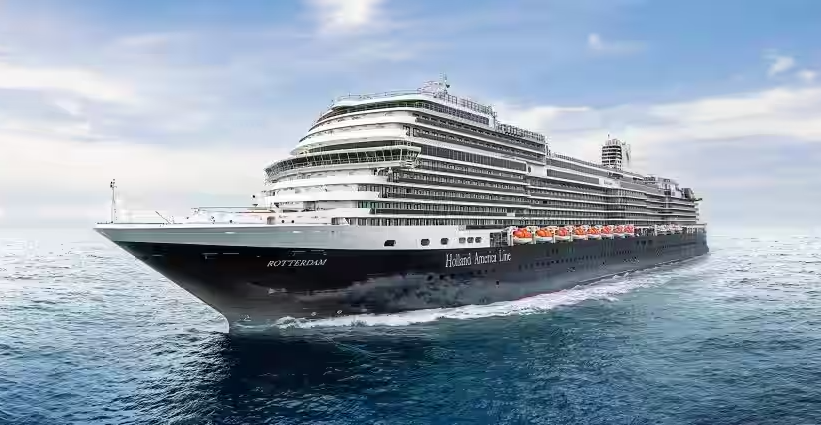
14 nightsFrom Rotterdam10 ports of call
14-Day Icelandic Fjords & Celtic Origins: Scottish Highlands
Holland America Line · Rotterdam
Overview
A 14-night voyage aboard Rotterdam, departing Rotterdam on 11 Jul 2027 and returning to the same port, calling at 10 destinations along the way.
RotterdamInvergordonSeydhisfjordurAkureyriIsafjordurReykjavik, IcelandHeimaeyKirkwall, ScotlandSouth QueensferryRotterdam
Cabin prices
Live prices per person based on two sharing. Select a grade to see its fare options.
Loading live cabin prices…
Itinerary
14 nights · 18 ports of call- 1
Day 1 ·Rotterdam, The NetherlandsEmbark
11 Jul 2027Depart 15:00Often called the gateway to Europe, the port city of Rotterdam is full of old-world charm. The harbor offers amazing views and a maze of wharves and canals, along with towering spires make for a beautiful sight. Take a stroll and duck into one of the pubs or eateries along the way.
Only three pre World War II buildings in the city centre have survived and are worth a look - city hall, St. Laurence church and the White House. Explore the Museum Boymans van Beuningen, which houses a unique collection dating from the 14th century, or the Museum Voor Volkenkunde - home to ethnological exhibits. Exquisite architecture can be seen in many areas of Rotterdam, most notably in the Delfshaven quarter of the city - where 18th century houses are on display. For a laugh, check out Kijk-Kubus, an upside-down house. - 2
Day 2 ·At Sea
12 Jul 2027 - 3
Day 3 ·Invergordon
13 Jul 2027Arrive 07:00Depart 17:00The skirl of Highland bagpipes calls you ashore. Go in search of your clan tartan, and "Nessie," the spurious monster often sighted in Loch Ness. - 4
Day 4 ·At Sea
14 Jul 2027 - 5
Day 5 ·Seydisfjordur
15 Jul 2027Arrive 08:00Depart 17:00The lush valleys and dramatic waterfalls of Seyðisfjörður are some of the most picturesque sights on Iceland’s east coast. And at the head of the fjord sits the colorful, lively town of Seyðisfjörð with a thriving art and music scene thanks to the LungA Art Festival and concerts in the landmark Blue Church each summer. The Skaftfell Center for Visual Art, open year round, exhibits the work of young artists and also has a popular bistro and a bookstore. Seyðisfjörð was founded in the 19th century by Norwegian settlers, who built some of the brightly painted wooden buildings you see today. The town, population 700, has kept its connection to the European mainland: It's the only port in Iceland that regularly sees passenger ships from Europe, through a ferry service to and from Denmark and the Faroe Islands. The residents in the area surrounding Seyðisfjörð are more likely to be wild reindeer—originally imported from Norway, they're the only such animals in Iceland—and arctic foxes, while seals and porpoises swim along the coast. Many native bird species, including puffins and arctic terns, nest around town, with dozens of species at Skálanes, a nature reserve and research center. Farther afield is Iceland’s largest forest, one of its tallest waterfalls and many opportunities for hiking, cycling and kayaking. - 5
Day 5 ·Scenic cruising Seydisfjordur
15 Jul 2027 - 6
Day 6 ·Akureyri
16 Jul 2027Arrive 08:00Depart 17:00Often described as the capital of north Iceland, the country's second-largest city is both vibrant and pretty, and serves as an ideal hub for exploring the incredible landscape that surrounds it.
Located at the head of a 60-kilometer fjord—the country’s longest—and surrounded by snow-streaked mountains, Akureyri was originally settled in the 9th century and was first officially mentioned as a city in the 16th century. Today it boasts a population of around 17,000, a scenic harbor and an array of interesting shops, buzzy cafés and upscale restaurants. Its main sights include the Akureyri Church, a wonderful botanical garden (founded in 1912) and the fascinating Akureyri Museum.
From here it’s possible to explore some of the country’s most memorable landscapes, starting with Akureyri’s own fjord, Eyjafjörður, where you'll find several museums (including the Icelandic Folk and Outsider Art Museum), fishing villages like Grenivík and plenty of dramatic mountain scenery. Farther afield are the island of Grímsey, the volcanic wonderland of Lake Mývatn and a whole host of waterfalls, gorges, churches and saga sites. - 6
Day 6 ·Scenic cruising Eyjafjordur
16 Jul 2027 - 7
Day 7 ·Isafjordur
17 Jul 2027Arrive 08:00Depart 17:00Bordered on three sides by dramatic mountains that form a natural harbor, the idyllic town of Ísafjörður—population 2,600—serves as a charming exploration hub for the surrounding Westfjords peninsula. Settled since the 16th century, and traditionally dependent on fishing as its main source of income, its streets are today lined with old wooden houses interspersed with occasional shops, restaurants and cafés.
Despite its low-key atmosphere, Ísafjörður offers plenty to do, from visiting local museums and enjoying a game of golf, to hiking, biking and kayaking around the town and harbor. The town also hosts several notable events, such as Iceland's oldest cross-country ski race, the mud-football European Championships and a classical music festival, Við Djúpið.
The rugged and remote Westfjords offer many more attractions. A daily summer ferry transports visitors to the scenic Hornstrandir Nature Reserve and to Vigur, an island that's home to many protected bird populations. Follow the region’s striking coastline and you’ll find snow-streaked mountains, waterfalls and beaches. - 7
Day 7 ·Scenic Cruising Isafjardurdjur
17 Jul 2027 - 8
Day 8 ·Reykjavik
18 Jul 2027Arrive 07:00Depart 22:00See dramatic evidence of Iceland's volcanic origins: geysers, hotsprings, vast fields of cooled lava. Swim in the naturally-warmed Blue Lagoon. - 9
Day 9 ·Heimaey
19 Jul 2027Arrive 09:00Depart 18:00This charming Arctic settlement of around 4,500 people (and millions of wild puffins) offers unique opportunities for sightseeing. The visually dramatic setting is particularly suited to photographers looking to capture memorable vistas. - 10
Day 10 ·At Sea
20 Jul 2027 - 11
Day 11 ·Kirkwall
21 Jul 2027Arrive 08:00Depart 17:00While the southernmost isles of Orkney closely straddle the northeast corner of the Scottish mainland, historically the archipelago (around 70 islands in all) and its people have had as much in common with Scandinavia as they have had with Scotland. In fact, until the 15th century, the Orkney Islands were politically part of Norway.
Today the Orcadians are a fairly tight-knit and cooperative group of Scots—a rich community of artists and crofters (small-holding farmers), fisherfolk and those in the trades. A key attraction for tourists is the wealth of prehistoric sites on Orkney, including standing stones, burial chambers and even Stone Age settlements, such as Skara Brae, inhabited sometime around 3000 B.C.E. More recently, because of its isolation, Orkney was chosen as the place to keep Italian prisoners of war during WWII; a chapel built by them is a popular site to visit.
The island capital is Kirkwall (originally Kirkjuvagr meaning Church Bay). Here you'll find the Cathedral of St. Magnus—one of only two pre–Reformation cathedrals still largely intact in Scotland (the other is Glasgow's St. Mungo). Nearby, the historic town district includes the Earl's Palace, built for the infamous Earl Patrick Stewart, whose father was a bastard son of King James V and who was executed in 1615 for treason. - 12
Day 12 ·South Queensferry (Edinburgh)
22 Jul 2027Arrive 09:00History was made in this port, just across the Firth of Forth from Rosyth, when the future Queen Margaret of Scotland arrived around 1071. Her devout religious attitude established 'Queen's Ferry' as the place for pilgrims from abroad to alight on their way to St. Andrews—Scotland's ecclesiastical capital in the Middle Ages. Margaret's legacy continues less than a dozen miles away at Edinburgh Castle. A key attraction up on the castle's rock is St. Margaret's Chapel, believed to be the oldest section of the fortifications and the place where she worshipped.
There's more to Scotland's capital than the Castle, though. Edinburgh proudly displays multiple exhibits on national and international scientific achievement at the National Museum of Scotland, as well as some fantastic works of visual art at the National Galleries of Scotland. South Queensferry's moorings are also within easy striking distance of Scotland's largest metropolis: the city of Glasgow. Transformed in many ways since the post–WWII days when it had a reputation for grime and crime, the city is among the most vibrant in the U.K.: It is Scotland's de-facto capital of modern culture, with the hippest DJs and most accomplished conceptual artists. - 13
Day 13 ·South Queensferry (Edinburgh)
23 Jul 2027Depart 23:00History was made in this port, just across the Firth of Forth from Rosyth, when the future Queen Margaret of Scotland arrived around 1071. Her devout religious attitude established 'Queen's Ferry' as the place for pilgrims from abroad to alight on their way to St. Andrews—Scotland's ecclesiastical capital in the Middle Ages. Margaret's legacy continues less than a dozen miles away at Edinburgh Castle. A key attraction up on the castle's rock is St. Margaret's Chapel, believed to be the oldest section of the fortifications and the place where she worshipped.
There's more to Scotland's capital than the Castle, though. Edinburgh proudly displays multiple exhibits on national and international scientific achievement at the National Museum of Scotland, as well as some fantastic works of visual art at the National Galleries of Scotland. South Queensferry's moorings are also within easy striking distance of Scotland's largest metropolis: the city of Glasgow. Transformed in many ways since the post–WWII days when it had a reputation for grime and crime, the city is among the most vibrant in the U.K.: It is Scotland's de-facto capital of modern culture, with the hippest DJs and most accomplished conceptual artists. - 14
Day 14 ·At Sea
24 Jul 2027 - 15
Day 15 ·Rotterdam, The NetherlandsDisembark
25 Jul 2027Arrive 07:00Often called the gateway to Europe, the port city of Rotterdam is full of old-world charm. The harbor offers amazing views and a maze of wharves and canals, along with towering spires make for a beautiful sight. Take a stroll and duck into one of the pubs or eateries along the way.
Only three pre World War II buildings in the city centre have survived and are worth a look - city hall, St. Laurence church and the White House. Explore the Museum Boymans van Beuningen, which houses a unique collection dating from the 14th century, or the Museum Voor Volkenkunde - home to ethnological exhibits. Exquisite architecture can be seen in many areas of Rotterdam, most notably in the Delfshaven quarter of the city - where 18th century houses are on display. For a laugh, check out Kijk-Kubus, an upside-down house.
Your ship: Rotterdam
Explore Rotterdam's cabins, dining and onboard facilities.