
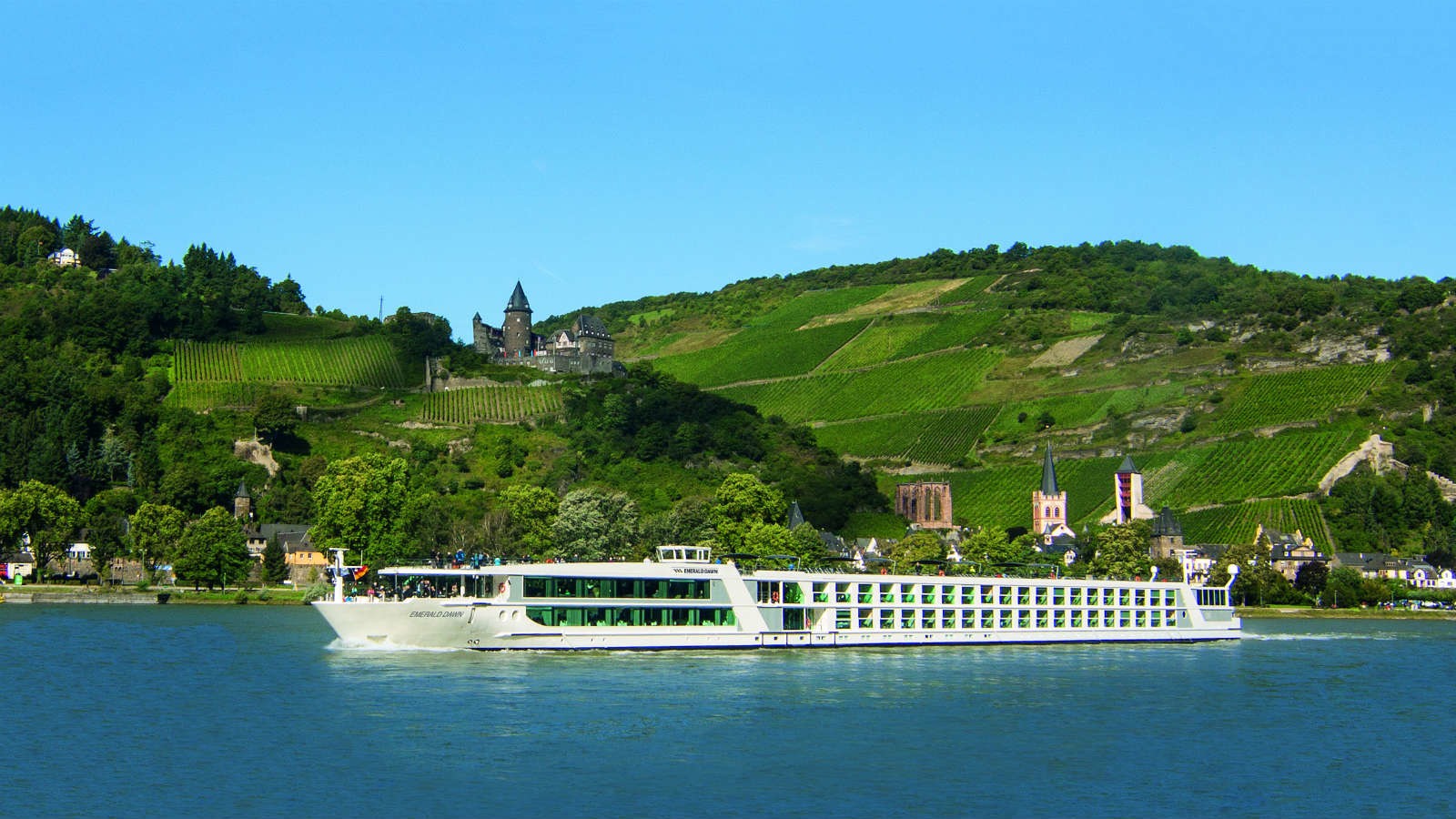
24 nightsFrom Prague16 ports of call
Eastern European Escapade & Splendours of Europe Prague to Amsterdam
Emerald Cruises · Emerald Luna
Overview
A 24-night voyage aboard Emerald Luna, departing Prague on 29 Jul 2026 and arriving in Amsterdam, calling at 16 destinations along the way.
PragueWarnemunde (For Berlin), GermanyKrakowBudapestBratislavaVienna, AustriaDurnsteinPassau (Munich)RegensburgNurembergBambergWurzburgWertheim, GermanyRudesheimCologneAmsterdam
Cabin prices
Live prices per person based on two sharing. Select a grade to see its fare options.
Loading live cabin prices…
Itinerary
24 nights · 25 ports of call- 1
Day 1 ·PragueEmbark
29 Jul 2026Prague, capital city of the Czech Republic, is bisected by the Vltava River. Nicknamed “the City of a Hundred Spires,” it's known for its Old Town Square, the heart of its historic core, with colorful baroque buildings, Gothic churches and the medieval Astronomical Clock, which gives an animated hourly show. Completed in 1402, pedestrian Charles Bridge is lined with statues of Catholic saints. - 2
Day 2 ·Prague
30 Jul 2026Prague, capital city of the Czech Republic, is bisected by the Vltava River. Nicknamed “the City of a Hundred Spires,” it's known for its Old Town Square, the heart of its historic core, with colorful baroque buildings, Gothic churches and the medieval Astronomical Clock, which gives an animated hourly show. Completed in 1402, pedestrian Charles Bridge is lined with statues of Catholic saints. - 3
Day 3 ·Prague
31 Jul 2026Prague, capital city of the Czech Republic, is bisected by the Vltava River. Nicknamed “the City of a Hundred Spires,” it's known for its Old Town Square, the heart of its historic core, with colorful baroque buildings, Gothic churches and the medieval Astronomical Clock, which gives an animated hourly show. Completed in 1402, pedestrian Charles Bridge is lined with statues of Catholic saints. - 4
Day 4 ·Berlin
1 Aug 2026Berlin, Germany’s capital, dates to the 13th century. Reminders of the city's turbulent 20th-century history include its Holocaust memorial and the Berlin Wall's graffitied remains. Divided during the Cold War, its 18th-century Brandenburg Gate has become a symbol of reunification. The city's also known for its art scene and modern landmarks like the gold-colored, swoop-roofed Berliner Philharmonie, built in 1963. - 5
Day 5 ·Berlin
2 Aug 2026Berlin, Germany’s capital, dates to the 13th century. Reminders of the city's turbulent 20th-century history include its Holocaust memorial and the Berlin Wall's graffitied remains. Divided during the Cold War, its 18th-century Brandenburg Gate has become a symbol of reunification. The city's also known for its art scene and modern landmarks like the gold-colored, swoop-roofed Berliner Philharmonie, built in 1963. - 6
Day 6 ·Krakow
3 Aug 2026Kraków, a southern Poland city near the border of the Czech Republic, is known for its well-preserved medieval core and Jewish quarter. Its old town – ringed by Planty Park and remnants of the city’s medieval walls – is centered on the stately, expansive Rynek Glówny (market square). This plaza is the site of the Cloth Hall, a Renaissance-era trading outpost, and St. Mary’s Basilica, a 14th-century Gothic church. - 7
Day 7 ·Krakow
4 Aug 2026Kraków, a southern Poland city near the border of the Czech Republic, is known for its well-preserved medieval core and Jewish quarter. Its old town – ringed by Planty Park and remnants of the city’s medieval walls – is centered on the stately, expansive Rynek Glówny (market square). This plaza is the site of the Cloth Hall, a Renaissance-era trading outpost, and St. Mary’s Basilica, a 14th-century Gothic church. - 8
Day 8 ·Krakow
5 Aug 2026Kraków, a southern Poland city near the border of the Czech Republic, is known for its well-preserved medieval core and Jewish quarter. Its old town – ringed by Planty Park and remnants of the city’s medieval walls – is centered on the stately, expansive Rynek Glówny (market square). This plaza is the site of the Cloth Hall, a Renaissance-era trading outpost, and St. Mary’s Basilica, a 14th-century Gothic church. - 9
Day 9 ·Auschwitz
6 Aug 2026 - 10
Day 10 ·Budapest
7 Aug 2026Budapest, Hungary’s capital, is bisected by the River Danube. Its 19th-century Chain Bridge connects the hilly Buda district with flat Pest. A funicular runs up Castle Hill to Buda’s Old Town, where the Budapest History Museum traces city life from Roman times onward. Trinity Square is home to 13th-century Matthias Church and the turrets of the Fishermen’s Bastion, which offer sweeping views. - 11
Day 11 ·Budapest
8 Aug 2026Budapest, Hungary’s capital, is bisected by the River Danube. Its 19th-century Chain Bridge connects the hilly Buda district with flat Pest. A funicular runs up Castle Hill to Buda’s Old Town, where the Budapest History Museum traces city life from Roman times onward. Trinity Square is home to 13th-century Matthias Church and the turrets of the Fishermen’s Bastion, which offer sweeping views. - 12
Day 12 ·Budapest
9 Aug 2026Budapest, Hungary’s capital, is bisected by the River Danube. Its 19th-century Chain Bridge connects the hilly Buda district with flat Pest. A funicular runs up Castle Hill to Buda’s Old Town, where the Budapest History Museum traces city life from Roman times onward. Trinity Square is home to 13th-century Matthias Church and the turrets of the Fishermen’s Bastion, which offer sweeping views. - 13
Day 13 ·Bratislava
10 Aug 2026Bratislava, the capital of Slovakia, is set along the Danube River by the border with Austria and Hungary. It’s surrounded by vineyards and the Little Carpathian mountains, crisscrossed with forested hiking and cycling trails. The pedestrian-only, 18th-century old town is known for its lively bars and cafes. Perched atop a hill, the reconstructed Bratislava Castle overlooks old town and the Danube - 14
Day 14 ·Vienna
11 Aug 2026Vienna, Austria’s capital, lies in the country’s east on the Danube River. Its artistic and intellectual legacy was shaped by residents including Mozart, Beethoven and Sigmund Freud. The city is also known for its Imperial palaces, including Schönbrunn, the Habsburgs’ summer residence. In the MuseumsQuartier district, historic and contemporary buildings display works by Egon Schiele, Gustav Klimt and other artists. - 15
Day 15 ·Dürnstein
12 Aug 2026Dürnstein is a small town on the Danube river in the Krems-Land district, in the Austrian state of Lower Austria. It is one of the most-visited tourist destinations in the Wachau region and also a well-known wine growing area. - 16
Day 16 ·Passau
13 Aug 2026Passau, a German city on the Austrian border, lies at the confluence of the Danube, Inn and Ilz rivers. Known as the Three Rivers City, it's overlooked by the Veste Oberhaus, a 13th-century hilltop fortress housing a city museum and observation tower. The old town below is known for its baroque architecture, including St. Stephen's Cathedral, featuring distinctive onion-domed towers and an organ with 17,974 pipes. - 17
Day 17 ·Regensburg
14 Aug 2026Regensburg, a Bavarian city on the Danube River in southeast Germany, is known for its well-preserved medieval core. The 12th-century Stone Bridge, a 310m-long icon with 16 arches, crosses the river to the old town. The 13th-century Regensburg Cathedral, a twin-spired Gothic landmark, is home to the Regensburger Domspatzen choir. Walhalla, a Parthenon replica just east of the city, honors illustrious Germans. - 18
Day 18 ·Nuremberg
15 Aug 2026Nuremberg is the second-largest city of the German state of Bavaria after its capital Munich, and its 518,370 inhabitants make it the 14th-largest city in Germany. - 19
Day 19 ·Bamberg
16 Aug 2026Bamberg is a town in northern Bavaria, Germany, laid out over 7 hills where the Regnitz and Main rivers meet. Its old town preserves structures from the 11th to 19th centuries including the muraled Altes Rathaus (town hall), which occupies an island in the Regnitz reached by arched bridges. The Romanesque Bamberg Cathedral, begun in the 11th century, features 4 towers and numerous stone carvings. - 20
Day 20 ·Wurzburg
17 Aug 2026Würzburg is a city in Germany's Bavaria region. It's known for lavish baroque and rococo architecture, particularly the 18th-century Residenz palace, with ornate rooms, a huge fresco by Venetian artist Tiepolo and an elaborate staircase. Home to numerous wine bars, cellars and wineries, Würzburg is the center of the Franconian wine country, with its distinctive bocksbeutel (bottles with flattened round shapes). - 21
Day 21 ·Wertheim
18 Aug 2026Wertheim is a town in southwestern Germany, in the state of Baden-Württemberg with a population of around 23,400. It is located on the confluence of the rivers Tauber and Main. Wertheim is best known for its landmark castle and medieval town centre. - 22
Day 22 ·Rudesheim
19 Aug 2026Rüdesheim am Rhein is a town in the Rhine Valley, Germany. It’s known for winemaking, especially of Riesling wines. In the center, Drosselgasse is a lane lined with shops, taverns and restaurants. Nearby, Siegfried’s Mechanical Music Cabinet is a museum of automated musical instruments. Medieval Brömserburg Castle is home to the Rheingau Wine Museum, exhibiting wine paraphernalia from ancient times to the present. - 23
Day 23 ·Cologne
20 Aug 2026Cologne, a 2,000-year-old city spanning the Rhine River in western Germany, is the region’s cultural hub. A landmark of High Gothic architecture set amid reconstructed old town, the twin-spired Cologne Cathedral is also known for its gilded medieval reliquary and sweeping river views. The adjacent Museum Ludwig showcases 20th-century art, including many masterpieces by Picasso, and the Romano-Germanic Museum houses Roman antiquities. - 24
Day 24 ·Amsterdam
21 Aug 2026Amsterdam is the Netherlands’ capital, known for its artistic heritage, elaborate canal system and narrow houses with gabled facades, legacies of the city’s 17th-century Golden Age. Its Museum District houses the Van Gogh Museum, works by Rembrandt and Vermeer at the Rijksmuseum, and modern art at the Stedelijk. Cycling is key to the city’s character, and there are numerous bike paths - 25
Day 25 ·AmsterdamDisembark
22 Aug 2026Amsterdam is the Netherlands’ capital, known for its artistic heritage, elaborate canal system and narrow houses with gabled facades, legacies of the city’s 17th-century Golden Age. Its Museum District houses the Van Gogh Museum, works by Rembrandt and Vermeer at the Rijksmuseum, and modern art at the Stedelijk. Cycling is key to the city’s character, and there are numerous bike paths
Your ship: Emerald Luna
Explore Emerald Luna's cabins, dining and onboard facilities.