
28 nightsFrom Zurich31 ports of call
Jewels of Europe & Romantic Rhine & Moselle from Zurich
Scenic River Cruises · Scenic Ruby
Overview
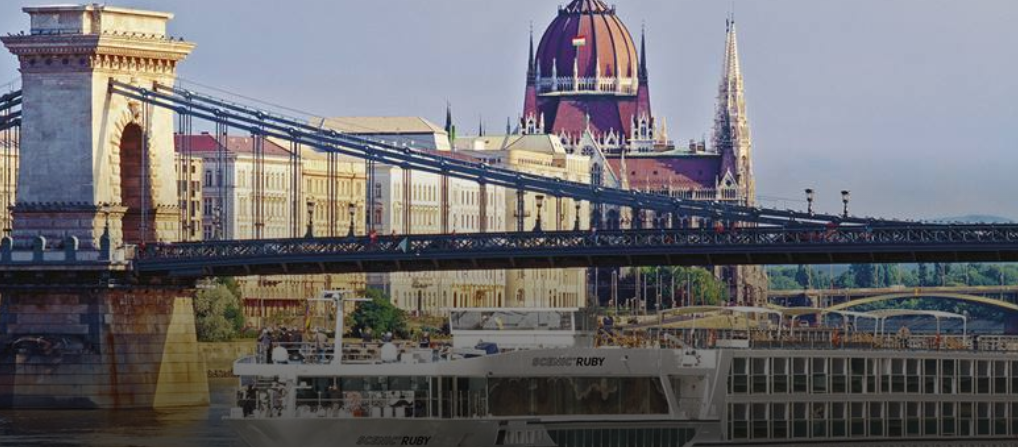
A 28-night voyage aboard Scenic Ruby, departing Zurich on 14 Oct 2026 and arriving in Budapest, calling at 31 destinations along the way.
ZurichBaselBreisachKehlStrasbourgMannheimRhine GorgeRudesheimCochemBernkastelKoblenzDusseldorfArnhemAntwerpVeereUtrechtAmsterdamCologneRhine GorgeRudesheimMiltenbergWertheim, GermanyWurzburgBambergNurembergRegensburgPassau (Munich)DurnsteinKremsVienna, AustriaBudapest
Cabin prices
Live prices per person based on two sharing. Select a grade to see its fare options.
Loading live cabin prices…
Itinerary
28 nights · 37 ports of call- 1
Day 1 ·ZurichEmbark
14 Oct 2026The city of Zurich, a global center for banking and finance, lies at the north end of Lake Zurich in northern Switzerland. The picturesque lanes of the central Altstadt (Old Town), on either side of the Limmat River, reflect its pre-medieval history. Waterfront promenades like the Limmatquai follow the river toward the 17th-century Rathaus (town hall). - 1
Day 1 ·Basel
14 Oct 2026Basel is a city on the Rhine River in northwest Switzerland, close to the country’s borders with France and Germany. Its medieval old town centers around Marktplatz, dominated by the 16th-century, red-sandstone Town Hall. Its 12th-century Gothic cathedral has city views, and contains the tomb of the 16th-century Dutch scholar, Erasmus. The city’s university houses some of Erasmus’ works. - 2
Day 2 ·Breisach
15 Oct 2026Breisach is a town with approximately 16,500 inhabitants, situated along the Rhine in the Rhine Valley, in the district Breisgau-Hochschwarzwald, Baden-Württemberg, Germany, about halfway between Freiburg and Colmar — 20 kilometres away from each — and about 60 kilometres north of Basel near the Kaiserstuhl. - 3
Day 3 ·Kehl
16 Oct 2026Kehl is a town in southwestern Germany in the Ortenaukreis, Baden-Württemberg. It is located on the river Rhine, directly opposite the French city of Strasbourg. - 3
Day 3 ·Strasbourg
16 Oct 2026Strasbourg is the capital city of the Grand Est region, formerly Alsace, in northeastern France. It's also the formal seat of the European Parliament and sits near the German border, with culture and architecture blending German and French influences. Its Gothic Cathédrale Notre-Dame features daily shows from its astronomical clock and sweeping views of the Rhine River from partway up its 142m spire. - 4
Day 4 ·Mannheim
17 Oct 2026Mannheim is a city in southwest Germany, on the Rhine and Neckar rivers. The baroque 18th-century Mannheim Palace houses historical exhibits, plus the University of Mannheim. In the grid-like center, called the Quadrate, Marktplatz Square features a baroque fountain with statues. Planken shopping street leads southeast to the Romanesque Water Tower, in the art nouveau gardens of Friedrichsplatz. - 5
Day 5 ·Rhine Gorge
18 Oct 2026The Rhine Gorge is a popular name for the Upper Middle Rhine Valley, a 65 km section of the Rhine between Koblenz and Bingen in the states of Rhineland-Palatinate and Hesse in Germany. - 5
Day 5 ·Rudesheim
18 Oct 2026Rüdesheim am Rhein is a town in the Rhine Valley, Germany. It’s known for winemaking, especially of Riesling wines. In the center, Drosselgasse is a lane lined with shops, taverns and restaurants. Nearby, Siegfried’s Mechanical Music Cabinet is a museum of automated musical instruments. Medieval Brömserburg Castle is home to the Rheingau Wine Museum, exhibiting wine paraphernalia from ancient times to the present. - 6
Day 6 ·Cochem
19 Oct 2026Cochem is the seat of and the biggest town in the Cochem-Zell district in Rhineland-Palatinate, Germany. With just over 5,000 inhabitants, Cochem falls just behind Kusel, in the Kusel district, as Germany's second smallest district seat. Since 7 June 2009, it has belonged to the Verbandsgemeinde of Cochem. - 7
Day 7 ·Bernkastel
20 Oct 2026Bernkastel-Kues is a town on the Middle Moselle in the Bernkastel-Wittlich district in Rhineland-Palatinate, Germany. It is a well-known winegrowing centre. - 8
Day 8 ·Moselle Valley Cruising
21 Oct 2026 - 9
Day 9 ·Koblenz
22 Oct 2026Koblenz, spelled Coblenz before 1926, is a German city on the banks of the Rhine and of the Moselle, a multi-nation tributary. Koblenz was established as a Roman military post by Drusus around 8 B.C. Its name originates from the Latin cōnfluentēs, meaning " confluence". - 9
Day 9 ·Koblenz
22 Oct 2026Koblenz, spelled Coblenz before 1926, is a German city on the banks of the Rhine and of the Moselle, a multi-nation tributary. Koblenz was established as a Roman military post by Drusus around 8 B.C. Its name originates from the Latin cōnfluentēs, meaning " confluence". - 10
Day 10 ·Dusseldorf
23 Oct 2026Düsseldorf is a city in western Germany known for its fashion industry and art scene. It's divided by the Rhine River, with its Altstadt (Old Town) on the east bank and modern commercial areas to the west. In the Altstadt, St. Lambertus Church and Schlossturm (Castle Tower) both date to the 13th century. Streets such as Königsallee and Schadowstrasse are lined with boutique shops. - 11
Day 11 ·Arnhem
24 Oct 2026Arnhem is a city and municipality situated in the eastern part of the Netherlands. It is the capital of the province of Gelderland and located on both banks of the rivers Nederrijn and Sint-Jansbeek, which was the source of the city's development. - 12
Day 12 ·Antwerp
25 Oct 2026Antwerp is a port city on Belgium’s River Scheldt, with history dating to the Middle Ages. In its center, the centuries-old Diamond District houses thousands of diamond traders, cutters and polishers. Antwerp’s Flemish Renaissance architecture is typified by the Grote Markt, a central square in the old town. At the 17th-century Rubens House, period rooms display works by the Flemish Baroque painter Peter Paul Rubens. - 13
Day 13 ·Veere
26 Oct 2026Veere - 14
Day 14 ·Utrecht
27 Oct 2026 - 15
Day 15 ·Amsterdam
28 Oct 2026Amsterdam is the Netherlands’ capital, known for its artistic heritage, elaborate canal system and narrow houses with gabled facades, legacies of the city’s 17th-century Golden Age. Its Museum District houses the Van Gogh Museum, works by Rembrandt and Vermeer at the Rijksmuseum, and modern art at the Stedelijk. Cycling is key to the city’s character, and there are numerous bike paths. - 16
Day 16 ·Amsterdam
29 Oct 2026Amsterdam is the Netherlands’ capital, known for its artistic heritage, elaborate canal system and narrow houses with gabled facades, legacies of the city’s 17th-century Golden Age. Its Museum District houses the Van Gogh Museum, works by Rembrandt and Vermeer at the Rijksmuseum, and modern art at the Stedelijk. Cycling is key to the city’s character, and there are numerous bike paths. - 17
Day 17 ·Cologne
30 Oct 2026Eau de Cologne, or simply cologne, is a perfume originating from Cologne, Germany. Originally mixed by Johann Maria Farina in 1709, it has since come to be a generic term for scented formulations in - 18
Day 18 ·Rhine Gorge
31 Oct 2026The Rhine Gorge is a popular name for the Upper Middle Rhine Valley, a 65 km section of the Rhine between Koblenz and Bingen in the states of Rhineland-Palatinate and Hesse in Germany. - 18
Day 18 ·Rudesheim
31 Oct 2026Rüdesheim am Rhein is a town in the Rhine Valley, Germany. It’s known for winemaking, especially of Riesling wines. In the center, Drosselgasse is a lane lined with shops, taverns and restaurants. Nearby, Siegfried’s Mechanical Music Cabinet is a museum of automated musical instruments. Medieval Brömserburg Castle is home to the Rheingau Wine Museum, exhibiting wine paraphernalia from ancient times to the present. - 19
Day 19 ·Miltenberg
1 Nov 2026Miltenberg is a town in the Regierungsbezirk of Lower Franconia in Bavaria, Germany. It is the seat of the like-named district and has a population of over 9,000. - 19
Day 19 ·Wertheim
1 Nov 2026Wertheim is a town in southwestern Germany, in the state of Baden-Württemberg with a population of around 23,400. It is located on the confluence of the rivers Tauber and Main. Wertheim is best known for its landmark castle and medieval town centre. - 20
Day 20 ·Wurzburg
2 Nov 2026Würzburg is a city in Germany's Bavaria region. It's known for lavish baroque and rococo architecture, particularly the 18th-century Residenz palace, with ornate rooms, a huge fresco by Venetian artist Tiepolo and an elaborate staircase. Home to numerous wine bars, cellars and wineries, Würzburg is the center of the Franconian wine country, with its distinctive bocksbeutel (bottles with flattened round shapes). - 21
Day 21 ·Bamberg
3 Nov 2026Bamberg is known for its special beer and many local breweries and beer gardens. The most famous of Bamberg's breweries is the historic smoked beer brewery, Schlenkerla. This 6th-generation family brewery has been quenching thirst since 1405 and still taps beer the old-world way – from wooden barrels. - 22
Day 22 ·Nuremberg
4 Nov 2026Nuremberg is the largest city of the German federal state of Bavaria after its capital Munich, and its 518,370 inhabitants make it the 14th-largest city in Germany. - 23
Day 23 ·Regensburg
5 Nov 2026Regensburg, a Bavarian city on the Danube River in southeast Germany, is known for its well-preserved medieval core. The 12th-century Stone Bridge, a 310m-long icon with 16 arches, crosses the river to the old town. The 13th-century Regensburg Cathedral, a twin-spired Gothic landmark, is home to the Regensburger Domspatzen choir. Walhalla, a Parthenon replica just east of the city, honors illustrious Germans. - 24
Day 24 ·Passau
6 Nov 2026Passau, a German city on the Austrian border, lies at the confluence of the Danube, Inn and Ilz rivers. Known as the Three Rivers City, it's overlooked by the Veste Oberhaus, a 13th-century hilltop fortress housing a city museum and observation tower. The old town below is known for its baroque architecture, including St. Stephen's Cathedral, featuring distinctive onion-domed towers and an organ with 17,974 pipes. - 25
Day 25 ·Durnstein
7 Nov 2026Dürnstein is a small town on the Danube river in the Krems-Land district, in the Austrian state of Lower Austria. It is one of the most-visited tourist destinations in the Wachau region and also a well-known wine growing area. - 25
Day 25 ·Krems
7 Nov 2026 - 26
Day 26 ·Vienna
8 Nov 2026Vienna, Austria’s capital, lies in the country’s east on the Danube River. Its artistic and intellectual legacy was shaped by residents including Mozart, Beethoven and Sigmund Freud. The city is also known for its Imperial palaces, including Schönbrunn, the Habsburgs’ summer residence. In the MuseumsQuartier district, historic and contemporary buildings display works by Egon Schiele, Gustav Klimt and other artists. - 26
Day 26 ·Vienna
8 Nov 2026Vienna, Austria’s capital, lies in the country’s east on the Danube River. Its artistic and intellectual legacy was shaped by residents including Mozart, Beethoven and Sigmund Freud. The city is also known for its Imperial palaces, including Schönbrunn, the Habsburgs’ summer residence. In the MuseumsQuartier district, historic and contemporary buildings display works by Egon Schiele, Gustav Klimt and other artists. - 27
Day 27 ·Vienna
9 Nov 2026Vienna, Austria’s capital, lies in the country’s east on the Danube River. Its artistic and intellectual legacy was shaped by residents including Mozart, Beethoven and Sigmund Freud. The city is also known for its Imperial palaces, including Schönbrunn, the Habsburgs’ summer residence. In the MuseumsQuartier district, historic and contemporary buildings display works by Egon Schiele, Gustav Klimt and other artists. - 28
Day 28 ·Budapest
10 Nov 2026Budapest, Hungary’s capital, is bisected by the River Danube. Its 19th-century Chain Bridge connects the hilly Buda district with flat Pest. A funicular runs up Castle Hill to Buda’s Old Town, where the Budapest History Museum traces city life from Roman times onward. Trinity Square is home to 13th-century Matthias Church and the turrets of the Fishermen’s Bastion, which offer sweeping views. - 29
Day 29 ·BudapestDisembark
11 Nov 2026Budapest, Hungary’s capital, is bisected by the River Danube. Its 19th-century Chain Bridge connects the hilly Buda district with flat Pest. A funicular runs up Castle Hill to Buda’s Old Town, where the Budapest History Museum traces city life from Roman times onward. Trinity Square is home to 13th-century Matthias Church and the turrets of the Fishermen’s Bastion, which offer sweeping views.
Your ship: Scenic Ruby
Explore Scenic Ruby's cabins, dining and onboard facilities.