
15 nightsFrom Kangerlussuaq12 ports of call
Wild Labrador Coast: Missions, Fjords & Wilderness
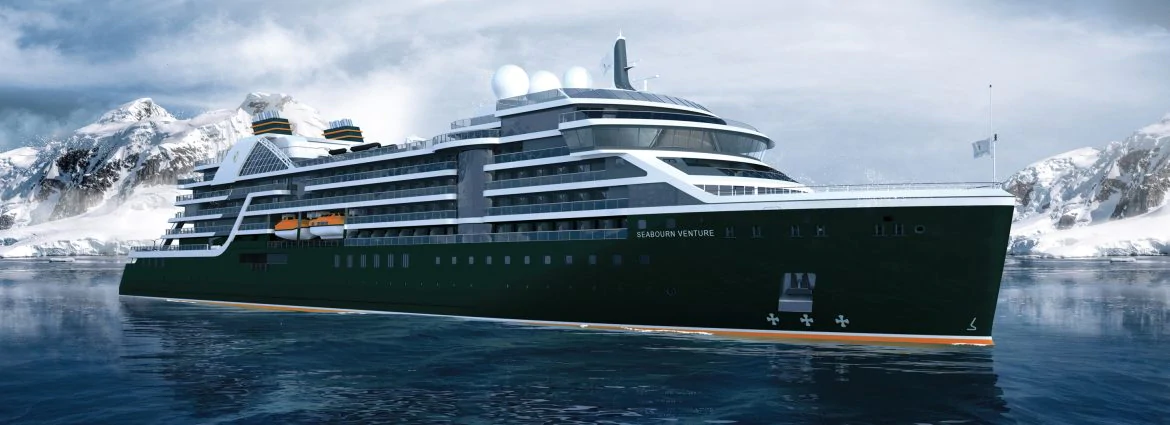
Seabourn · Seabourn Venture
Overview
A 15-night voyage aboard Seabourn Venture, departing Kangerlussuaq on 20 Sept 2026 and arriving in Halifax, calling at 12 destinations along the way.
KangerlussuaqPangnirtungKekerten IslandNunavut CanadaMonumental IslandLower Savage Islands, CanadaNachvak FjordHebron, NL, CanadaNain, CanadaIndian HarbourBattle Harbour, CanadaHalifax
Cabin prices
Live prices per person based on two sharing. Select a grade to see its fare options.
Loading live cabin prices…
Itinerary
15 nights · 21 ports of call- 1
Day 1 ·KangerlussuaqEmbark
20 Sept 2026In October, 1941 the United States Army Air Force constructed an airbase at the site of Kangerlussuaq. It served as a refuelling stop for single-engine military aircraft being flown to Britain during World War II. Form their last port of call, Goose Bay, Labrador, it was 1,600 kilometers (1,000 miles) to Kangerlussuaq until they could refuel. Kangerlussuaq fjord (‘Big Fjord’), is 170 kilometers (105 miles) long and was often shrouded in fog, providing a serious navigation problem for those aircrews.
Today, with the use of modern technology, navigation is no longer an issue. The landscape was ideal for the site of an airport. A large alluvial plain, deposited by the nearby glacial-outflow river, provided a perfectly flat environment for an airport. Kangerlussuaq is the largest commercial airport in Greenland and supports a population of 500. A little known fact, from 1971 to 1987, 33 missiles from various countries, were fired from Kangerlussuaq for upper atmospheric scientific research. - 2
Day 2 ·Kangerlussuaq
21 Sept 2026Depart 17:00In October, 1941 the United States Army Air Force constructed an airbase at the site of Kangerlussuaq. It served as a refuelling stop for single-engine military aircraft being flown to Britain during World War II. Form their last port of call, Goose Bay, Labrador, it was 1,600 kilometers (1,000 miles) to Kangerlussuaq until they could refuel. Kangerlussuaq fjord (‘Big Fjord’), is 170 kilometers (105 miles) long and was often shrouded in fog, providing a serious navigation problem for those aircrews.
Today, with the use of modern technology, navigation is no longer an issue. The landscape was ideal for the site of an airport. A large alluvial plain, deposited by the nearby glacial-outflow river, provided a perfectly flat environment for an airport. Kangerlussuaq is the largest commercial airport in Greenland and supports a population of 500. A little known fact, from 1971 to 1987, 33 missiles from various countries, were fired from Kangerlussuaq for upper atmospheric scientific research. - 3
Day 3 ·At Sea
22 Sept 2026 - 4
Day 4 ·Pangnirtung
23 Sept 2026Arrive 07:00Depart 12:00 - 5
Day 5 ·Kekerten Island
23 Sept 2026Arrive 14:30Depart 18:00 - 5
Day 5 ·Lady Franklin Island, Nunavut, Canada
24 Sept 2026Arrive 08:00Depart 12:00Lady Franklin Island, is an uninhabited Baffin Island offshore island located in the Canadian Arctic Archipelago in the territory of Nunavut. The island lies in Davis Strait, 25 mi from Hall Peninsula. There are at least seven smaller, unnamed islands off its northwest shore. - 6
Day 6 ·Monumental Island, Nunavut, Canada
24 Sept 2026Arrive 13:00Depart 18:00In 1845, British explorer Sir John Franklin, on the period’s most technologically advanced expedition, vanished in search of the fabled Northwest Passage. Monumental Island was named by fellow Arctic explorer Charles Francis Hall in memory of Franklin. Located in Davis Strait south of Baffin Island, it is known as Oomienwa in the local Inuktitut language.
This barren, rocky and windswept island is home to a variety of wildlife. Nesting black guillemots are the most prolific seabird. The Island is a favorite resting spot for walrus and they may be viewed at numerous haul-outs around the island. The elusive polar bears patrol the ice-floes in search of seals while whales feed offshore.
This is also an excellent location for viewing elaborately sculpted icebergs of all sizes and shapes. Numerous glaciers descend from the island’s high peaks, their crevasses appearing almost to glow an iridescent blue against a landscape of stark white - 6
Day 6 ·Lower Savage Islands, Canada
25 Sept 2026Arrive 07:00Depart 12:00 - 6
Day 6 ·Resolution Island, Nunavut, Canada
25 Sept 2026Depart 17:00 - 7
Day 7 ·Nachvak Fiord, Torngat Mts, Canada
26 Sept 2026Arrive 07:00Depart 19:30 - 8
Day 8 ·Ramah Bay, Torngat Mts, Canada
27 Sept 2026Arrive 04:00Depart 12:30 - 9
Day 9 ·Rose Island, Torngat Mts, Canada
27 Sept 2026Arrive 15:30Depart 19:30 - 9
Day 9 ·Hebron, NL, Canada
28 Sept 2026Arrive 08:00 - 10
Day 10 ·Nain, Labrador, Canada
29 Sept 2026Arrive 09:00Depart 17:00 - 11
Day 11 ·Indian Harbour, NL, Canada
30 Sept 2026Arrive 09:30Depart 17:00 - 12
Day 12 ·Battle Harbour, Labrador, Canada
1 Oct 2026Arrive 07:00Depart 23:30 - 13
Day 13 ·L Anse aux Meadows, Newfoundland, Canada
1 Oct 2026Arrive 14:00Depart 19:30Located at the most northerly tip of Newfoundland, L'Anse aux Meadows is nestled near the fishing village of St. Anthony. It is the site of the first European settlement in the New World, approximately 500 years before Columbus' arrival. Other Norse groups had relocated from their homelands to the New World. In 1961, explorer and writer Helge Instad discovered a group of large mounds in the countryside. These mounds were excavated revealing the remains of a Norse settlement. This site became L'Anse aux Meadows National Historic Park in 1977 and is noted on the UNESCO World Heritage List of important cultural properties. The site at L'Anse aux Meadows has been completely excavated allowing visitors to see the remains of the homes, a smithy, and various worksheds. The park's interpretive center displays Norse artifacts from the excavation which include iron rivets, a flywheel and the floorboard of a boat. Researchers still debate as to whether the site at L'Anse aux Meadows is Leif Eriksson's 'Vinland,' a lush, beautiful area where he settled in for the winter around the year 1000.
Parks Canada will greet you on disembarking the ship and you may explore at leisure this first settlement of the New World. - 13
Day 13 ·Exploring East coast of Newfoundland
2 Oct 2026 - 14
Day 14 ·At Sea
3 Oct 2026 - 15
Day 15 ·At Sea
4 Oct 2026 - 16
Day 16 ·Halifax, Nova ScotiaDisembark
5 Oct 2026Arrive 07:00With its exceptionally delightful harbor side setting, early Europeans were first attracted to Halifax in 1749 with the establishment here of a military outpost by Colonel Cornwallis. The ports natural advantages of a well-protected harbor and close proximity to major fishing grounds resulted in its growth into a major military base and sea port. The peninsula has had several major immigrations during its history; English, French, German, Irish and Scottish have come in substantial numbers at various times. Travelers familiar with the South Pacific will find it interesting to know that Captain James Cook, whose explorations defined most of the Pacific Basin for Europeans, also spent four years in Halifax charting Nova Scotia and the waters of the St. Lawrence. A college town, Halifax has an exhilarating and youthful air about it, as evidenced by many bicyclists and skateboarders. The heart of Halifax offers wonderful restaurants and shopping, galleries, museums, and sites of historic interest including the Naval Dockyard, which dates from 1757, and St. Paul's Church. Heading out of town, the wonders of nature are to be found in the form of the sea, with the smell of salty air, cool ocean breezes, and the powerful force of waves crashing against the rugged shoreline.
Your ship: Seabourn Venture
Explore Seabourn Venture's cabins, dining and onboard facilities.